2024 past paper: complete solution navigator
← Worked Examples: answers by chapter or year
Original paper: Pastpaper/23ENGTY004.pdf.
All printed subquestions have a teaching solution linked below.
Read the source diagram together with the calculation.
Each linked lesson presents its method, full working and answer.
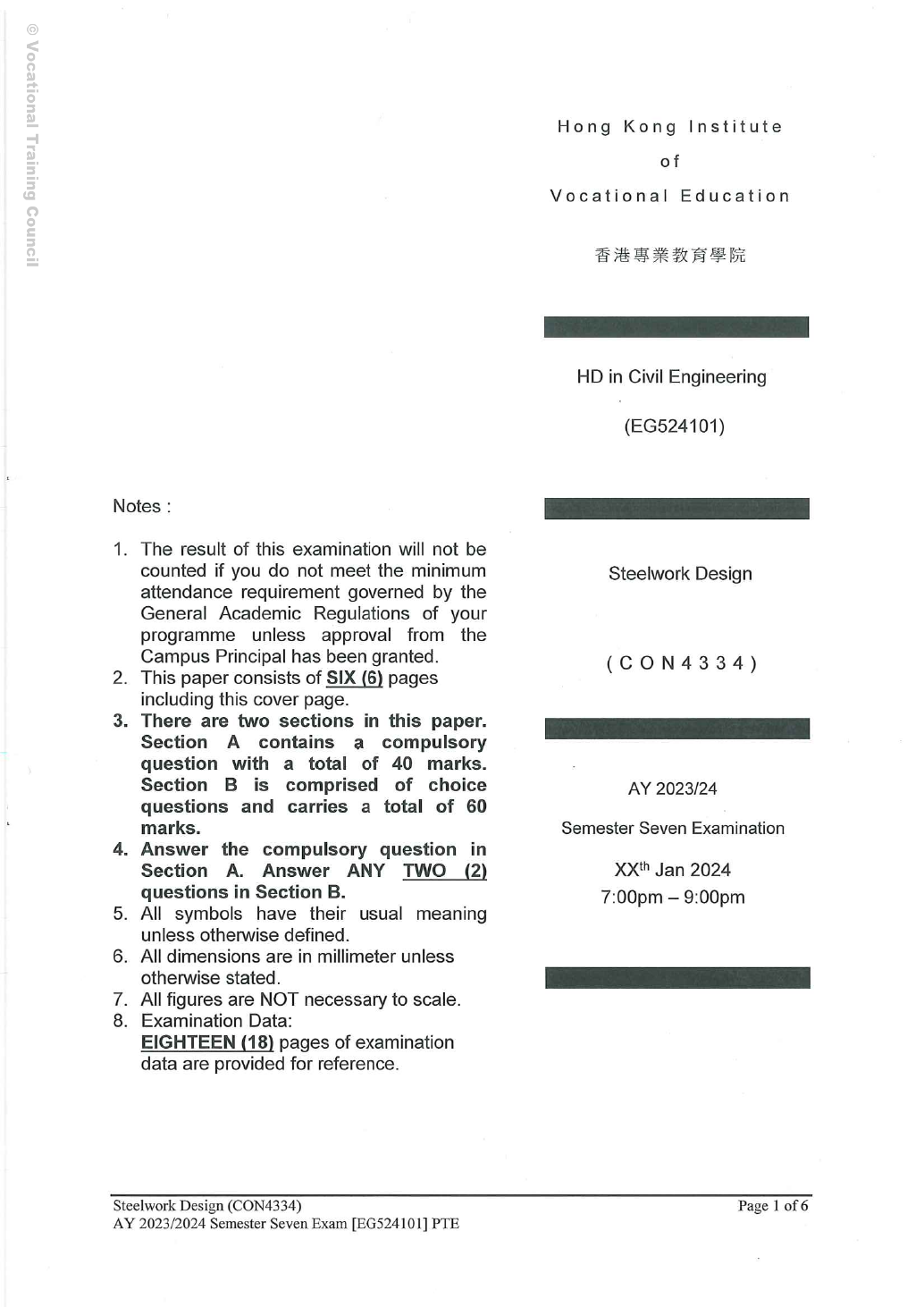
Printed examination format
Time allowed: hours.
Answer compulsory Section A ( marks) and any TWO Section B questions ( marks each).
Required total: marks; marks are offered.
The printed marks below are official question allocations.
No official worked solutions or marking schemes were supplied.
Every model solution, method-mark suggestion and exam strategy on this website is independently written teaching guidance.
Suggested time plan.
This is teaching guidance, not an official rule.
Allow minutes to read and choose questions.
Allow minutes for Section A.
Allow minutes for each selected Section B question.
Allow minutes to check units, omissions and conclusions.
Section A Q1: floor beams and short theory
Follow one strip of floor
An area load must become a beam load before beam reactions can be calculated.
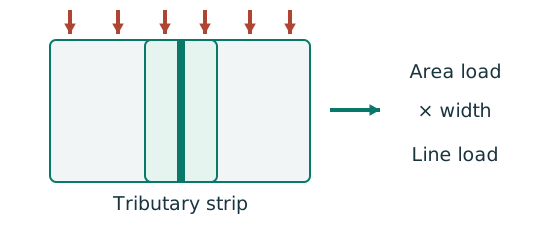
Prediction, then explanation. At fixed area load, twice the tributary width gives twice the line load. An end reaction remains a concentrated force.
Consider one metre along the beam. The associated floor area is b square metres. Multiply area load by that width.
q is area load in kN/m²; b is tributary width in m; w is line load in kN/m.
Scope. Determine b from slab spanning and supports. Add beam self-weight separately. A secondary-beam reaction is not automatically a UDL.
Check and takeaway. Illustration: . The width cancels one length unit.
Keep load categories separate
A floor carries permanent material and changing occupancy loads. Find the design load for the stated check.
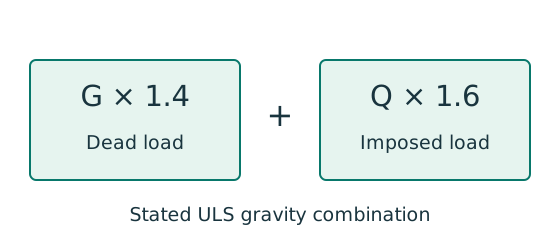
Prediction, then explanation. Increasing imposed load changes its own term. It does not change the dead-load factor or the steel stiffness.
First convert mass to weight where required. Next collect G and Q in compatible units. Apply the combination specified by the course problem.
G is characteristic dead load; Q is characteristic imposed load. Wu is the design load for this course gravity combination.
Scope. This combination is not universal. Use the specified service load for deflection and the stated factors for other standards or cases.
Check and takeaway. Illustration: G = 10 kN and Q = 5 kN give 22 kN. Factoring their sum by one guessed factor loses the distinction.
Apply the reasoning to this section’s data and conditions
| Part | Task / full teaching solution | Printed marks |
|---|---|---|
| a 1-ai | Floor factored intensity | |
| a 1-aii | Verify B1 actions | |
| a 1-aiii | Verify B2 actions | |
| a 1-aiv | Beam classes | |
| a 1-av | B1 shear, bending and deflection | |
| a 1-avi | B2 shear, bending and deflection | |
| a 1-b | Four hot-rolled sections |
Section B Q2: connections
Count cuts through each loaded bolt
Find how many shear planes transfer the force through one side of the connection.
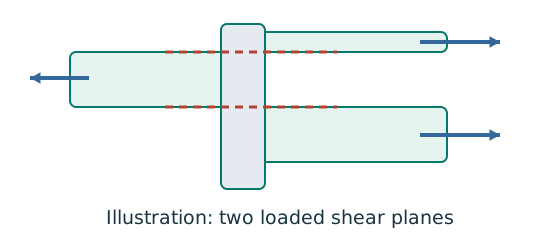
Prediction, then explanation. For equal sharing and unchanged bolt area, two active planes provide twice one plane’s shear resistance.
Select the area at the actual shear plane. Multiply by bolt shear strength. Count only the bolts and planes in the same transfer stage.
ps is bolt shear strength in N/mm²; As is the appropriate area in mm². nb counts bolts; ns counts equally loaded shear planes.
Scope. Use the thread area when threads cross the plane as required. Check bearing, plate failure and detailing separately.
Check and takeaway. Both halves of a butt splice carry the full transmitted force in sequence. Counting both halves together would double the apparent resistance.
The weld resists through its throat
Convert a visible fillet leg into resistance per effective length.
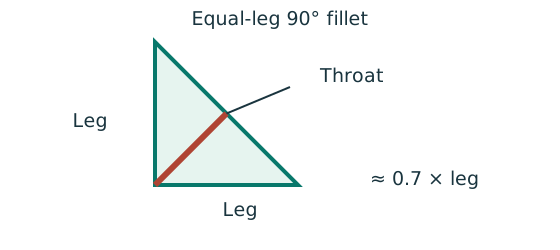
Prediction, then explanation. At fixed weld strength, doubling the leg doubles throat and line resistance in this model. Detailing limits can prevent that choice.
For the course right-angle equal-leg fillet, take throat as 0.7 times leg. Multiply throat area per unit length by weld strength.
s and a are leg and throat in mm. pw is weld strength in N/mm². qcap is resistance in kN/mm.
Scope. Use effective length, the correct steel/electrode strength and permitted leg limits. Full-penetration butt welds use a different model.
Check and takeaway. Illustration: a 6 mm leg at 250 N/mm² gives .
Apply the reasoning to this section’s data and conditions
| Part | Task / full teaching solution | Printed marks |
|---|---|---|
| b 2-ai | Bolt shear capacity | |
| b 2-aii | Bolt bearing capacity | |
| b 2-aiii | Angle bearing capacity | |
| b 2-aiv | Angle tensile capacity | |
| b 2-b | Eccentric rectangular weld group |
Section B Q3: columns
A strong cross-section can belong to an unstable member
A column carries axial compression and bending. Explain why more than one check is required.
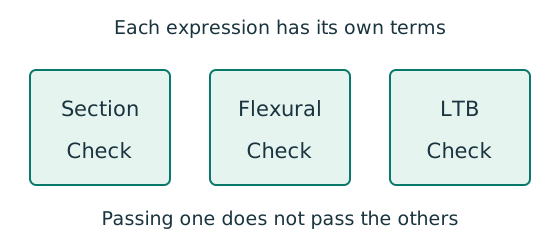
Prediction, then explanation. At fixed moments and resistances, increasing compression increases utilisation. A section pass cannot remove the length-dependent instability checks.
Separate cross-section, flexural-buckling and LTB interaction equations. Use each equation’s own denominators and first-order or amplified moments.
is a section axial resistance. is a member compression resistance. Elastic and prescribed are different bending denominators.
Scope. Preserve the course barred-moment definitions and Eq. 8.81 convention. Do not substitute plastic moduli into an elastic denominator.
Check and takeaway. Report each requested utilisation and the governing check. The largest properly calculated ratio identifies the closest limit.
Apply the reasoning to this section’s data and conditions
| Part | Task / full teaching solution | Printed marks |
|---|---|---|
| b 3-a | Column class | |
| b 3-b | Column cross-section capacity | |
| b 3-c | Column member buckling |
Section B Q4: unrestrained beams
Vertical bending can trigger sideways motion
A beam has enough local bending resistance. Check whether its compression flange can move sideways and twist.
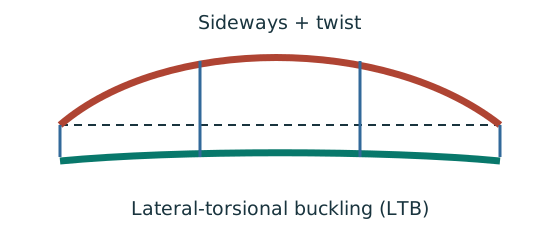
Prediction, then explanation. Adding a valid lateral restraint shortens a stability segment. It need not change the beam’s vertical reaction or moment diagram.
Identify the compressed flange and effective restraints. Calculate the specified slenderness, read buckling strength and compare resistance with the segment demand.
LE and ry use the same length unit. pb uses N/mm²; Sx uses mm³; Mb uses N·mm. mLT is dimensionless.
Scope. Use the specified section class, effective-length branch and loading condition. Load height alone does not prove a destabilizing case.
Check and takeaway. Removing a lateral restraint requires a new segment stability check. The old shorter-segment result cannot establish the longer segment’s adequacy.
Moment shape matters within one segment
Represent a nonuniform moment distribution in the applicable member-buckling equation.
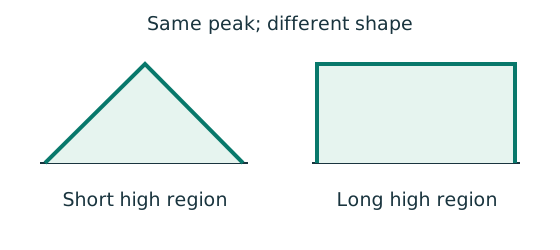
Prediction, then explanation. Two segments can have equal peak moment but different distributions. Their equivalent moment factors can therefore differ.
Evaluate moments from the true whole-beam analysis at the required positions. Apply the exact table’s weights, signs and lower bound.
mLT is an LTB factor. mx and my belong to the specified flexural checks. They are not interchangeable.
Scope. Some rules use magnitudes; others require signed ordinates. A factor does not reduce the actual moment used in a local section check.
Check and takeaway. Measure quarter points from the segment start, not automatically from the beam’s left support.
Apply the reasoning to this section’s data and conditions
| Part | Task / full teaching solution | Printed marks |
|---|---|---|
| b 4-a | Beam support reactions | |
| b 4-b | Shear-force and bending-moment diagrams | |
| b 4-c | Segment BC buckling resistance | |
| b 4-d | Segment CD buckling resistance |
Review an attempt
Make the next decision from the known conditions
Read the specific task below and identify the quantity or explanation it asks for.
Prediction, then explanation. Changing a load value may preserve the method. Changing the support or failure mechanism can require a different method.
Separate given, lookup, calculated and assumed values. State why the model applies. Keep necessary intermediate steps and units beside the equations.
A conditional answer states the exact condition required for its conclusion. It does not fill missing data with a guess.
Scope. A repeated result is not an independent verification. Use equilibrium, dimensions, a reverse substitution or an appropriate limiting case.
Check and takeaway. The explanation and answer are shown together in this edition. No response, score or completed interaction is needed to continue.
Apply the reasoning to this section’s data and conditions
- Mark incorrect decisions separately from arithmetic slips: wrong load factor, wrong support span, wrong restraint, wrong table, wrong units.
The first incorrect line identifies where the method fails.
Every later line that depends on it must be recalculated.
A changed-input example tests the same method.
Its prediction explains whether the result should rise or fall before the calculation confirms the change.
Record conditional assumptions and missing data.
A plausible answer must not become a fabricated official answer.
Graduated practice and unseen variants · A new timed mock in the supplied format