Exam error checklist and source discrepancies
Open “Animation lab” beside a teaching step for a visual explanation or a walkthrough of its original expressions. Models are illustrative; source answers remain unchanged.
Use the first list before handing in an answer. The second records actual differences in the supplied sources. An independently derived correction is not an official marking scheme.
The last six minutes of an exam
- Have I answered the compulsory question and exactly the required number of options, including every labelled subpart?
- Does each load carry its source and status: characteristic, already factored, calculated reaction or lookup self-weight?
- Do reactions balance total load and moment? Does the BMD close to zero at a simple support with no applied end couple?
- Have I used the exact section row, correct axis, thickness-dependent and -to- conversion?
- Have I separated low/high shear, section capacity, LTB, local web behaviour and deflection?
- For bolts, did I count shear planes and transfer sides correctly? For welds, did I use effective length and the correct centroid?
- For columns, did I use the correct curve per axis, correct moment sign, amplified versus first-order moment and correct denominator?
- Do dimensions come from labels or justified calculations, rather than scale measurements?
- Have I compared demand and resistance with units, stated pass/fail and named conditions that remain unverified?
Animation labFollow the calculation sequence
Supplement to the original lesson. Enable JavaScript to play, step through calculations and rotate 3D models. The following explanation remains readable offline.
- Locate the load, supports, connection geometry and any stated assumptions.
- Keep given values, table lookups and calculated values distinct; reconcile their units.
- The calculation player steps through the existing expressions in their original order.
- Compare demand with resistance or the relevant limit. Keep missing inputs and conditional conclusions explicit.
Source discrepancies and how this site handles them
| Original source / location | Issue | Treatment and evidence |
|---|---|---|
| Syllabus p 4 versus Ch 1 p 7 and Data File footers | Syllabus cites 2011 (2023 Edition); supplied teaching/data identify 2011. | Use the supplied course equations and tables consistently; standards note. |
| Data File p 2, central point-load deflection | Prints , which has units rather than displacement. | Use , supported by Word note p 2 and 2023 Data 1; original correct equation. |
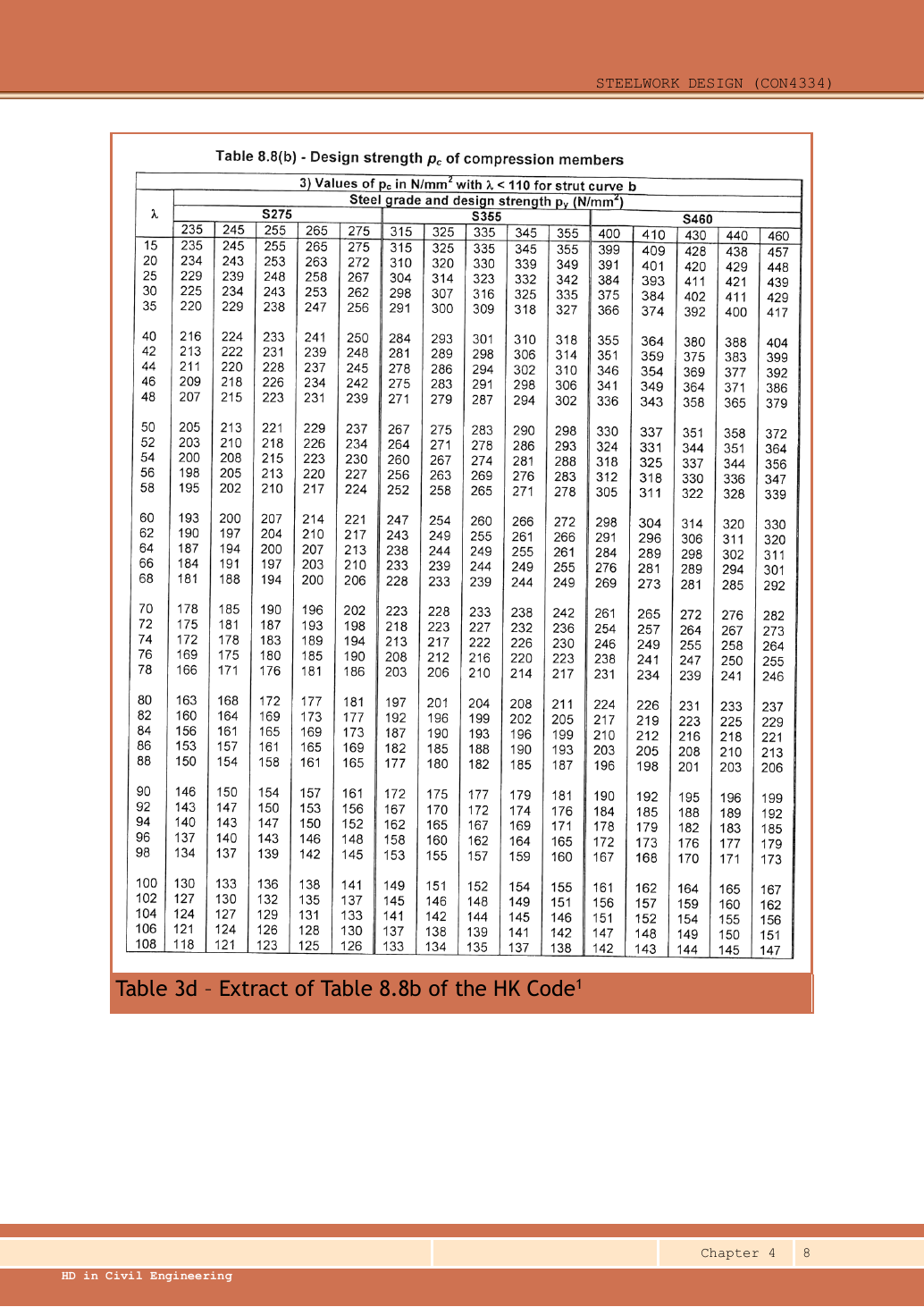
| Data File p 8, curve b / py 355 / λ90 | Cell prints . | Use , clearly shown in Ch 4 p 8, same row and column. |
| Data File p 3, compressed column equations | Bars and elastic moment denominators are not fully represented. | Use full lecture Eqs.8.80/8.81 and keep amplified/first-order moments distinct; full method. |
| Data File p 12, angle block | Some thickness labels are inconsistent with the area/property sequence. | 2024 angle question uses the stated // rectangular leg method; explicit derivation. Do not invent a corrected table row. |
| Ch 2 Example 1 pp 16–17 | Drawing shows four centre crosses; text and solution specify two bolts. | Follow the explicit two-bolt model and disclose the mismatch; worked solution. |
| Ch 2 Example 9 p 42 | Side Y text says add but its arithmetic adds for a fillet. | Correct deduction ; final physical lengths / remain; derivation. |
| Ch 2 Example 10 pp 43–44 versus minimum-size table p 33 | Selected fillet joins a main plate; supplied minimum table requires . | Preserve lecture trial, then design an alternative with runs and returns; checked dimensions. |
| Chapter 2 Tutorial 5, pp.45/47 | angle and gusset give maximum edge leg but minimum leg . | No size satisfies both supplied rules; show the conflict and required redesign, not a fictitious passing detail; solution. |
| Ch 3 Example 4 p 31 | Names a UB. | Listed properties match supplied row; solution uses that row. |
| Ch 4 Example 3 pp 29–30 | Amplified moment appears as after a calculation. | Use consistent unrounded moment from exact loads, or if retaining lecturer rounded ; derivation. |
| Ch 4 Example 5 p 38 | Rounded interaction terms sum to printed . | Unrounded sum is about , rounding to ; pass unchanged; calculation. |
| Assignment 2 heading and Q1 | Filename/header/figure identifiers conflict; key text sentence is clipped from rendered paragraph. | Use the supplied text-layer section/length data explicitly; original figures retained; source note. |
| 2024 paper, six supplied pages | Mentions an 18-page data attachment that is not included. | Use identified standalone/2023 supplied lookups; missing attachment is not fabricated; paper navigator. |
| Small rounding differences in lecture tables/examples | Some cells truncate or use rounded intermediate capacities. | Recalculate from printed input areas, keep guard digits and distinguish rounding from changed assumptions; every table cell. |
Animation labFollow the calculation sequence
Supplement to the original lesson. Enable JavaScript to play, step through calculations and rotate 3D models. The following explanation remains readable offline.
- Locate the load, supports, connection geometry and any stated assumptions.
- Keep given values, table lookups and calculated values distinct; reconcile their units.
- The calculation player steps through the existing expressions in their original order.
- Compare demand with resistance or the relevant limit. Keep missing inputs and conditional conclusions explicit.
Conditions that cannot be verified from a sketch alone
The coverage checklist records affected items as incomplete when a requested final detail needs absent input. Examples include local bearing/contact lengths, missing plate thickness for a weld-size limit, unknown transverse bolt gauge for no-prying applicability, and an unstated LTB load-height/end-restraint model. A conditional calculation is still useful teaching, but it is not an unconditional certification.
Read the item-by-item blockers. All original files remain unchanged. The website’s illustration for the AI-sketch assignment is authored teaching material; it is not a fabricated student conversation screenshot.
Animation labFollow the calculation sequence
Supplement to the original lesson. Enable JavaScript to play, step through calculations and rotate 3D models. The following explanation remains readable offline.
- Locate the load, supports, connection geometry and any stated assumptions.
- Keep given values, table lookups and calculated values distinct; reconcile their units.
- The calculation player steps through the existing expressions in their original order.
- Compare demand with resistance or the relevant limit. Keep missing inputs and conditional conclusions explicit.
A better error log
| Record | Example |
|---|---|
| First incorrect decision | I used the full dimension rather than the support-to-support B2 span. |
| Evidence I missed | A column symbol occurs on the middle grid line. |
| Repair | Draw only one free-body span; label each support before transferring loads. |
| Independent retest | Solve the 2024 floor variant with altered slab load and no open solution. |
Try it yourself. Why is “I made an arithmetic mistake” too vague after a wrong LTB result?
Reveal answer and reasoning
The first error may be choosing full span instead of restraint spacing, using the wrong unit, or reading rather than . Identify the first wrong decision so the next unfamiliar problem is solved correctly.
Animation labFollow the calculation sequence
Supplement to the original lesson. Enable JavaScript to play, step through calculations and rotate 3D models. The following explanation remains readable offline.
- Locate the load, supports, connection geometry and any stated assumptions.
- Keep given values, table lookups and calculated values distinct; reconcile their units.
- The calculation player steps through the existing expressions in their original order.
- Compare demand with resistance or the relevant limit. Keep missing inputs and conditional conclusions explicit.