Local web checks: both modes must pass (Web Bearing and Buckling)
Task: Understand why local buckling can govern despite a generous bearing margin.
Go straight to Step 1 ↓Design flow for this type of question: Laterally restrained beam →
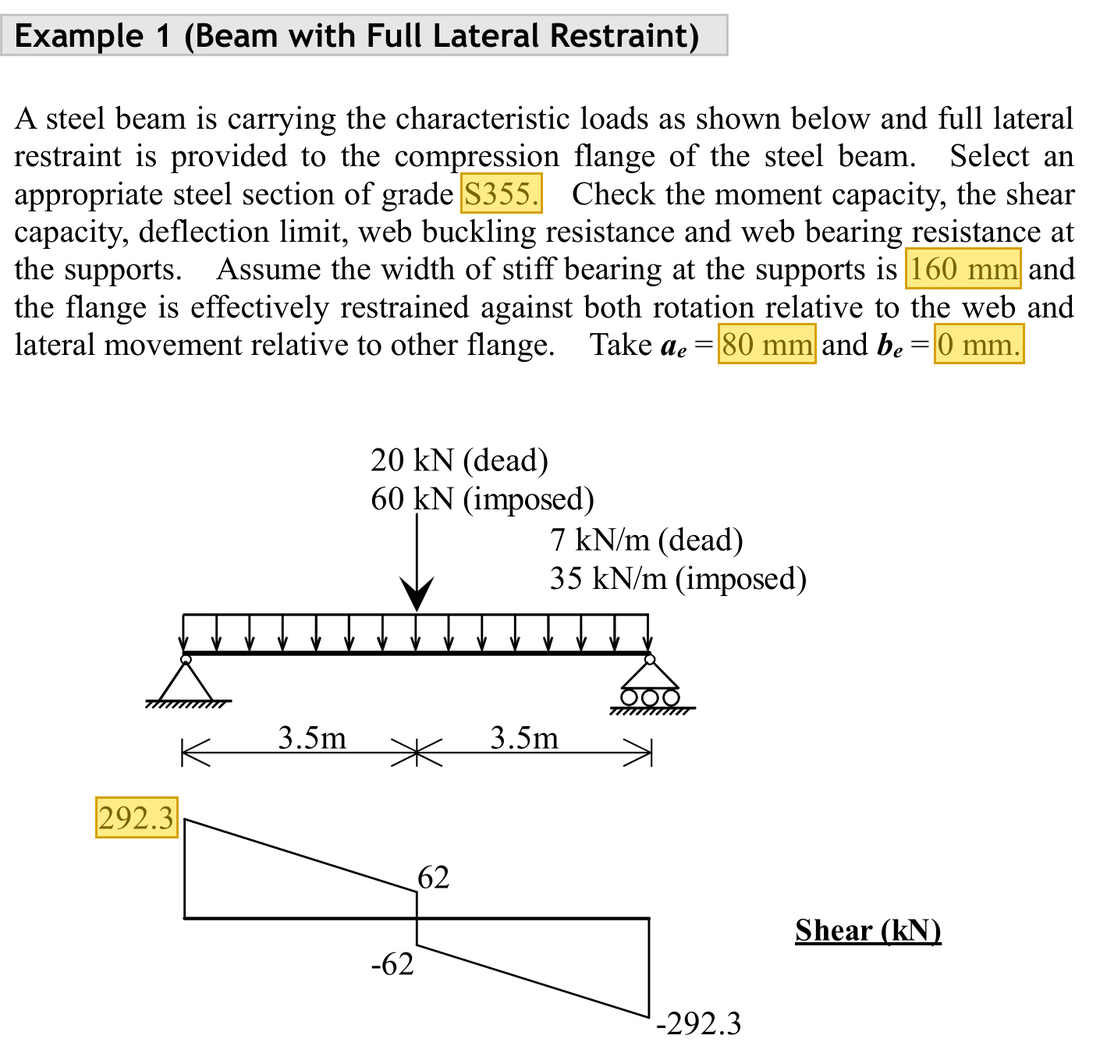
The question in short: A 533×210×82 UB in S355 has a support reaction of 292.3 kN, which enters the 9.6 mm thick web through a bearing 160 mm wide. Decide whether the web is crushed or buckles sideways.
What differs from the previous example of this type: The previous example only chose a trial section. This one takes that section and checks local bearing and buckling of the web at the support, where buckling only just passes.
| Given | Value and Unit |
|---|---|
| Applied force | Support reaction 292.3 kN (from the shear diagram in the question) |
| Bearing | Stiff bearing ; ; be = 0 |
| Section | 533×210×82 UB (chosen in the previous example), S355; , , , ; |
Yellow: values given in the question. The same values are marked where they are substituted in the steps below.
Orange box: values read directly from the Data File, the same values boxed orange in the lookup screenshots. A value interpolated between two table rows is a calculation, so it has no box.
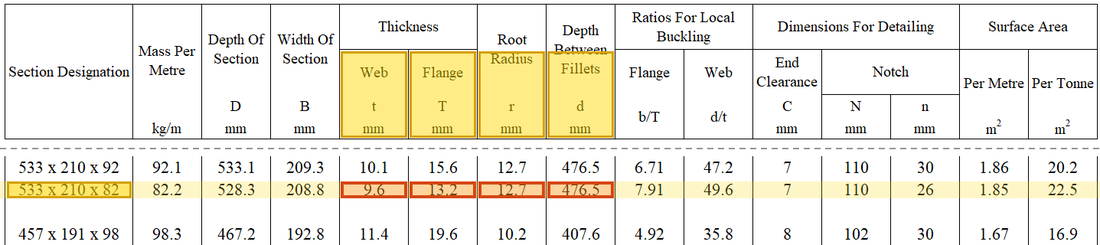
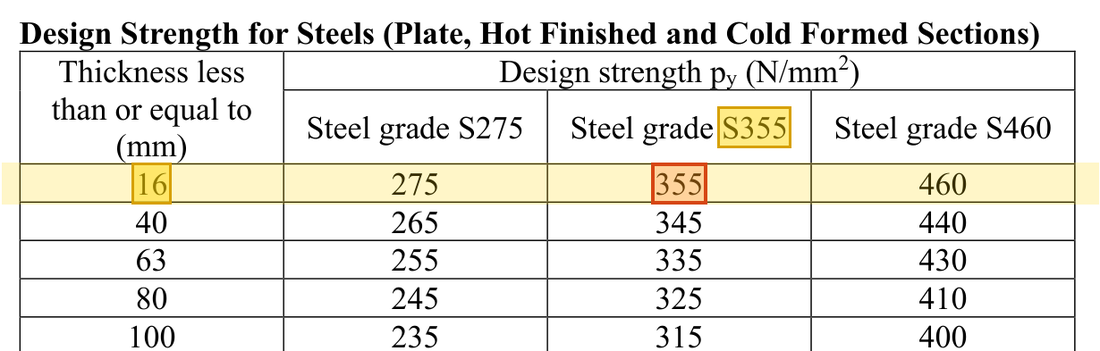
Solution Route: Identify the same force location→choose the end-distance branch→calculate both resistances→compare with the same demand.
This browser cannot show the 3D model.
The reaction enters the web from the bearing plate through the bottom flange. The web is thin, so two local failures are checked; this is separate from the shear capacity of the whole beam.
- Support reaction292.3 kN
- Bearing plate and flangeThe force spreads upwards over a length
- Web bearingDemand 292.3 kNCapacity 721.8144 kNUtilisation 0.40
- Web bucklingDemand 292.3 kNCapacity 297.5 kNUtilisation 0.98 · closest to the limit
- Step 1 · Identify local loading
Why this step: The reaction is not shared by the whole web. It is concentrated in a short length above the support, and that short length may fail first.
The support transmits 292.3 kN through a 160 mm contact width into the web, distinct from overall shear resistance .
- Step 2 · Select for this end condition
Why this step: The force spreads out as it passes through the flange and root fillet. and are used to find how long a piece of web it presses on when it arrives.
be = 0, so be/k = 2; , with and read from the section table. These are geometric and formula conditions, not results of moment equilibrium.
New symbols in this step- , : Rolled-section junction length in mm; dimensionless end-condition factor
- Step 3 · Web bearing
Why this step: This guards against the web above the support yielding and being squashed. The capacity is the most force this length of web can carry.
Effective bearing length is . Multiply by web thickness and strength, then convert N to kN.
New symbols in this step- , : Bearing contact width and course end-distance parameter; mm
- , : Local bearing and buckling resistances; kN
Where the numbers come from: from Step 2.
Units: mm times mm gives mm², times N/mm² gives N, and dividing by 1000 gives kN, because 1 kN is 1000 N.
Load path · How the reaction enters the webThe reaction enters the bottom flange from the bearing plate and spreads upwards through the flange and root radius; at the root of the web the loaded length has grown from to (yellow). Web bearing asks whether the web over this length crushes; web buckling treats the same strip of web as a strut of height . - Step 4 · Select the buckling branch
Why this step: The support is close to the beam end, leaving little web beyond it to share the force, so the reduced buckling formula applies.
The lecturer uses the near-end branch with . Compare the lengths first; do not skip this prerequisite.
New symbols in this step- , : Effective web depth and thickness; mm
- Step 5 · Write the complete course buckling expression
Why this step: A taller, thinner web bulges sideways more easily. The formula starts from the bearing capacity and adjusts it for the web's depth and thickness.
The first ratio addresses end distance; the second includes web slenderness and local geometry. Multiply by bearing resistance last. Both ratios are dimensionless.
- Step 6 · Substitute term by term
Why this step: Substituting gives the force the web can take before it bulges sideways. It is much smaller than the bearing capacity, showing that a thin web is more at risk from buckling.
Using course-rounded and reproduces approximately 297.5 kN.
New symbols in this step- , : Web design yield strength N/mm²; dimensionless classification/buckling strength factor
Where the numbers come from: from Step 2.
- Step 7 · Compare both failure modes
Why this step: A web that is not crushed can still buckle. The buckling utilisation is close to one, so a slightly larger reaction would make it fail.
Compare each capacity with the same reaction . The smaller buckling resistance is close to governing.
Where the numbers come from: from Step 6.
Bearing and local buckling both pass, but buckling margin is small. A different support position or contact length requires reselecting the expression branch.
All the symbols of this example
| Symbols | Meaning and Units |
|---|---|
| , | Bearing contact width and course end-distance parameter; mm |
| , | Effective web depth and thickness; mm |
| , | Rolled-section junction length in mm; dimensionless end-condition factor |
| , | Web design yield strength N/mm²; dimensionless classification/buckling strength factor |
| , | Local bearing and buckling resistances; kN |
Video positions: 17 October 00:30:00 · 17 October 00:50:00