Initial section selection from load demand (Trial Section Selection)
Task: Understand that initial selection identifies a candidate, not a completed design.
Go straight to Step 1 ↓Design flow for this type of question: Laterally restrained beam →
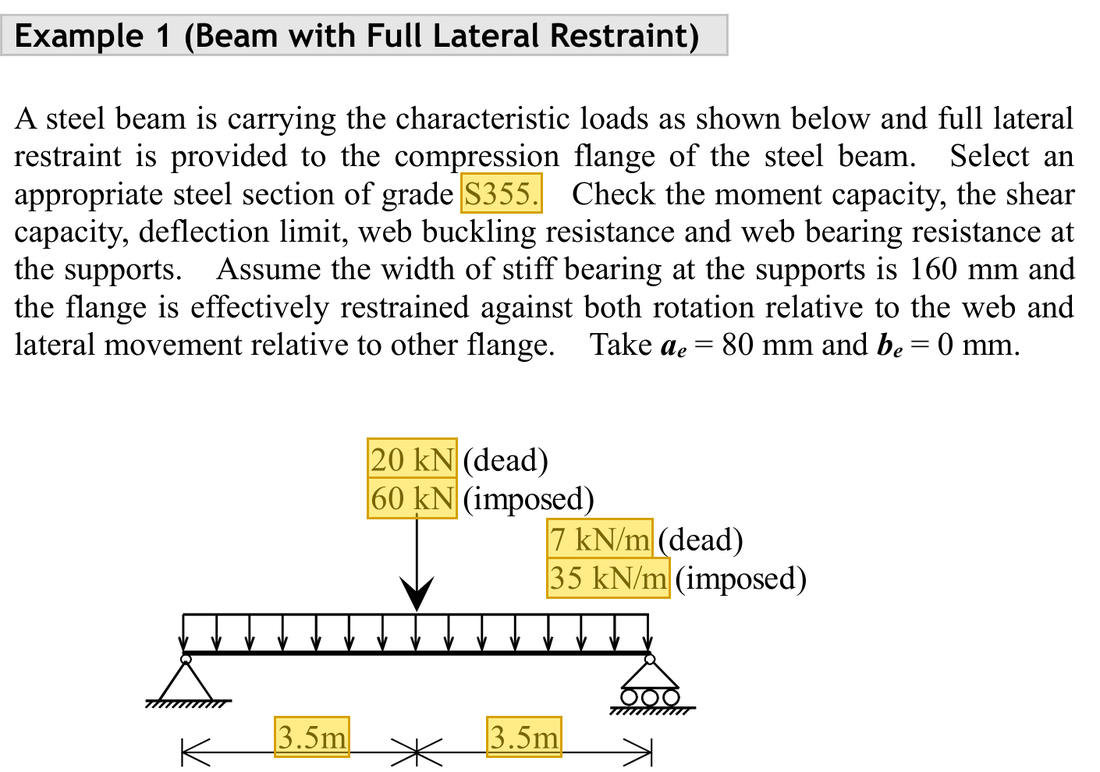
The question in short: A 7 m simply supported beam carries a midspan point load (20 kN dead, 60 kN imposed) and a uniform load over the whole span (7 kN/m dead, 35 kN/m imposed). In S355 steel, find a candidate section large enough for the moment.
What differs from the previous example of this type: In the previous example the section was fixed and only the web at the support was checked. Here the section is not yet known, and the moment is used to work back to the size needed.
| Given | Value and Unit |
|---|---|
| Model | Simply supported, 3.5 + 3.5 = 7 m; midspan point load: dead 20 kN, imposed 60 kN; full-span UDL: dead 7 kN/m, imposed 35 kN/m |
| Initial assumptions | S355, ; low shear and classification are checked after the section is chosen |
Yellow: values given in the question. The same values are marked where they are substituted in the steps below.
Orange box: values read directly from the Data File, the same values boxed orange in the lookup screenshots. A value interpolated between two table rows is a calculation, so it has no box.
Solution Route: Calculate moment→required modulus→table selection→recheck assumptions→complete remaining checks.
The point load and the UDL act on the same simply supported beam and each gives a midspan moment. The largest moment gives the section modulus needed.
- Design loads;
- Largest moment (midspan)
- Section modulus neededAbout 1746.55 cm³ → try 533×210×82 UB
- SupportsThe reactions pass through the web into the bearings (next example)
- Step 1 · Separate load effects
Why this step: Before choosing a section, the greatest bending the beam will see must be known. The design moment at midspan is the basis for the choice.
First combine the point load and the UDL with ; both cause sagging moment at midspan and are added in this model.
Load path · Load, shear force and bending momentBoth loads are symmetrical, so each reaction is half the total load and the largest moment is at midspan. This moment fixes the section modulus needed; the 292.3 kN reaction is the force in the web checks of the next example. - Step 2 · Convert to Nmm first
Why this step: The section must be large enough to resist this moment before the steel yields. Dividing the moment by gives the smallest plastic modulus needed.
Moment must be in Nmm before division by in N/mm².
New symbols in this step- , : Moment demand in kNm; shear demand in kN
- , , : Design yield/bending buckling strength and elastic modulus; N/mm²
Where the numbers come from: from Step 1.
Units: kNm times 10^6 gives Nmm, because 1 kN is 1000 N and 1 m is 1000 mm; Nmm divided by N/mm² gives mm³.
- Step 3 · Match table units
Why this step: The section table uses a different unit from the calculated value. Converting to the same unit lets the table be searched directly for a section not smaller than the demand.
Divide by 1000 if the table lists in cm³.
Where the numbers come from: from Step 2.
Units: mm³ divided by 1000 gives cm³, because 1 cm is 10 mm, and multiplying three times makes 1 cm³ equal to 1000 mm³.
- Step 4 · Read actual dimensions of the candidate
Why this step: The later classification, shear and deflection checks all need the real thicknesses and section properties. The numbers in the section name are only approximate sizes.
After selecting 533×210×82, read , , , and from its row. The designation does not provide every actual dimension.
Data file lookup · Data Page 9 · Universal Beams — Dimensions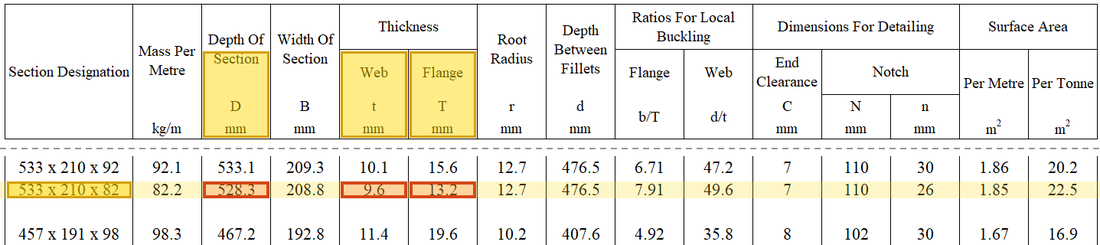
533×210×82 UB: , , ; , so the assumed holds.Yellow: given parameter, row or columnOrange: value read from the table, boxed orange in the text too Data file lookup · Data Page 10 · Universal Beams — Properties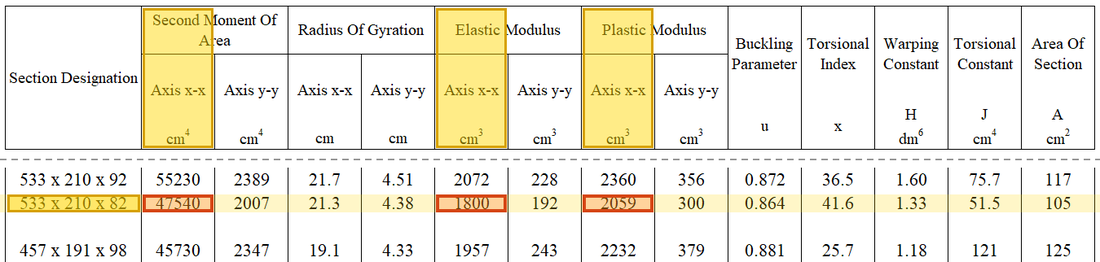
533×210×82 UB: , , ; exceeds the required 1746.55 cm³.Yellow: given parameter, row or columnOrange: value read from the table, boxed orange in the text too - Step 5 · Recheck assumptions
Why this step: The trial choice assumed a design strength, a section class and low shear. Once the section is picked these assumptions must be confirmed, otherwise the capacity is lower than estimated.
Adjust the initial estimate if actual thickness changes , classification differs or shear is high. Also check the 1.2pyZ cap.
is only an initial screen. , , deflection , local supports and restraint conditions still determine acceptance.
All the symbols of this example
| Symbols | Meaning and Units |
|---|---|
| , , | Area load kN/m², line load kN/m, point load kN |
| , , | Span in m or mm; end reactions in kN |
| , | Moment demand in kNm; shear demand in kN |
| , , , | Overall depth, classification web depth, web thickness and flange thickness; mm |
| , , , | Shear area mm², second moment of area mm⁴, plastic/elastic moduli mm³ |
| , , | Design yield/bending buckling strength and elastic modulus; N/mm² |
Video positions: 17 October 00:40:00