B3 support: local web bearing and buckling (B3 Local Web Checks)
Task: Continue B3's overall checks with the two local support checks from the lecturer's worksheet.
Go straight to Step 1 ↓Design flow for this type of question: Laterally restrained beam →
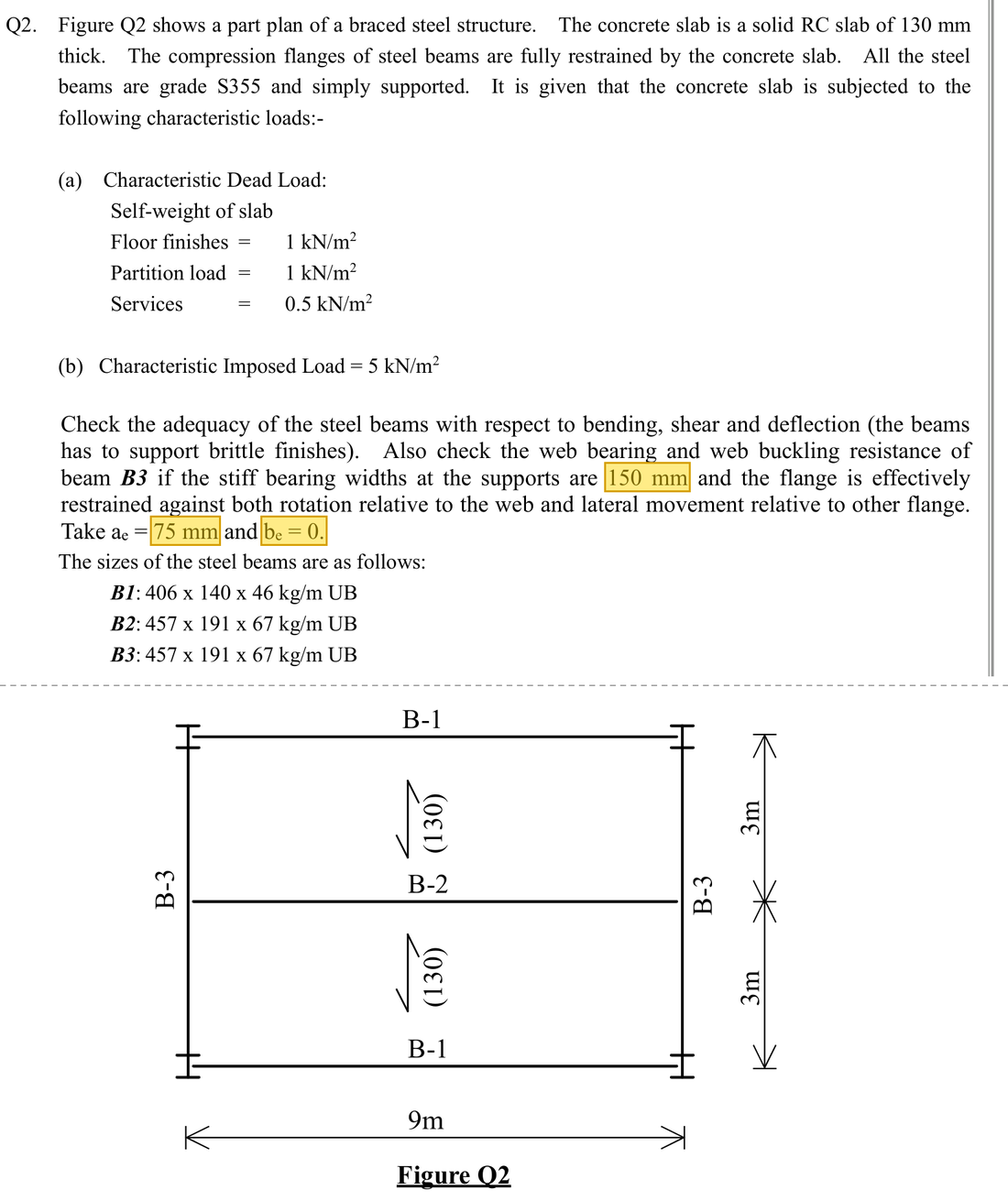
The question in short: At B3's support, a reaction of 112.656 kN enters the 8.5 mm thick web through a bearing 150 mm wide. Decide whether the web above the support is crushed, or buckles sideways like a thin plate.
What differs from the previous example of this type: The previous example checked the whole beam for moment, shear and deflection. This one looks only at the short piece of web above the support, for local bearing and local buckling.
| Given | Value and Unit |
|---|---|
| Demand | B3 reaction 112.656 kN (B3 example) |
| Geometry | Stiff bearing 150 mm; ; be = 0; ; |
| Junction and material | , ; |
Yellow: values given in the question. The same values are marked where they are substituted in the steps below.
Orange box: values read directly from the Data File, the same values boxed orange in the lookup screenshots. A value interpolated between two table rows is a calculation, so it has no box.
Solution Route: →bearing resistance→ branch→local buckling→compare reaction .
This browser cannot show the 3D model.
The reaction of B3 enters the web from the bearing plate through the bottom flange. The web is thin, so two local failures are checked.
- Reaction of B3112.656 kN
- Bearing plate and flangeThe force spreads upwards over a length
- Web bearingDemand 112.656 kNCapacity 590.8265 kNUtilisation 0.19
- Web bucklingDemand 112.656 kNCapacity 246.99 kNUtilisation 0.46 · closest to the limit
- Step 1 · Flange–web junction geometry
Why this step: The reaction passes through the flange and the root fillet before reaching the web, spreading out on the way. is the thickness it spreads through.
is , not . Read both lengths from the section table first.
New symbols in this step- , : Rolled-section junction length in mm; dimensionless end-condition factor
Data file lookup · Data Page 9 · Universal Beams — Dimensions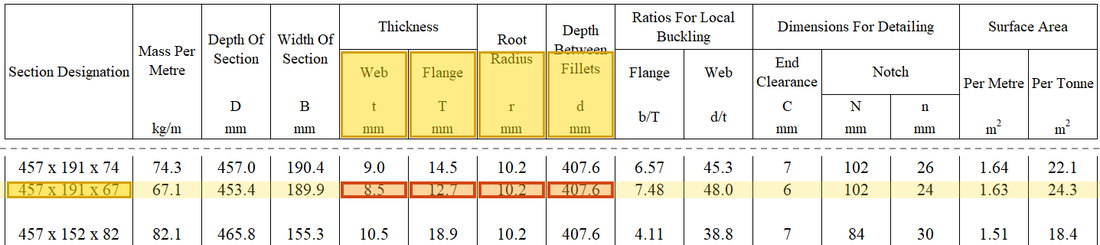
457×191×67 UB: , , , ; .Yellow: given parameter, row or columnOrange: value read from the table, boxed orange in the text too Data file lookup · Data Page 1 · Design strength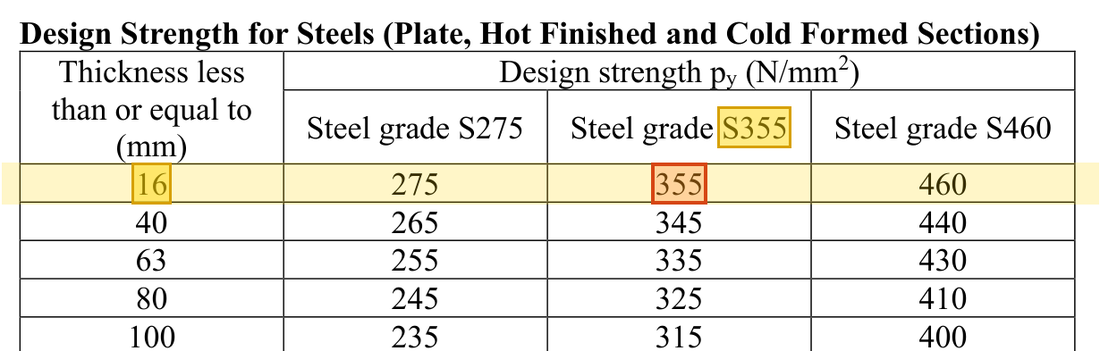
A rolled section is classified by its thickest element: flange , so the row, S355 column gives ; the web checks use this value as . How the grade and thickness choose this row →Yellow: given parameter, row or columnOrange: value read from the table, boxed orange in the text too - Step 2 · Web bearing
Why this step: This guards against the web being crushed directly above the support. The longer the length of web the spread force presses on, the harder it is to crush.
be = 0, so be/k = 2; length times thickness gives the area.
New symbols in this step- , : Bearing contact width and course end-distance parameter; mm
Where the numbers come from: from Step 1.
Units: mm times mm gives mm², and times N/mm² gives N. Dividing by 1000 changes N into kN, because 1 kN is 1000 N.
Load path · How the reaction enters the webThe reaction of B3 enters the bottom flange from the 150 mm bearing plate and spreads upwards to a loaded length at the root of the web (yellow). Bearing and buckling are both compared with the same 112.656 kN reaction. - Step 3 · Branch selection
Why this step: When the support is very close to the beam end, little web lies beyond it to help share the force, so the buckling capacity uses the less favourable formula.
The worksheet uses and compares it with .
New symbols in this step- , : Effective web depth and thickness; mm
- Step 4 · Local buckling
Why this step: The web is tall and thin, so under compression it may bulge sideways like a sheet of paper. This step finds the force it can take before that happens.
Use the course expression with all lengths in mm. The corrected result 246.9868 kN follows from the expression below.
New symbols in this step- , : Web design yield strength N/mm²; dimensionless classification/buckling strength factor
- , : Local bearing and buckling resistances; kN
- Step 5 · Trace the correction
Why this step: The buckling capacity comes from the bearing capacity multiplied by two ratios. Following the corrected formula makes sure the later comparison uses the right figure.
The lecturer initially obtains 148.4 kN, then corrects the expression and multiplies by to obtain 246.9868 kN. This example uses the corrected result.
- Step 6 · Comparison
Why this step: Bearing and buckling are two different ways the web can fail, and the same reaction must pass both. Buckling has the smaller capacity, so it is the weakest item.
Compare both resistances with the same support reaction . Local buckling is closer to its limit.
The displayed support passes local bearing and buckling. Intermediate 148.4 kN is not the final answer. These capacities also differ from the other 533-series beam's 721.8/297.5; do not mix problems.
All the symbols of this example
| Symbols | Meaning and Units |
|---|---|
| , | Bearing contact width and course end-distance parameter; mm |
| , | Effective web depth and thickness; mm |
| , | Rolled-section junction length in mm; dimensionless end-condition factor |
| , | Web design yield strength N/mm²; dimensionless classification/buckling strength factor |
| , | Local bearing and buckling resistances; kN |
Video positions: 17 October 01:20:00 · 17 October 01:35:00 · 17 October 01:35:35