Worked Example

Q5: utilisation slightly above 1, judged marginally OK by the lecturer (Marginal Utilization)

Task: Follow the lecturer's calculation of the two member checks and learn how the lecturer judges a result slightly above 1.

Original question · Lecture notes Chapter 4, p. 41 (Tutorial 4 Q5)
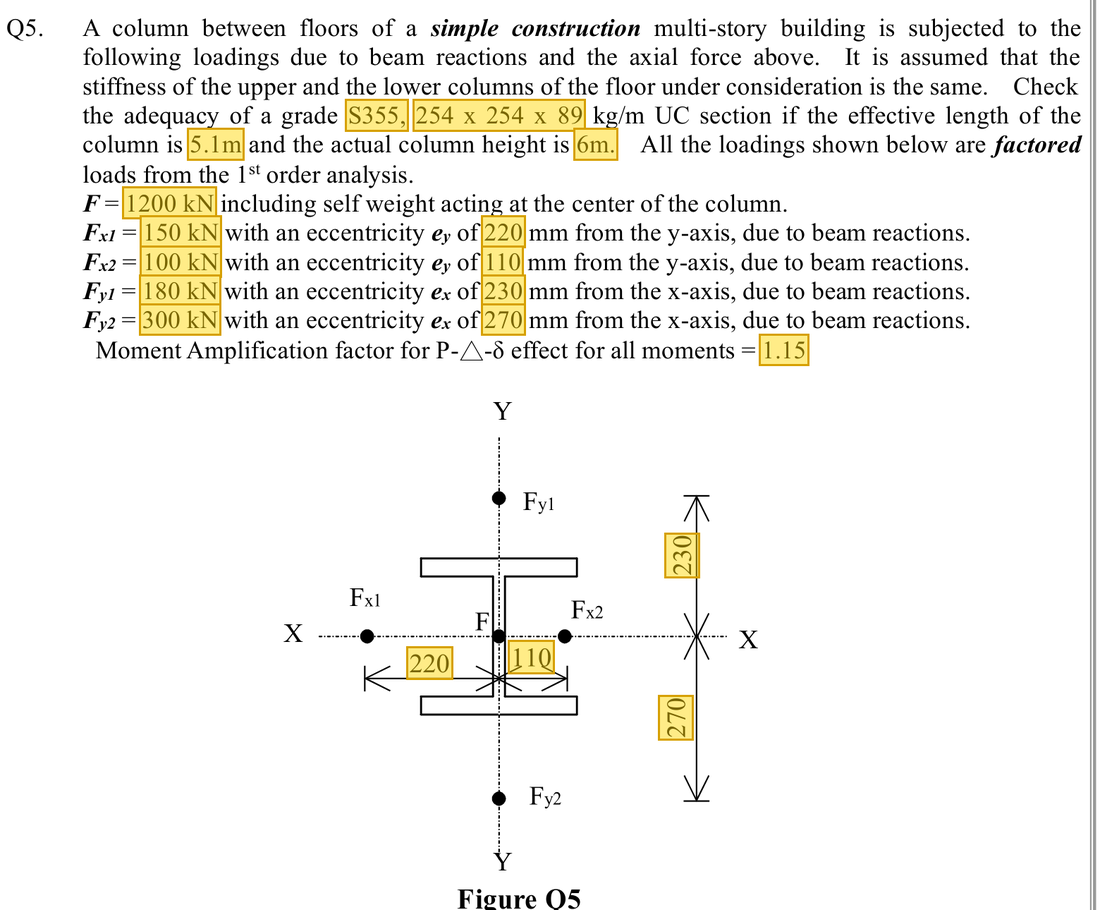
Original question with the given values boxed
Yellow boxes: values the question gives, the same values marked yellow in the Given table below.

The question in short: A 254×254×89 UC column carries 1200 kN at its centre plus four downward forces that act away from the centre and so bend the column. Find the total compression and the moments about both axes, then check the section and the whole column.

What differs from the previous example of this type: In the previous example the moments were given. Here they come from off-centre forces times their lever arms and are shared equally between the column lengths above and below, and the member checks use no m factors.

GivenValue and Unit
LoadingF=1200 kN\htmlClass{given}{F=1200\ \mathrm{kN}} (at the column centre); Fx1 = 150, Fx2 = 100, Fy1 = 180, Fy2 = 300 kN
Lever armsxx direction 0.27/0.23 m; yy direction 0.22/0.11 m
Distribution in this problemSimple construction; the upper and lower columns have the same stiffness, so each takes half the moment; amplification 1.15 about both axes
Section254×254×89 UC, S355; Le=5100 mm\htmlClass{given}{L_e=5100\ \mathrm{mm}}; actual column height 6 m
Section propertiesT=17.3 mm\htmlClass{read}{T=17.3\ \mathrm{mm}}, py=345\htmlClass{read}{p_y=345}; Ag=113 cm2\htmlClass{read}{A_g=113\ \mathrm{cm^{2}}}; ry=65.5 mm\htmlClass{read}{r_y=65.5\ \mathrm{mm}}; Sx=1224\htmlClass{read}{S_x=1224}, Zx=1096\htmlClass{read}{Z_x=1096}, Sy=575\htmlClass{read}{S_y=575}, Zy=379 cm3\htmlClass{read}{Z_y=379\ \mathrm{cm^{3}}}

Yellow: values given in the question. The same values are marked where they are substituted in the steps below.
Orange box: values read directly from the Data File, the same values boxed orange in the lookup screenshots. A value interpolated between two table rows is a calculation, so it has no box.


Data file lookup · Data Page 11 · Universal Columns — Properties
254×254×89 UC: ry = 6.55 cm = 65.5 mm, Zx = 1096, Zy = 379, Sx = 1224, Sy = 575 cm³, A = 113 cm².
254×254×89 UC: ry=6.55 cm=65.5 mmr_y=6.55\ \mathrm{cm}=65.5\ \mathrm{mm}, Zx=1096Z_x=1096, Zy=379Z_y=379, Sx=1224S_x=1224, Sy=575 cm3S_y=575\ \mathrm{cm^{3}}, A=113 cm2A=113\ \mathrm{cm^{2}}.Yellow: given parameter, row or columnOrange: value read from the table, boxed orange in the text too
Data file lookup · Data Page 11 · Universal Columns — Dimensions
254×254×89 UC: flange T = 17.3 mm.
254×254×89 UC: flange T=17.3 mmT=17.3\ \mathrm{mm}.Yellow: given parameter, row or columnOrange: value read from the table, boxed orange in the text too
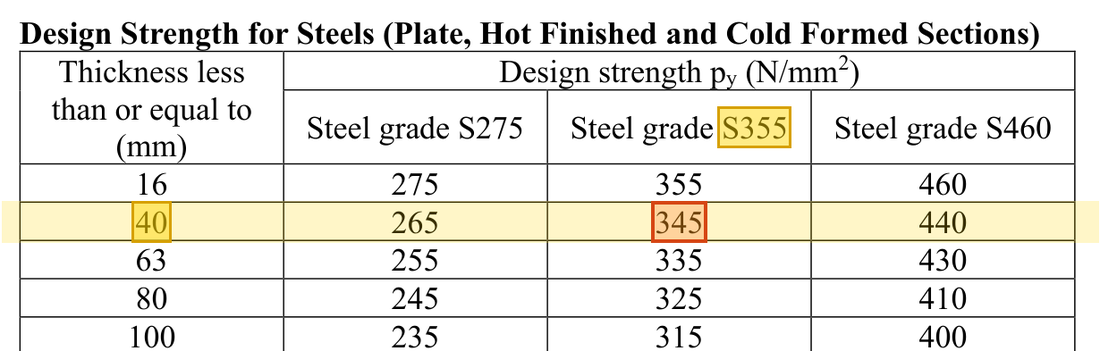
Data file lookup · Data Page 1 · Design strength pyp_y
T = 17.3 mm thick: the T ≤ 40 mm row, S355 column gives py = 345 N/mm².
T=17.3 mmT=17.3\ \mathrm{mm} thick: the T≤40 mmT\le40\ \mathrm{mm} row, S355 column gives py=345 N/mm2p_y=345\ \mathrm{N/mm^{2}}. How the grade and thickness choose this row →Yellow: given parameter, row or columnOrange: value read from the table, boxed orange in the text too

Solution Route: Combine loads→eccentric moments→specified distribution→amplification→section check→two member checks→the lecturer's judgement.

Interactive 3D model · drag to turn

This browser cannot show the 3D model.

The four beam reactions are off the column centre: Fx1 and Fx2 lie on the XX axis, 220 and 110 mm from the YY axis; Fy1 and Fy2 lie on the YY axis, 230 and 270 mm from the XX axis. Moments from opposite sides act in opposite directions and are subtracted, then shared equally by the upper and lower columns.Yellow: values given in the question; orange box: values read from the Data File; white: calculated results; red arrows: forces.
Load path · the stations the force passes through, in order

The reactions of four beams enter the column at its top. They are off the column centre, so besides axial force they cause moments about both axes; the upper and lower columns each take half of these moments.

  1. Beam reactions add up to the axial force
    Fc=1930 kNF_c=1930\ \mathrm{kN}
    Step 1
  2. Eccentricity gives moments (half each way)
    Mx=19.8M_x=19.8, My=11 kNmM_y=11\ \mathrm{kNm}; amplified to 22.77 and 12.65 kNm
    Step 2–4
  3. Cross-section check
    Sum 0.63Limit 1
    Step 5
  4. Member check 1 (buckling)
    Sum 1.05Limit 1
    marginally OK (as the lecturer reads it)
    Step 6–7
  5. Member check 2 (lateral-torsional buckling)
    Sum 1.052Limit 1
    marginally OK (as the lecturer reads it)
    Step 8–9
Red frame: the station closest to its limit. Each station links to the step that calculates it. Press “Show on the 3D model” to light up that part of the model above; press again to clear.
  1. Step 1 · Combine axial forces

    Why this step: Whether a force acts at the centre or to one side, it all travels down this column, so every force adds to the compression. Acting off-centre only adds a moment as well.

    Add all five downward actions, not just the largest 1200.

    New symbols in this step
    • FcF_c, PcP_c: Design axial force and buckling compression resistance; kN
    Fc=∑F=1200+150+100+180+300=1930 kNF_c=\sum F={\htmlClass{given}{1200}}+{\htmlClass{given}{150}}+{\htmlClass{given}{100}}+{\htmlClass{given}{180}}+{\htmlClass{given}{300}}=1930\ \mathrm{kN}
    Fc=∑F=1200+150+100+180+300=1930 kN\begin{aligned}F_c&=\sum F\\&={\htmlClass{given}{1200}}+{\htmlClass{given}{150}}+{\htmlClass{given}{100}}+{\htmlClass{given}{180}}+{\htmlClass{given}{300}}\\&=1930\ \mathrm{kN}\end{aligned}

    ▶ The lecturer on this part: 31 October 02:25:00

  2. Step 2 · xx-direction moment

    Why this step: A force away from the column centre acts like a spanner and bends the column head. Forces on opposite sides turn it in opposite ways and partly cancel; what is left is the moment at the joint.

    Subtract opposing rotations, then divide by 2 for this problem's upper/lower segment distribution.

    New symbols in this step
    • MxM_x, MyM_y, MLTM_{LT}: Two-axis and LTB governing moment demands; kNm
    Mx=12∑Fey=(300(0.27)−180(0.23))/2=19.8 kNmM_x=\tfrac12\sum Fe_y=({\htmlClass{given}{300}}({\htmlClass{given}{0.27}})-{\htmlClass{given}{180}}({\htmlClass{given}{0.23}}))/2=19.8\ \mathrm{kNm}
    Mx=12∑Fey=(300(0.27)−180(0.23))/2=19.8 kNm\begin{aligned}M_x&=\tfrac12\sum Fe_y\\&=({\htmlClass{given}{300}}({\htmlClass{given}{0.27}})-{\htmlClass{given}{180}}({\htmlClass{given}{0.23}}))/2\\&=19.8\ \mathrm{kNm}\end{aligned}
  3. Step 3 · yy-direction moment

    Why this step: The two off-centre forces in the other direction bend the column about its other axis. The moment at the joint is carried by the column lengths above and below; with equal stiffness each takes half.

    Again use force times perpendicular lever arm first.

    My=12∑Fex=(150(0.22)−100(0.11))/2=11 kNmM_y=\tfrac12\sum Fe_x=({\htmlClass{given}{150}}({\htmlClass{given}{0.22}})-{\htmlClass{given}{100}}({\htmlClass{given}{0.11}}))/2=11\ \mathrm{kNm}
    My=12∑Fex=(150(0.22)−100(0.11))/2=11 kNm\begin{aligned}M_y&=\tfrac12\sum Fe_x\\&=({\htmlClass{given}{150}}({\htmlClass{given}{0.22}})-{\htmlClass{given}{100}}({\htmlClass{given}{0.11}}))/2\\&=11\ \mathrm{kNm}\end{aligned}
    Load path · How the beam reactions bend the column
    xyF = 1200 kNFx1​ = 150 kN220Fx2​ = 100 kN110Fy1​ = 180 kN230Fy2​ = 300 kN270Plan: ⊗ marks a downward forceLever arms measured from the column centre (mm)Elevation: half to each column lengthUpper column: halfLower column: halfMx​ = (300 × 0.27 − 180 × 0.23) / 2 = 19.8 kNmMy​ = (150 × 0.22 − 100 × 0.11) / 2 = 11 kNm
    Left, the column seen from above. All five forces act downwards and add up to the 1930 kN axial force. Fy1 and Fy2 lie on opposite sides of the xx axis, so their moments oppose and are subtracted to give the moment about xx; Fx1 and Fx2 are subtracted likewise for the moment about yy. The upper and lower columns are equally stiff and take half each.
  4. Step 4 · Specified amplification

    Why this step: Amplifying adds in the extra moment that develops as the compressed column deforms. The moments here are small and stay small after amplification; the column is mainly in compression.

    1.15 multiplies moment demand, not section resistance.

    Mx′=1.15Mx=1.15(19.8)=22.77,My′=1.15My=1.15(11)=12.65 kNmM_x'={\htmlClass{given}{1.15}}M_x={\htmlClass{given}{1.15}}(19.8)=22.77,\qquad M_y'={\htmlClass{given}{1.15}}M_y={\htmlClass{given}{1.15}}(11)=12.65\ \mathrm{kNm}
    Mx′=1.15Mx=1.15(19.8)=22.77My′=1.15My=1.15(11)=12.65 kNm\begin{aligned}M_x'&={\htmlClass{given}{1.15}}M_x={\htmlClass{given}{1.15}}(19.8)=22.77\\M_y'&={\htmlClass{given}{1.15}}M_y\\&={\htmlClass{given}{1.15}}(11)\\&=12.65\ \mathrm{kNm}\end{aligned}

    Where the numbers come from: 19.819.8 from Step 2; 1111 from Step 3.

  5. Step 5 · The section can still pass

    Why this step: The section check only asks whether the steel is crushed and ignores the length of the column. The low utilisation shows that the weakness of this column is not section strength but the buckling checked next.

    The section check uses plastic capacities: AgpyA_gp_y for compression and the smaller of pySp_yS and 1.2pyZ for moment.

    New symbols in this step
    • AgA_g, pyp_y, pcp_c: Gross area mm²; yield and compression buckling strengths N/mm²
    • McxM_{cx}, McyM_{cy}, MbM_b: Corresponding bending resistances; kNm, with different section/member definitions
    Agpy=113(100)(345)/1000=3898.5 kNMcx=min⁡(345(1224), 1.2(345)(1096))/1000=422.3 kNmMcy=min⁡(345(575), 1.2(345)(379))/1000=156.9 kNmηs=FcAgpy+Mx′Mcx+My′Mcy=1930/3898.5+22.77/422.3+12.65/156.9≈0.630\begin{aligned}A_gp_y&={\htmlClass{read}{113}}(100)({\htmlClass{read}{345}})/1000=3898.5\ \mathrm{kN}\\M_{cx}&=\min({\htmlClass{read}{345}}({\htmlClass{read}{1224}}),\ 1.2({\htmlClass{read}{345}})({\htmlClass{read}{1096}}))/1000=422.3\ \mathrm{kNm}\\M_{cy}&=\min({\htmlClass{read}{345}}({\htmlClass{read}{575}}),\ 1.2({\htmlClass{read}{345}})({\htmlClass{read}{379}}))/1000=156.9\ \mathrm{kNm}\\\eta_s&=\frac{F_c}{A_gp_y}+\frac{M_x'}{M_{cx}}+\frac{M_y'}{M_{cy}}\\&=1930/3898.5+22.77/422.3+12.65/156.9\approx0.630\end{aligned}
    Agpy=113(100)(345)/1000=3898.5 kNMcx=min⁡(345(1224), 1.2(345)(1096))/1000=422.3 kNmMcy=min⁡(345(575), 1.2(345)(379))/1000=156.9 kNmηs=FcAgpy+Mx′Mcx+My′Mcy=1930/3898.5+22.77/422.3+12.65/156.9≈0.630\begin{aligned}A_gp_y&={\htmlClass{read}{113}}(100)({\htmlClass{read}{345}})/1000\\&=3898.5\ \mathrm{kN}\\M_{cx}&=\min({\htmlClass{read}{345}}({\htmlClass{read}{1224}}),\\&\quad \ 1.2({\htmlClass{read}{345}})({\htmlClass{read}{1096}}))/1000\\&=422.3\ \mathrm{kNm}\\M_{cy}&=\min({\htmlClass{read}{345}}({\htmlClass{read}{575}}),\\&\quad \ 1.2({\htmlClass{read}{345}})({\htmlClass{read}{379}}))/1000\\&=156.9\ \mathrm{kNm}\\\eta_s&=\frac{F_c}{A_gp_y}+\frac{M_x'}{M_{cx}}+\frac{M_y'}{M_{cy}}\\&=1930/3898.5\\&\quad +22.77/422.3\\&\quad +12.65/156.9\\&\approx0.630\end{aligned}

    Where the numbers come from: 19301930 from Step 1; 22.7722.77 from Step 4; 12.6512.65 from Step 4.

    Units: AgA_g is multiplied by 100 to change cm² into mm²; times pyp_y gives N, and dividing by 1000 gives kN. SS and ZZ are multiplied by 1000 to change cm³ into mm³; Nmm divided by 1000000 gives kNm, a net division by 1000.

    ▶ The lecturer on this part: 31 October 02:35:00

  6. Step 6 · Buckling reduces resistance

    Why this step: The column is fairly slender, so it bows about its weak axis before the steel is crushed, and PcP_c is much smaller than AgpyA_gp_y. The compression term therefore takes up most of the capacity.

    λ=Le/ry≈77.86\lambda=L_e/r_y\approx77.86; in the py=345p_y=345 column of Table 8.8(c) it lies between the 76 and 78 rows, and interpolation gives pc≈191.34 N/mm2p_c\approx191.34\ \mathrm{N/mm^{2}}.

    New symbols in this step
    λ=LE/ry=5100/65.5≈77.86pc=196+77.86−7678−76(191−196)≈191.34 N/mm2Pc=pcAg≈191.34(113)(100)/1000≈2162 kN\begin{aligned}\lambda&=L_E/r_y={\htmlClass{given}{5100}}/{\htmlClass{read}{65.5}}\approx77.86\\p_c&={\htmlClass{read}{196}}+\frac{77.86-{\htmlClass{given}{76}}}{{\htmlClass{given}{78}}-{\htmlClass{given}{76}}}({\htmlClass{read}{191}}-{\htmlClass{read}{196}})\approx191.34\ \mathrm{N/mm^2}\\P_c&=p_cA_g\approx191.34({\htmlClass{read}{113}})(100)/1000\approx2162\ \mathrm{kN}\end{aligned}
    λ=LE/ry=5100/65.5≈77.86pc=196+77.86−7678−76(191−196)≈191.34 N/mm2Pc=pcAg≈191.34(113)(100)/1000≈2162 kN\begin{aligned}\lambda&=L_E/r_y={\htmlClass{given}{5100}}/{\htmlClass{read}{65.5}}\approx77.86\\p_c&={\htmlClass{read}{196}}+\frac{77.86-{\htmlClass{given}{76}}}{{\htmlClass{given}{78}}-{\htmlClass{given}{76}}}({\htmlClass{read}{191}}-{\htmlClass{read}{196}})\\&\approx191.34\ \mathrm{N/mm^2}\\P_c&=p_cA_g\\&\approx191.34({\htmlClass{read}{113}})(100)/1000\\&\approx2162\ \mathrm{kN}\end{aligned}

    Units: AgA_g of 113 cm² is multiplied by 100 to change it into mm². pcp_c in N/mm² times mm² gives N, and dividing by 1000 gives kN. λ\lambda is mm divided by mm and has no unit.

    Data file lookup · Data Page 8 · Table 8.8(c)
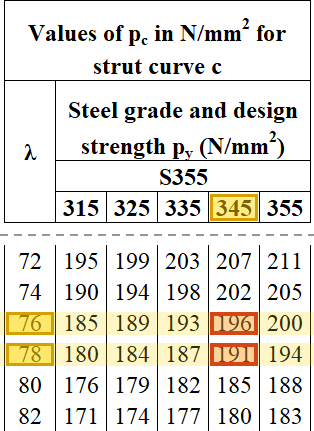
    Table 8.8(c), py = 345 column: λ = 76 → 196 and λ = 78 → 191 N/mm²; interpolating at λ = 77.86 gives pc ≈ 191.34 N/mm².
    Table 8.8(c), py=345p_y=345 column: λ=76\lambda=76 → 196 and λ=78\lambda=78 → 191 N/mm²; interpolating at λ=77.86\lambda=77.86 gives pc≈191.34 N/mm2p_c\approx191.34\ \mathrm{N/mm^{2}}.Yellow: given parameter, row or columnOrange: value read from the table, boxed orange in the text too

    ▶ The lecturer on this part: 31 October 02:45:00

  7. Step 7 · First member expression

    Why this step: This check asks whether the whole column bows out and buckles under compression plus the eccentric moments. The compression term alone nearly uses up PcP_c, so adding even small moments takes the total past the limit.

    In simple construction the member checks use no m factors and the elastic capacities pyZp_yZ as denominators. The total is slightly above 1.

    pyZx=345(1096)/1000=378.1,pyZy=345(379)/1000=130.8 kNmη1=FcPc+Mx′pyZx+My′pyZy≈1930/2162+22.77/378.1+12.65/130.8≈1.050\begin{aligned}p_yZ_x&={\htmlClass{read}{345}}({\htmlClass{read}{1096}})/1000=378.1,\quad p_yZ_y={\htmlClass{read}{345}}({\htmlClass{read}{379}})/1000=130.8\ \mathrm{kNm}\\\eta_1&=\frac{F_c}{P_c}+\frac{M_x'}{p_yZ_x}+\frac{M_y'}{p_yZ_y}\\&\approx1930/2162+22.77/378.1+12.65/130.8\approx1.050\end{aligned}
    pyZx=345(1096)/1000=378.1pyZy=345(379)/1000=130.8 kNmη1=FcPc+Mx′pyZx+My′pyZy≈1930/2162+22.77/378.1+12.65/130.8≈1.050\begin{aligned}p_yZ_x&={\htmlClass{read}{345}}({\htmlClass{read}{1096}})/1000=378.1\\p_yZ_y&={\htmlClass{read}{345}}({\htmlClass{read}{379}})/1000\\&=130.8\ \mathrm{kNm}\\\eta_1&=\frac{F_c}{P_c}+\frac{M_x'}{p_yZ_x}+\frac{M_y'}{p_yZ_y}\\&\approx1930/2162\\&\quad +22.77/378.1\\&\quad +12.65/130.8\\&\approx1.050\end{aligned}

    Where the numbers come from: 19301930 from Step 1; 21622162 from Step 6; 22.7722.77 from Step 4; 12.6512.65 from Step 4.

    Units: ZxZ_x and ZyZ_y are multiplied by 1000 to change cm³ into mm³. pyp_y times mm³ gives Nmm, and dividing by 1000000 gives kNm, so the formula divides by 1000.

    ▶ The lecturer on this part: 31 October 02:49:52

  8. Step 8 · Member LTB expression

    Why this step: This check guards against the compression flange moving sideways under the xx-axis moment, with the column twisting, while the column is in compression. Because the moment is small, using MbM_b changes the result very little from the first check.

    In simple construction λLT=0.5L/ry\lambda_{LT}=0.5L/r_y with LL the actual column height, 6 m; interpolate pbp_b in the py=345p_y=345 column of Table 8.3a and find MbM_b. With MbM_b as the denominator of the bending term, the result is still about 1.05.

    λLT=0.5L/ry=0.5(6000)/65.5≈45.8pb=302+45.8−4550−45(285−302)≈299.3 N/mm2Mb=pbSx=299.3(1224)/1000≈366.3 kNmη2=FcPc+Mx′Mb+My′pyZy≈1930/2162+22.77/366.3+12.65/130.8≈1.052\begin{aligned}\lambda_{LT}&=0.5L/r_y=0.5({\htmlClass{given}{6000}})/{\htmlClass{read}{65.5}}\approx45.8\\p_b&={\htmlClass{read}{302}}+\frac{45.8-{\htmlClass{given}{45}}}{{\htmlClass{given}{50}}-{\htmlClass{given}{45}}}({\htmlClass{read}{285}}-{\htmlClass{read}{302}})\approx299.3\ \mathrm{N/mm^2}\\M_b&=p_bS_x=299.3({\htmlClass{read}{1224}})/1000\approx366.3\ \mathrm{kNm}\\\eta_2&=\frac{F_c}{P_c}+\frac{M_x'}{M_b}+\frac{M_y'}{p_yZ_y}\\&\approx1930/2162+22.77/366.3+12.65/130.8\approx1.052\end{aligned}
    λLT=0.5L/ry=0.5(6000)/65.5≈45.8pb=302+45.8−4550−45(285−302)≈299.3 N/mm2Mb=pbSx=299.3(1224)/1000≈366.3 kNmη2=FcPc+Mx′Mb+My′pyZy≈1930/2162+22.77/366.3+12.65/130.8≈1.052\begin{aligned}\lambda_{LT}&=0.5L/r_y\\&=0.5({\htmlClass{given}{6000}})/{\htmlClass{read}{65.5}}\\&\approx45.8\\p_b&={\htmlClass{read}{302}}+\frac{45.8-{\htmlClass{given}{45}}}{{\htmlClass{given}{50}}-{\htmlClass{given}{45}}}({\htmlClass{read}{285}}-{\htmlClass{read}{302}})\\&\approx299.3\ \mathrm{N/mm^2}\\M_b&=p_bS_x\\&=299.3({\htmlClass{read}{1224}})/1000\\&\approx366.3\ \mathrm{kNm}\\\eta_2&=\frac{F_c}{P_c}+\frac{M_x'}{M_b}+\frac{M_y'}{p_yZ_y}\\&\approx1930/2162\\&\quad +22.77/366.3\\&\quad +12.65/130.8\\&\approx1.052\end{aligned}

    Where the numbers come from: 19301930 from Step 1; 21622162 from Step 6; 22.7722.77 from Step 4; 12.6512.65 from Step 4; 130.8130.8 from Step 7.

    Units: The 6 m column height is multiplied by 1000 to give 6000 mm before dividing by ryr_y in mm. For MbM_b, SxS_x is multiplied by 1000 to change cm³ into mm³ and Nmm is divided by 1000000 to give kNm, a net division by 1000.

    Data file lookup · Data Page 5 · Table 8.3a
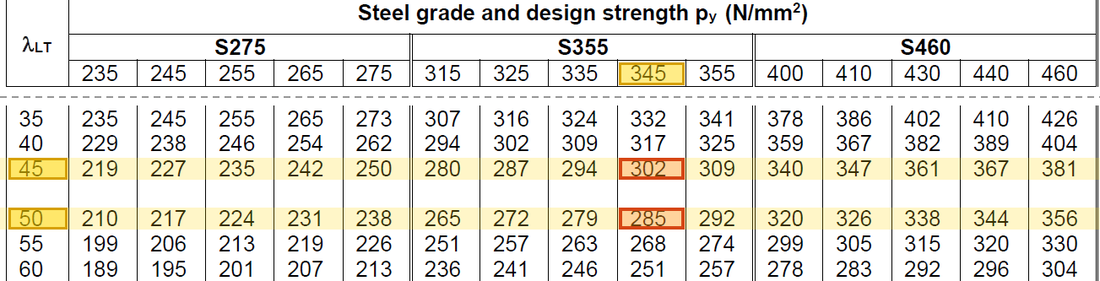
    Table 8.3a, py = 345 column: λLT = 45 → 302 and λLT = 50 → 285 N/mm²; with the simple-construction λLT = 0.5L/ry ≈ 45.8, interpolation gives pb ≈ 299.3 N/mm².
    Table 8.3a, py=345p_y=345 column: λLT=45\lambda_{LT}=45 → 302 and λLT=50\lambda_{LT}=50 → 285 N/mm²; with the simple-construction λLT=0.5L/ry≈45.8\lambda_{LT}=0.5L/r_y\approx45.8, interpolation gives pb≈299.3 N/mm2p_b\approx299.3\ \mathrm{N/mm^{2}}.Yellow: given parameter, row or columnOrange: value read from the table, boxed orange in the text too
    Load path · How the ratios add up
    Limit 1Cross-section0.4950.0540.081≈ 0.63Member 1 (buckling)0.8930.060.097≈ 1.05 marginally OKMember 2 (LTB)0.8930.0620.097≈ 1.052 marginally OKAxial termx-axis moment termy-axis moment term
    The cross-section check uses only about 60%. In the member checks the buckling capacity PcP_c replaces AgpyA_gp_y, so the blue axial term grows from 0.495 to 0.893 and the total just passes the red dashed line; the lecturer reads this as marginally OK.

    ▶ The lecturer on this part: 31 October 02:45:00

  9. Step 9 · The lecturer's judgement

    Why this step: A utilisation of 1 means the capacity is exactly used up; anything above 1 is the share by which demand exceeds capacity. That is why this result is reported with its value, not just as a pass.

    Both expressions are about 1.05, only about 5% above 1. The lecturer writes “marginally OK” beside the worksheet, meaning just acceptable. In the exam, follow the lecturer and state which expression it is and its value.

    ▶ The lecturer on this part: 31 October 02:49:52

Conclusion

The two member checks give about 1.050 and 1.052, slightly above 1; the lecturer judges this marginally OK (just acceptable). In the answer, write the values and “marginally OK”; do not round to 1 and simply write OK, and do not use the section utilisation 0.63 to offset the member checks. Remark: under the strict ≤1 condition, 1.05 exceeds the limit by about 5%, and the lecturer also says it is, in principle, not OK; in practice a larger section could be used, but all checks must then be repeated.

All the symbols of this example

SymbolsMeaning and Units
FcF_c, PcP_cDesign axial force and buckling compression resistance; kN
AgA_g, pyp_y, pcp_cGross area mm²; yield and compression buckling strengths N/mm²
LeL_e, rxr_x, ryr_y, λ\lambdaEffective length and radius of gyration mm; dimensionless slenderness
MxM_x, MyM_y, MLTM_{LT}Two-axis and LTB governing moment demands; kNm
SxS_x, SyS_y, ZxZ_x, ZyZ_yTwo-axis plastic/elastic moduli; convert the tabulated cm³
McxM_{cx}, McyM_{cy}, MbM_bCorresponding bending resistances; kNm, with different section/member definitions
ηs\eta_s, η1\eta_1, η2\eta_2Total utilisations for the section and two member expressions; dimensionless

Video positions: 31 October 02:25:00 · 31 October 02:35:00 · 31 October 02:50:00

↑ Top