Worked Example

8 m revision beam: resistance and deformation again (Beam Check Practice)

Task: Practise obtaining shear resistance VcV_c from section geometry, then deflection Δ\Delta from a separate SLS load set.

The question in short: A beam spanning 8000 mm uses a 457×191×82 UB in S355. The design moment is 390.3 kNm and the imposed midspan point load is 45 kN. Find the shear and moment capacities and check the deflection.

What differs from the previous example of this type: The steps are the same as in the previous example, but the span, the section and the imposed point load have all changed. Every value must come from this example, not the last one.

GivenValue and Unit
Section457×191×82 UB, S355; t=9.9\htmlClass{read}{t=9.9}, D=460\htmlClass{read}{D=460}, T=16.0 mm\htmlClass{read}{T=16.0\ \mathrm{mm}}; Sx=1831\htmlClass{read}{S_x=1831}, Zx=1611 cm3\htmlClass{read}{Z_x=1611\ \mathrm{cm^{3}}}; Ix=37050 cm4\htmlClass{read}{I_x=37050\ \mathrm{cm^{4}}}; py=355\htmlClass{read}{p_y=355}
ULSM=390.3 kNm\htmlClass{given}{M=390.3\ \mathrm{kNm}} (lecturer’s worksheet)
SLSMidspan P=45 kN\htmlClass{given}{P=45\ \mathrm{kN}}; L=8000 mm\htmlClass{given}{L=8000\ \mathrm{mm}}; E=205000 N/mm2\htmlClass{read}{E=205000\ \mathrm{N/mm^{2}}}

Yellow: values given in the question. The same values are marked where they are substituted in the steps below.
Orange box: values read directly from the Data File, the same values boxed orange in the lookup screenshots. A value interpolated between two table rows is a calculation, so it has no box.
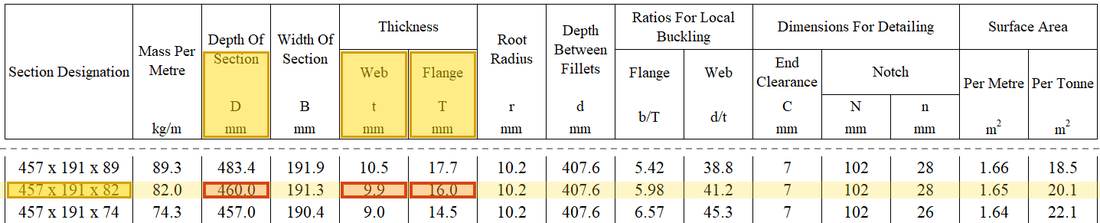
Data file lookup · Data Page 9 · Universal Beams — Dimensions
457×191×82 UB: D = 460.0 mm, t = 9.9 mm, T = 16.0 mm. T equals 16 mm, so it still falls in the T ≤ 16 mm row.
457×191×82 UB: D=460.0 mmD=460.0\ \mathrm{mm}, t=9.9 mmt=9.9\ \mathrm{mm}, T=16.0 mmT=16.0\ \mathrm{mm}. TT equals 16 mm, so it still falls in the T≤16 mmT\le16\ \mathrm{mm} row.Yellow: given parameter, row or columnOrange: value read from the table, boxed orange in the text too
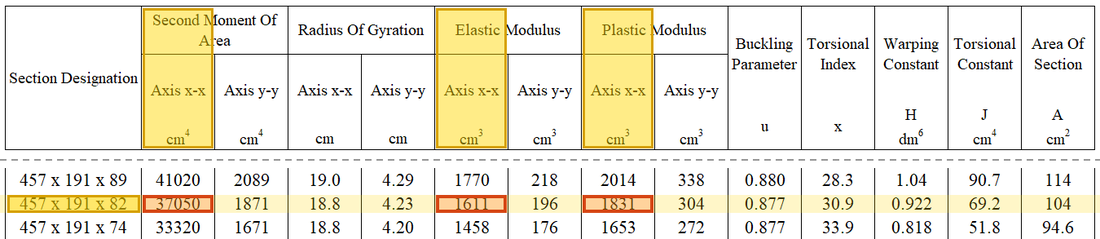
Data file lookup · Data Page 10 · Universal Beams — Properties
457×191×82 UB: Ix = 37050 cm⁴, Zx = 1611 cm³, Sx = 1831 cm³. The lecturer's screen uses Ix = 37051 cm⁴, 1 cm⁴ more than the table; this page uses the table value, and the deflection is 6.32 mm either way. The moment candidates 650.0 = 355 × 1831/1000 and 686.3 = 1.2 × 355 × 1611/1000 kNm come from these values.
457×191×82 UB: Ix=37050 cm4I_x=37050\ \mathrm{cm^{4}}, Zx=1611 cm3Z_x=1611\ \mathrm{cm^{3}}, Sx=1831 cm3S_x=1831\ \mathrm{cm^{3}}. The lecturer's screen uses Ix=37051 cm4I_x=37051\ \mathrm{cm^{4}}, 1 cm⁴ more than the table; this page uses the table value, and the deflection is 6.32 mm either way. The moment candidates 650.0 = 355 × 1831/1000 and 686.3 = 1.2 × 355 × 1611/1000 kNm come from these values.Yellow: given parameter, row or columnOrange: value read from the table, boxed orange in the text too
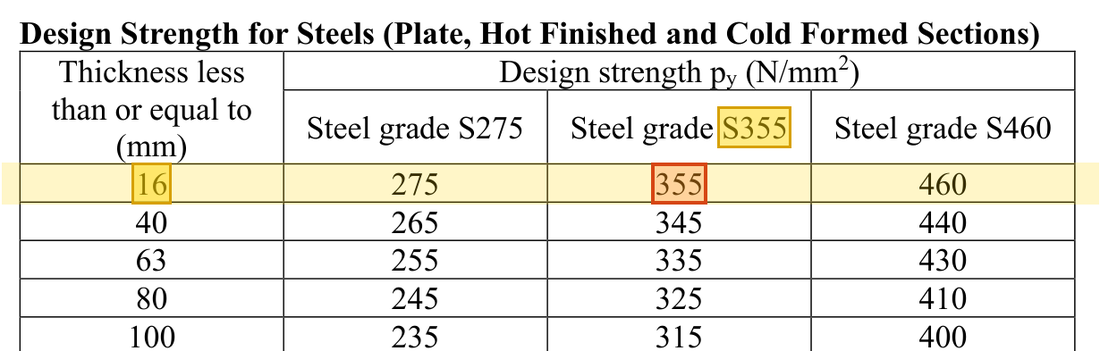
Data file lookup · Data Page 1 · Design strength pyp_y
Flange T = 16.0 mm thick: the T ≤ 16 mm row, S355 column gives py = 355 N/mm².
Flange T=16.0 mmT=16.0\ \mathrm{mm} thick: the T≤16 mmT\le16\ \mathrm{mm} row, S355 column gives py=355 N/mm2p_y=355\ \mathrm{N/mm^{2}}. How the grade and thickness choose this row →Yellow: given parameter, row or columnOrange: value read from the table, boxed orange in the text too

Solution Route: AvA_v→VcV_c→low-shear condition→McM_c→deflection Δ\Delta and limit.

Load path · the stations the force passes through, in order

The same path as the 6 m revision beam: load → shear and moment in the beam → supports. The span, section and loads are different here.

  1. Forces from the class sheet
    M=390.3 kNmM=390.3\ \mathrm{kNm}
  2. Shear capacity
    Vc≈933.38 kNV_c\approx933.38\ \mathrm{kN}; coexistent shear ratio about 0.10
  3. Bending (midspan)
    Demand 390.3 kNmCapacity 650 kNm
    Utilisation 0.60 · closest to the limit
  4. Deflection (SLS point load)
    Demand 6.32 mmCapacity 22.22 mm
    Utilisation 0.28
Red frame: the station closest to its limit. Each station links to the step that calculates it.
Load path · Load, shear force and bending moment
Loads and reactionsself-weightPRA​RB​4 m4 mBending moment diagram M (kNm): sagging moment drawn below the lineM = 390.3 kNm
A sketch of the moment diagram for a midspan point load with self-weight, drawn from M=390.3 kNmM=390.3\ \mathrm{kNm} on the class sheet. The largest moment is at midspan and is the value used in the bending check.
  1. Step 1 · Shear area

    Why this step: The upright web is what resists shear. Its thickness times the full depth of the section gives the area available for shear.

    The specified rolled section uses tDtD.

    New symbols in this step
    Av=tD=9.9(460)=4554 mm2A_v=tD={\htmlClass{read}{9.9}}({\htmlClass{read}{460}})=4554\ \mathrm{mm^2}
  2. Step 2 · Shear resistance

    Why this step: This is the most shear the web can take before it yields. It is then used to judge whether shear affects the moment capacity.

    Strength times area gives N; divide by 1000 for kN.

    New symbols in this step
    • McM_c, VcV_c, MbM_b: Section bending resistance in kNm, shear resistance in kN, LTB resistance in kNm
    • pyp_y, pbp_b, EE: Design yield/bending buckling strength and elastic modulus; N/mm²
    Vc=pyAv/3=355(4554)/(3 1000)≈933.38 kNV_c=p_yA_v/\sqrt3={\htmlClass{read}{355}}(4554)/(\sqrt3\,1000)\approx933.38\ \mathrm{kN}
    Vc=pyAv/3=355(4554)/(3 1000)≈933.38 kN\begin{aligned}V_c&=p_yA_v/\sqrt3\\&={\htmlClass{read}{355}}(4554)/(\sqrt3\,1000)\\&\approx933.38\ \mathrm{kN}\end{aligned}

    Where the numbers come from: 45544554 from Step 1.

    Units: N/mm² times mm² gives N; 1 kN is 1000 N, so dividing by 1000 gives kN.

  3. Step 3 · Bending

    Why this step: With a low shear ratio the web still has enough strength to help in bending, so the full moment capacity can be compared with the design moment.

    Displayed coexisting shear ratio is about 0.10<0.6, so follow the unreduced course procedure.

    Mc=min⁡(pySx, 1.2pyZx)=min⁡(355(1831), 1.2(355)(1611))/1000=min⁡(650.0, 686.3)=650.0 kNm>390.3 kNm\begin{aligned}M_c&=\min(p_yS_x,\ 1.2p_yZ_x)=\min({\htmlClass{read}{355}}({\htmlClass{read}{1831}}),\ 1.2({\htmlClass{read}{355}})({\htmlClass{read}{1611}}))/1000\\&=\min(650.0,\ 686.3)=650.0\ \mathrm{kNm}>{\htmlClass{given}{390.3}}\ \mathrm{kNm}\end{aligned}
    Mc=min⁡(pySx, 1.2pyZx)=min⁡(355(1831), 1.2(355)(1611))/1000=min⁡(650.0, 686.3)=650.0 kNm>390.3 kNm\begin{aligned}M_c&=\min(p_yS_x,\ 1.2p_yZ_x)\\&=\min({\htmlClass{read}{355}}({\htmlClass{read}{1831}}),\\&\quad \ 1.2({\htmlClass{read}{355}})({\htmlClass{read}{1611}}))/1000\\&=\min(650.0,\ 686.3)\\&=650.0\ \mathrm{kNm}\\&>{\htmlClass{given}{390.3}}\ \mathrm{kNm}\end{aligned}

    Units: N/mm² times cm³ gives 1000 Nmm, because 1 cm³ is 1000 mm³. Changing to kNm divides by 1000000, so overall the product is divided by 1000.

    ▶ The lecturer on this part: 14 November 02:04:37

  4. Step 4 · SLS point load

    Why this step: Deflection only considers the imposed point load that occurs in everyday use, so the load here is smaller than in the strength checks and carries no load factor.

    45 kN becomes 45000 N and II is converted from cm⁴ to mm⁴. The lecturer’s screen uses Ix=37051 cm4I_x=37051\ \mathrm{cm^{4}}; the table value is 37050 cm⁴; both give a deflection Δ\Delta of 6.32 mm.

    New symbols in this step
    • Δ\Delta, η\eta: Deflection mm; demand/resistance utilisation is dimensionless
    Δ=PL348EI=45000(8000)348(205000)(37050×104)≈6.32 mm\Delta=\frac{PL^3}{48EI}=\frac{{\htmlClass{given}{45000}}({\htmlClass{given}{8000}})^3}{48({\htmlClass{read}{205000}})({\htmlClass{read}{37050}}\times10^4)}\approx6.32\ \mathrm{mm}
    Δ=PL348EI=45000(8000)348(205000)(37050×104)≈6.32 mm\begin{aligned}\Delta&=\frac{PL^3}{48EI}\\&=\frac{{\htmlClass{given}{45000}}({\htmlClass{given}{8000}})^3}{48({\htmlClass{read}{205000}})({\htmlClass{read}{37050}}\times10^4)}\\&\approx6.32\ \mathrm{mm}\end{aligned}

    Units: 45 kN times 1000 gives 45000 N. IxI_x in cm⁴ times 10^4 gives mm⁴, because 1 cm is 10 mm and four tens multiply to 10000.

    Data file lookup · Data Page 1 · Steel properties

    Data Page 1, steel properties: modulus of elasticity E = 205000 N/mm² (printed as 205,000).
    Data Page 1, steel properties: modulus of elasticity E=205000 N/mm2E=205000\ \mathrm{N/mm^{2}} (printed as 205,000).Yellow: given parameter, row or columnOrange: value read from the table, boxed orange in the text too
  5. Step 5 · Serviceability limit

    Why this step: A longer span is allowed a larger sag. The actual sag is far below the limit, so the beam does not bend too far in use.

    Use mm for span LL too.

    New symbols in this step
    • LL, RAR_A, RBR_B: Span in m or mm; end reactions in kN
    Δ=6.32<L/360=8000/360≈22.22 mm\Delta=6.32<L/{\htmlClass{read}{360}}={\htmlClass{given}{8000}}/{\htmlClass{read}{360}}\approx22.22\ \mathrm{mm}
    Δ=6.32<L/360=8000/360≈22.22 mm\begin{aligned}\Delta&=6.32\\&<L/{\htmlClass{read}{360}}\\&={\htmlClass{given}{8000}}/{\htmlClass{read}{360}}\\&\approx22.22\ \mathrm{mm}\end{aligned}
    Data file lookup · Data Page 2 · Table 5.1 Deflection limits
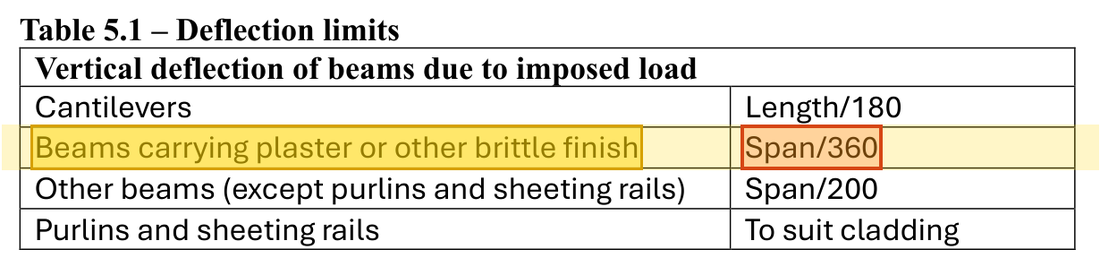
    For beams carrying plaster or other brittle finish, the imposed-load deflection limit is span/360.
    For beams carrying plaster or other brittle finish, the imposed-load deflection limit is span/360.Yellow: given parameter, row or columnOrange: value read from the table, boxed orange in the text too
Conclusion

This differs from the 6 m, 47.25 kN problem. Each has its own II and span LL; do not change only PP while retaining the previous denominator.

All the symbols of this example

SymbolsMeaning and Units
qq, ww, PPArea load kN/m², line load kN/m, point load kN
LL, RAR_A, RBR_BSpan in m or mm; end reactions in kN
MM, VVMoment demand in kNm; shear demand in kN
McM_c, VcV_c, MbM_bSection bending resistance in kNm, shear resistance in kN, LTB resistance in kNm
DD, dd, tt, TTOverall depth, classification web depth, web thickness and flange thickness; mm
AvA_v, II, SS, ZZShear area mm², second moment of area mm⁴, plastic/elastic moduli mm³
pyp_y, pbp_b, EEDesign yield/bending buckling strength and elastic modulus; N/mm²
Δ\Delta, η\etaDeflection mm; demand/resistance utilisation is dimensionless

Video positions: 14 November 02:05:00

↑ Top