850 kN lap weld: effective and provided lengths (Lap Weld)
Task: Find demand per weld and explain why the provided length is 220 mm rather than approximately 202 mm.
Go straight to Step 1 ↓Design flow for this type of question: Fillet-welded connection →
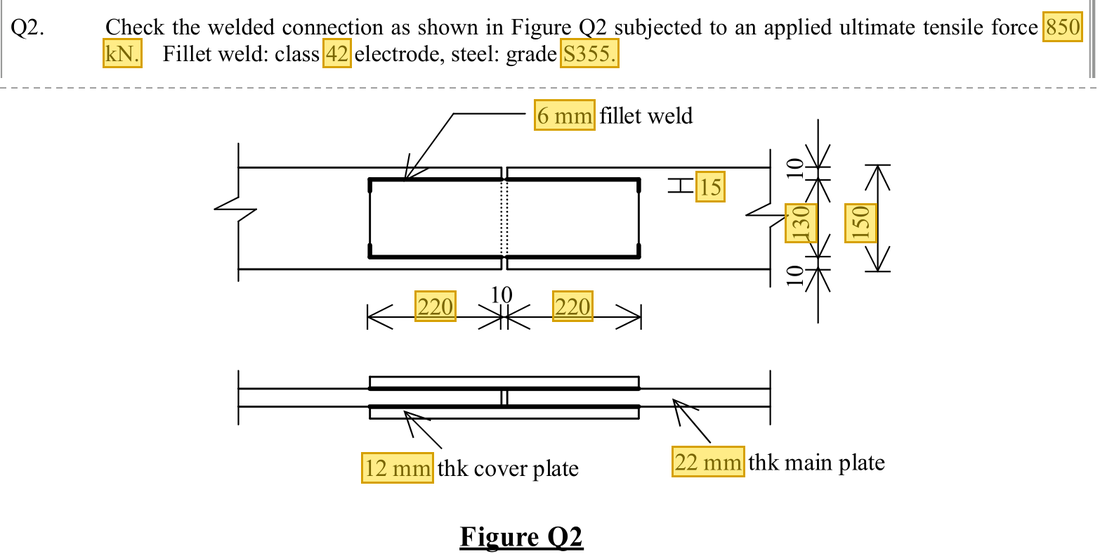
The question in short: A main plate is lapped to two cover plates with four 6 mm fillet welds and must pass on an ultimate tension of 850 kN. Find the weld length each run needs, confirm that the 220 mm provided is enough, and check that the main plate and cover plates are not pulled apart.
| Given | Value and Unit |
|---|---|
| Loading | Ultimate tensile force 850 kN |
| Welds | 6 mm fillet welds, four runs, each 220 mm long; 15 mm end returns; class 42 electrode, |
| Plates | S355; main plate 150 mm wide, 22 mm thick; two cover plates, each 130 mm wide and 12 mm thick |
Yellow: values given in the question. The same values are marked where they are substituted in the steps below.
Orange box: values read directly from the Data File, the same values boxed orange in the lookup screenshots. A value interpolated between two table rows is a calculation, so it has no box.
Solution Route: Resistance per millimetre→total effective length →divide among four lines→end allowance→actual selected length→detailing checks.
This browser cannot show the 3D model.
The 850 kN passes from the main plate through four fillet welds into the two cover plates, then back through four welds on the other side.
- Ultimate tension850 kN
- Main plate in tensionDemand 850 kNCapacity 1138.5 kNUtilisation 0.75
- Four fillet welds in shearDemand 850 kNCapacity 873.6 kNUtilisation 0.97 · closest to the limit
- Two cover plates in tensionDemand 850 kNCapacity 1107.6 kNUtilisation 0.77
- Four welds on the other sideSame size; they return the force to the main plate
- Step 1 · Throat
Why this step: A fillet weld has a triangular cross-section. Its narrowest part, the throat, is where the weld shears through, so strength is based on the throat and not on the leg size.
6 mm is leg size ; the course takes throat as 0.7 times this.
New symbols in this step- , : Leg size and effective throat; mm, with in this course
- Step 2 · Resistance per millimetre
Why this step: Knowing how much force each millimetre of weld can carry lets the next step divide the tension by it to find how much weld is needed.
A 1 mm weld length has effective area 4.2 mm². Multiply by strength for N, then convert to kN.
New symbols in this step- , : Weld design strength N/mm²; resistance per millimetre kN/mm
Where the numbers come from: from Step 1.
Units: Throat in mm times 1 mm of weld gives mm²; times N/mm² gives N. Dividing by 1000 turns N into kN, so the result is kN per mm of weld.
Data file lookup · Data Page 3 · Design strength of fillet weld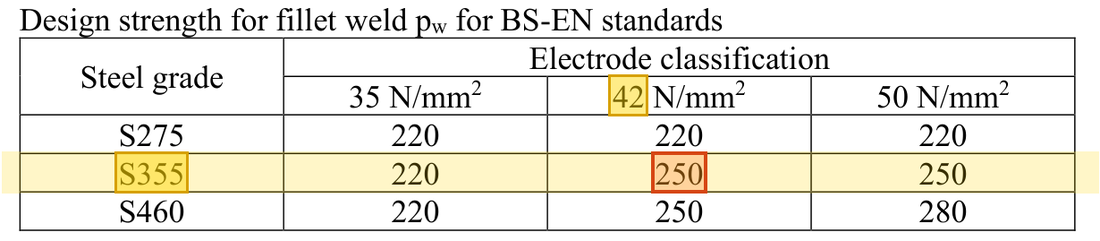
For S355 steel with class 42 electrodes the fillet weld design strength is .Yellow: given parameter, row or columnOrange: value read from the table, boxed orange in the text too - Step 3 · Total effective length
Why this step: This is the least load-carrying length that the four welds must have altogether. With less than this, the weld throat would shear through.
Force divided by force per millimetre leaves mm.
New symbols in this step- , : Applied force; kN
Where the numbers come from: from Step 2.
- Step 4 · Divide among four weld lines
Why this step: The four welds are the same size and sit symmetrically about the pull, so each takes an equal share of the force and the length can be divided equally.
This problem shares equally among four lines. Not every weld group permits equal sharing.
Where the numbers come from: from Step 3.
- Step 5 · Actual length and rounding
Why this step: The short stretches where a weld starts and stops are usually not full size and cannot be counted as carrying load, so the length actually welded must be longer than the calculated need.
Each run loses one leg length at each end, so the actual length must be at least the effective length plus . The figure provides 220 mm per run, which is enough.
Where the numbers come from: from Step 4.
- Step 6 · Recheck effective resistance
Why this step: Working backwards from the length actually provided gives a capacity that can be compared directly with the tension. It confirms the rounded size is enough, with a small margin.
Each run provides 220 mm; after deducting , 208 mm is effective, 832 mm for the four runs.
Where the numbers come from: from Step 2.
- Step 7 · Do not omit detailing
Why this step: Enough weld strength alone does not make the joint sound. A lap that is too short, or welds too far apart, loads the plate unevenly; the return weld stops the weld end from cracking first.
The course also checks lap length, transverse spacing and end returns. A 15 mm return is not the entire main weld length.
- Step 8 · Main-plate tension resistance
Why this step: Even if the welds hold, the plate itself could be pulled apart. This step confirms the full cross-section of the main plate can carry the same tension.
The 150×22 mm main plate has no bolt holes to deduct. Thickness gives .
Units: Width in mm times thickness in mm gives mm²; times in N/mm² gives N. Dividing by 1000 turns N into kN.
- Step 9 · Two cover plates
Why this step: The tension passes through the welds into the cover plates, which could also be pulled apart. Both plates work together, so their capacities are added before comparing with the tension.
Each is 130×12 mm with , giving 553.8 kN per plate. The two sharing in parallel provide 1107.6 kN total.
Units: The area of the two cover plates in mm² times in N/mm² gives N. Dividing by 1000 turns N into kN.
Data file lookup · Data Page 1 · Design strength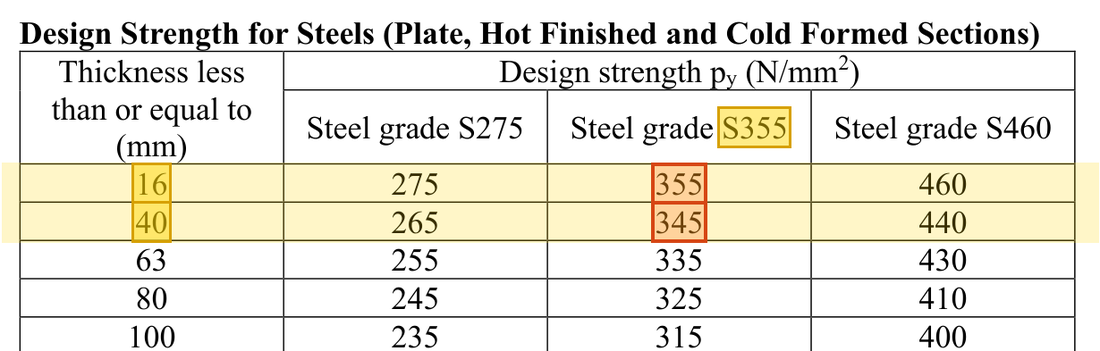
Cover plate 12 mm thick: the row, S355 column gives ; main plate 22 mm thick: the row, S355 column gives . How the grade and thickness choose this row →Yellow: given parameter, row or columnOrange: value read from the table, boxed orange in the text too
220 mm results from converting effective-length demand to a practical actual dimension. 809.5 versus the course's 810 is rounding, not a different problem.
All the symbols of this example
| Symbols | Meaning and Units |
|---|---|
| , | Leg size and effective throat; mm, with in this course |
| , | Weld design strength N/mm²; resistance per millimetre kN/mm |
| , | Actual or effective weld length; mm, as identified by each step |
| , | Applied force; kN |
Video positions: 3 October Recording A 00:15:00 · 3 October Recording B 00:10:00 · 14 November 00:55:00 · 3 October Recording A 00:20:00