M27 plate bearing: calculate all four bounds (Four Bearing Limits)
Task: Identify the geometry and material used by each candidate resistance.
Go straight to Step 1 ↓Design flow for this type of question: Ordinary bolted connection →
The question in short: One M27 bolt bears on a 14 mm plate. The end distance is 70 mm, the clear distance between holes is 50 mm, and the demand is about 166.7 kN per bolt. Work out the four bearing limits of the plate and compare the smallest with the demand.
What differs from the previous example of this type: Unlike the earlier full-joint examples, only the bearing of one plate is checked here, with the four limits taken apart one by one.
| Given | Value and Unit |
|---|---|
| Geometry | , , , ; standard holes |
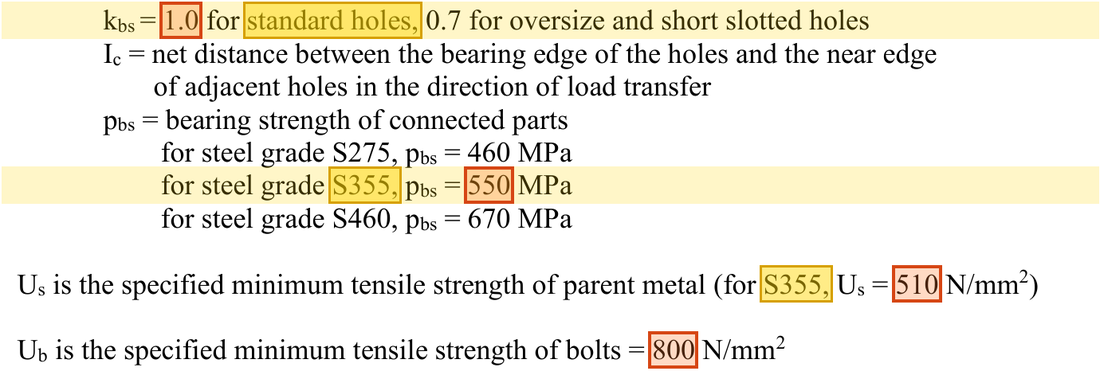
| Material | ; ; |
| Demand | Approximately 166.7 kN per bolt on the lecturer's screen |
Yellow: values given in the question. The same values are marked where they are substituted in the steps below.
Orange box: values read directly from the Data File, the same values boxed orange in the lookup screenshots. A value interpolated between two table rows is a calculation, so it has no box.
Solution Route: Substitute into four expressions separately→compare in consistent units→take the minimum→compare with per-bolt demand.
One bolt presses on the hole wall of the 14 mm plate. The plate can fail in four ways; the smallest of the four capacities is used.
- Force per boltAbout 166.7 kN
- Hole wall crushesDemand 166.7 kNCapacity 207.9 kNUtilisation 0.80 · closest to the limit
- Tear-out at the plate endDemand 166.7 kNCapacity 269.5 kNUtilisation 0.62
- Tearing between holesDemand 166.7 kNCapacity 535.5 kNUtilisation 0.31
- Cap from the bolt strengthDemand 166.7 kNCapacity 604.8 kNUtilisation 0.28
- Step 1 · Hole-wall term
Why this step: The bolt presses on the hole wall over an area of bolt diameter times plate thickness. This term guards against the wall being crushed and the hole stretching.
is the 27 mm bolt diameter; is this 14 mm plate's thickness.
New symbols in this step- , : Hole-type and effective-area factors; dimensionless
Units: and are in mm and is in N/mm², so the product is in N; dividing by 1000 gives kN.
- Step 2 · End-distance term
Why this step: If the hole is too near the plate end, the bolt can push out the short piece of steel behind the hole. A longer end distance gives this term more capacity.
is measured along the force, not transversely to the edge.
Units: and are in mm and is in N/mm², so the product is in N; dividing by 1000 gives kN.
- Step 3 · Clear-distance term
Why this step: This term guards against the bolt tearing through the steel left between two holes. The wider the holes are spaced, the more steel there is and the harder it is to tear.
Use with plate .
New symbols in this step- , , , : Bolt diameter, hole diameter, end distance along force and clear hole spacing; mm
Units: and are in mm and is in N/mm², so the product is in N; dividing by 1000 gives kN.
- Step 4 · Bolt-strength cap
Why this step: However strong the plate is, the bearing force passed to it cannot exceed a ceiling tied to the bolt strength. This term is that ceiling.
The final expression uses , not again.
Units: and are in mm and is in N/mm², so the product is in N; dividing by 1000 gives kN.
- Step 5 · Take the governing value
Why this step: The smallest is the hole-wall term, so crushing of the hole wall would happen first as the force grows. It still exceeds the demand per bolt, so plate bearing is adequate.
All four bounds must be satisfied, so take the minimum.
New symbols in this step- , , , : Shear, bolt bearing, plate bearing and plate tension resistances; kN
Where the numbers come from: from Step 1; from Step 2; from Step 3; from Step 4.
Load path · Four limits on plate bearingThe bolt presses on the hole wall, and the plate can fail in four ways: the hole wall crushes, the bolt tears out through the plate end, the plate tears between two holes, and there is a cap set by the bolt strength. The smallest of the four values is used (red frame).
This calculates bearing for this 14 mm plate only. It is not the full solution to the 7 November 960 kN test or the later 1200 kN past-paper question.
All the symbols of this example
| Symbols | Meaning and Units |
|---|---|
| , , , | Shear, bolt bearing, plate bearing and plate tension resistances; kN |
| , , , | Bolt diameter, hole diameter, end distance along force and clear hole spacing; mm |
| , , , | Corresponding course design strengths; N/mm² |
| , | Plate and bolt ultimate tensile strengths; N/mm² |
| , | Hole-type and effective-area factors; dimensionless |
Video positions: 14 November 01:05:00