Tutorial 3 Q1: what the four section classes mean in bending
Open “Animation lab” beside a teaching step for a visual explanation or a walkthrough of its original expressions. Models are illustrative; source answers remain unchanged.
Need a simpler picture? Open “Simple explanation” beside a difficult step. These optional notes do not replace the full solution.
Describe the bending behaviour of Classes 1,2,3 and 4: plastic, compact, semi-compact and slender.
Original source: LectureNotes/Ch 3_Beam.pdf — p. 35. Values tagged given are in the question or diagram; lookup values come from a named table; calculated values follow from the working; assumptions are stated explicitly.
Read the diagram and collect the data
Given: a bending section is assigned one of four local-buckling classes. Required: describe moment resistance and rotation capacity. No force, length, numerical section or steel grade is given.
Before calculating: recognition and strategy
Think about the order of three events: the first fibre yields, plastic stress spreads through the section, and a thin plate locally buckles. Rotation capacity matters when a plastic hinge must keep turning while still carrying moment.
The four behaviours and their exam consequences
Simple explanation: A thin part can wrinkle first
A thin plate may wrinkle before the whole steel member reaches its intended resistance.
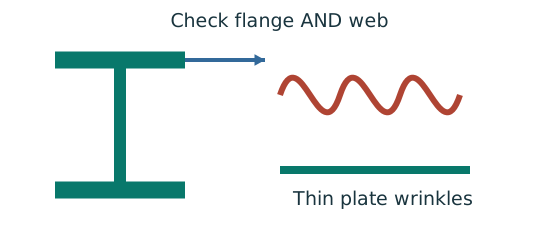
- Check flange and web slenderness using their own definitions.
- Compare each ratio with the correct class limits.
- The less favourable element determines the section class.
Remember: Bending limits and uniform-compression limits are different.
| Class | Behaviour before local buckling | Permitted course bending approach |
|---|---|---|
| 1 — plastic | Develops full plastic resistance and enough plastic rotation for a plastic hinge to redistribute moment. | Plastic resistance, with the course 1.2pᵧZ ceiling; suitable rotation capacity must still be relevant to the analysis. |
| 2 — compact | Develops plastic resistance, but local buckling limits the rotation available afterward. | Same capped plastic section resistance in the elastic-analysis examples; do not claim adequate plastic-hinge rotation. |
| 3 — semi-compact | Extreme compression fibre can reach yield, but local buckling prevents full plastic stress redistribution. | Use elastic resistance pᵧZ for low-shear bending. |
| 4 — slender | Local plate buckling occurs before gross-section elastic yield resistance is reached. | Use effective section properties/local-buckling treatment; neither gross pᵧS nor gross pᵧZ is automatically valid. |
The most slender relevant compression element governs the whole section class. A stocky flange does not rescue a slender web. Classification concerns local plates; an otherwise Class 1 beam can still fail global lateral-torsional buckling.
Here pᵧ is design strength in , elastic modulus and plastic modulus in ; multiplication gives . Divide by for . The two modulus symbols are deliberately different.
Animation labWhy thin elements buckle locally
Supplement to the original lesson. Enable JavaScript to play, step through calculations and rotate 3D models. The following explanation remains readable offline.
- The flange outstand and web have different widths, thicknesses and edge support conditions.
- A thinner plate can wrinkle locally before the complete member loses stability.
- Class 1 allows plastic rotation; Class 2 reaches plastic resistance; Class 3 reaches elastic resistance; Class 4 requires effective properties.
- Check every relevant compression element with the supplied limits and stress distribution. The deformation shown is qualitative.
Compact exam answer
Class 1 reaches plastic resistance with adequate plastic rotation; Class 2 reaches plastic resistance with limited rotation; Class 3 reaches elastic first-yield resistance but not full plastic resistance; Class 4 buckles locally before gross elastic resistance and needs effective properties.
Mistakes to avoid
- Do not describe Class 2 as elastic-only.
- Do not equate section class with lateral restraint.
- Do not say Class 4 has zero strength.
Procedure for an unfamiliar variant
- Identify the compression plate elements.
- Compare relevant width/thickness ratios with the correct stress-pattern limits.
- Take the governing class.
- State its moment and rotation consequences separately.
Independent self-check
Try it yourself. Invented variant: a beam is Class 1 but its compression flange is unrestrained over . Can you omit LTB?
Reveal answer and reasoning
No. Class 1 prevents premature local plate buckling for the assumed stress pattern. It does not prevent the whole beam twisting and moving sideways. LTB is a separate member check.