Tutorial 2 Q2: welded splice strength and minimum-leg correction
Open “Animation lab” beside a teaching step for a visual explanation or a walkthrough of its original expressions. Models are illustrative; source answers remain unchanged.
Need a simpler picture? Open “Simple explanation” beside a difficult step. These optional notes do not replace the full solution.
Check the ultimate tension splice in FigureQ2. Steel is S355, electrode Class 42, and the drawing specifies fillet welds, cover plates and main plates.
Original source: LectureNotes/Ch 2_Connection.pdf — p. 45, p. 46. Values tagged given are in the question or diagram; lookup values come from a named table; calculated values follow from the working; assumptions are stated explicitly.
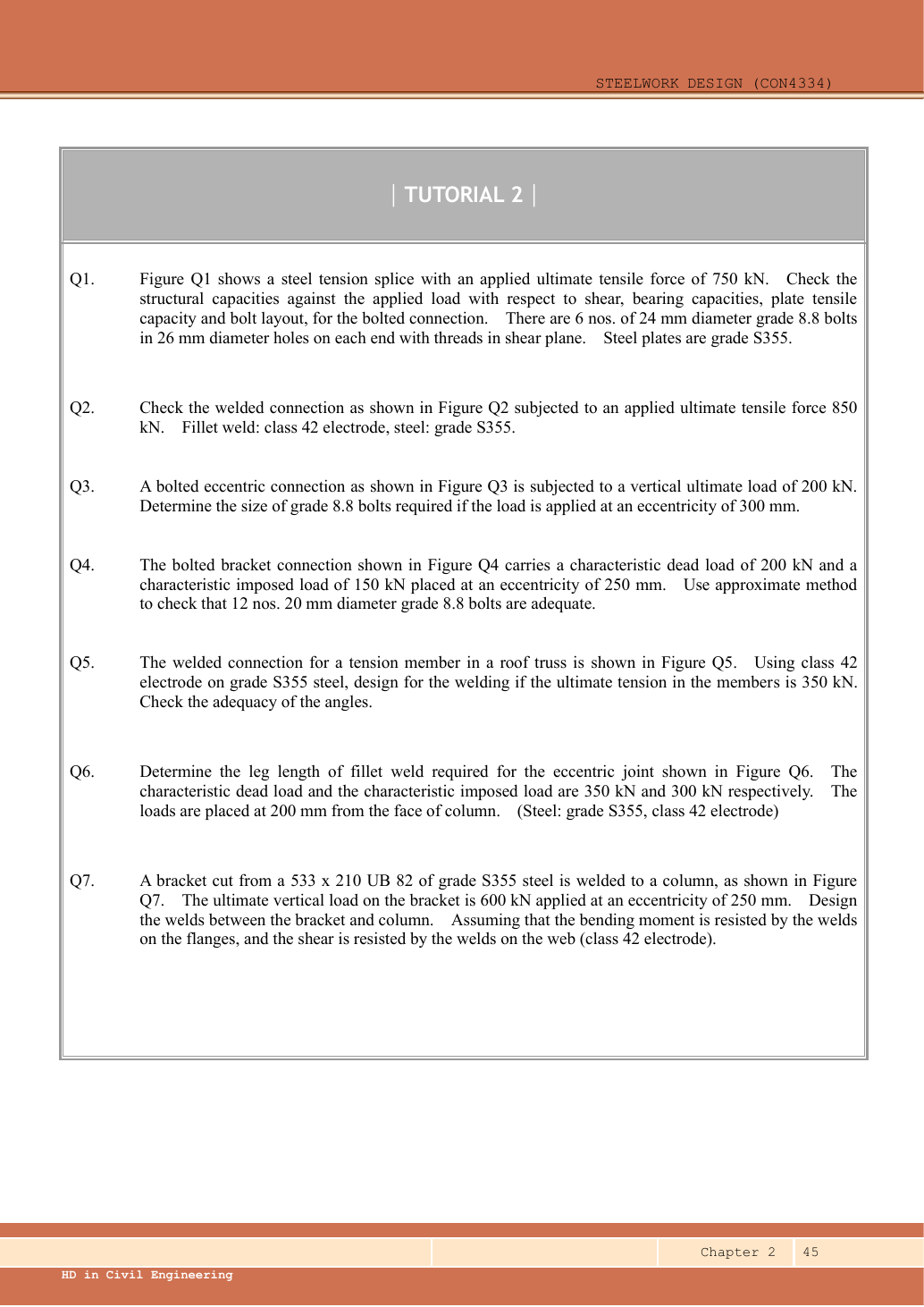
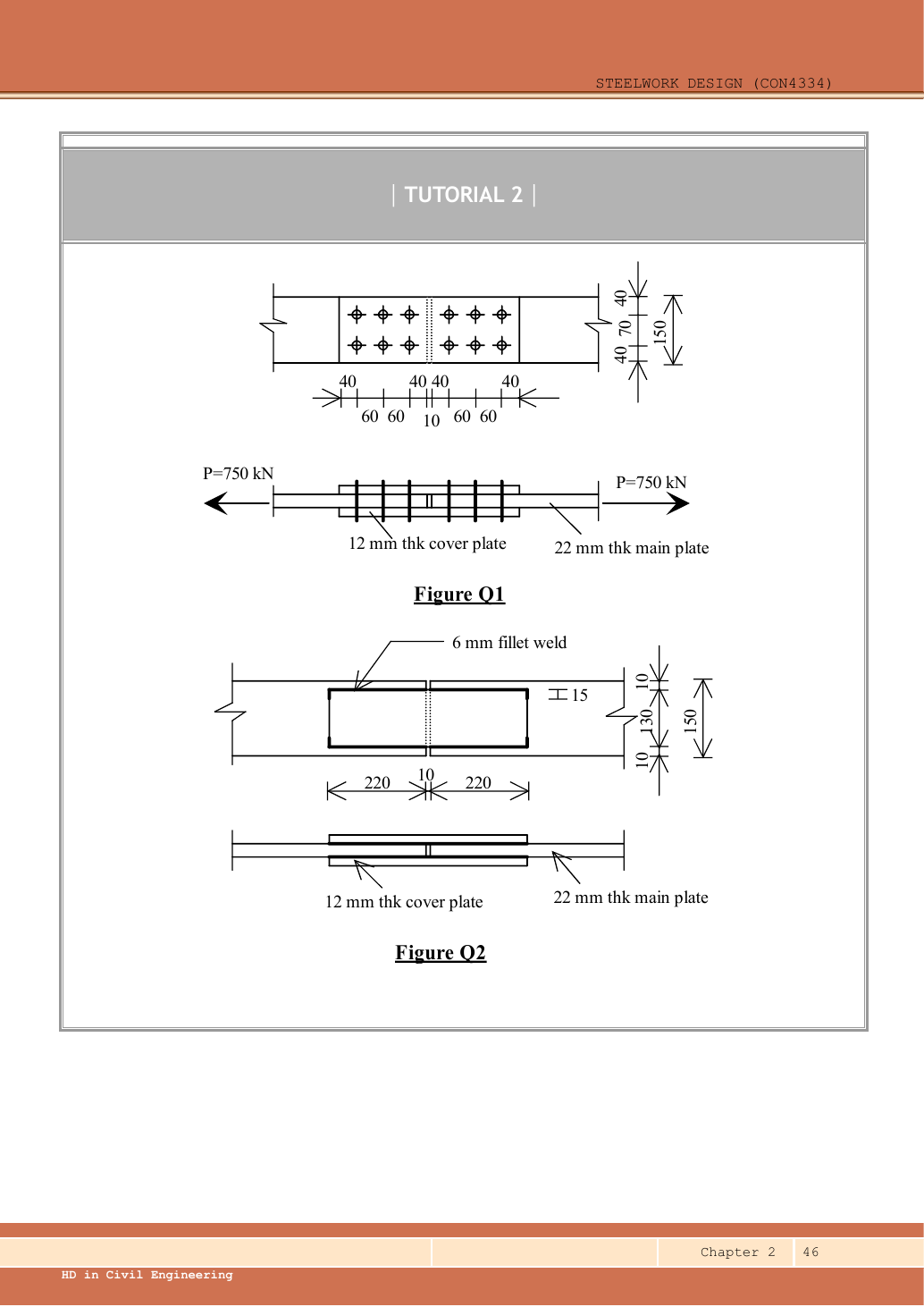
Read the diagram and collect the data
| Input | How it is used |
|---|---|
| Parallel runs | Each cover has two longitudinal side welds on each half; with two covers there are four load-transfer runs per half. |
| Length | Each run has physical length . Do not use as one effective run. |
| Material | The original website summary writes weld strength as , while the calculation below uses . This explanation follows the calculation notation. S355/Class 42 weld strength . Main-plate thickness , giving ; cover-plate thickness , giving . |
| Detailing | Thicker joined part selects minimum from Ch 2 Table 9.1. Cover edge permits at most by . |
Before calculating: recognition and strategy
The two splice halves each transfer . Sum the four parallel longitudinal runs within one half. Start/end deductions apply to each run. Check the main and cover plate tensile capacities, then examine weld-size and return detailing independently. Short corner returns are not needed as extra strength in this conservative longitudinal-run model.
1. Calculate the drawn weld resistance
Simple explanation: Why the weld throat is smaller than its leg
The shortest cut through the weld is thinner than the outside leg.
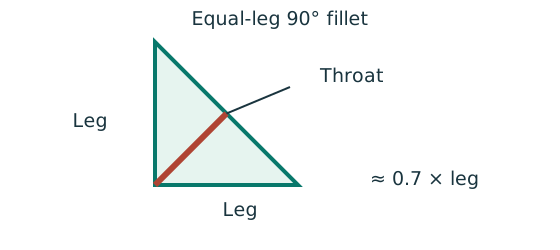
- For the stated equal-leg 90° fillet, throat is approximately 0.7 × leg.
- Multiply throat area by the matching weld design strength.
- For force per length, use a one-millimetre weld strip.
Remember: Choose strength from both the steel grade and electrode class.
Adding both left and right halves would double-count resistance in series.
Animation labFrom fillet leg to effective throat
Supplement to the original lesson. Enable JavaScript to play, step through calculations and rotate 3D models. The following explanation remains readable offline.
- An equal-leg fillet between perpendicular plates has an approximately right-triangular section.
- For this geometry, throat . It is shorter than the leg.
- Effective resisting area = . With here, capacity per length is .
- Use the course end allowances, minimum size and length rules; increasing the geometric length alone does not resolve every detailing check.
2. Plate tensile capacities
Use for each cover, not . The width is fixed by the dimension chain.
Animation labTension through an unperforated plate
Supplement to the original lesson. Enable JavaScript to play, step through calculations and rotate 3D models. The following explanation remains readable offline.
- For this concentric, unperforated plate, the full width and thickness form the resisting section. There are no bolt holes to deduct.
- The illustrative width is 100 mm. Adjust thickness t: , in .
- Using illustrative , in kN. Use the actual material and thickness band for the original question.
- The covers are moved apart for visibility. A symmetric pair each carries half the force. Check the main plate, each cover and the welds separately.
3. Check the drawn detail and make a labelled correction
Simple explanation: Drawn length and useful length differ
The start and end of a weld are not credited as fully effective in this course model.
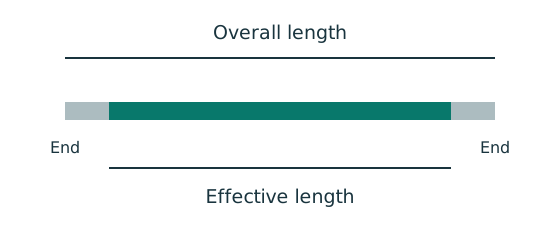
- Find the effective length required by strength.
- Add the specified end allowance to each separate run.
- Round up, then check minimum size, spacing and returns.
Remember: Strength alone does not prove a weld detail is acceptable.
Thus the given detail has enough calculated strength but fails the course minimum fillet size. A supported correction is leg with the same longitudinal runs, plus enlarged returns of at least ; choose returns as a design choice.
The corrected joint’s requested strength checks pass; cover tension is now the lowest resistance. The image remains the original / detail so the change is auditable.
Animation labFrom fillet leg to effective throat
Supplement to the original lesson. Enable JavaScript to play, step through calculations and rotate 3D models. The following explanation remains readable offline.
- An equal-leg fillet between perpendicular plates has an approximately right-triangular section.
- For this geometry, throat . It is shorter than the leg.
- Effective resisting area = . With here, capacity per length is .
- Use the course end allowances, minimum size and length rules; increasing the geometric length alone does not resolve every detailing check.
Compact exam answer
Given weld: four effective runs per half, capacity 873.6 kN>850. Main/cover pair tension / pass. However thicker part requires minimum fillet, so the drawn detail fails that condition. Proposed correction: fillet, runs, returns; weld capacity , acceptable size range and plate capacities unchanged.
Mistakes to avoid
- Deduct on each run.
- Do not count corner returns as extra needed resistance without a consistent model.
- Check minimum size even when strength passes.
- After increasing weld size, update effective lengths and returns.
Procedure for an unfamiliar variant
- Identify the force path and whether the joint is concentric, in-plane eccentric or out-of-plane eccentric.
- Read all dimensions from the relevant view; do not measure drawing scale.
- Distinguish characteristic from ultimate loads and factor only when needed.
- Calculate demand per fastener/weld with the appropriate equilibrium model.
- Check all requested resistances and detailing conditions separately.
- State whether the given detail passes, fails, or remains conditional on missing data.
Independent self-check
Try it yourself. Invented variant: keep the corrected weld but shorten each physical run to . Does weld strength pass ?
Reveal answer and reasoning
Effective length: Resistance: Fails. Required actual length: Adopt or greater, then recheck all detailing requirements.
Animation labFrom fillet leg to effective throat
Supplement to the original lesson. Enable JavaScript to play, step through calculations and rotate 3D models. The following explanation remains readable offline.
- An equal-leg fillet between perpendicular plates has an approximately right-triangular section.
- For this geometry, throat . It is shorter than the leg.
- Effective resisting area = . With here, capacity per length is .
- Use the course end allowances, minimum size and length rules; increasing the geometric length alone does not resolve every detailing check.