Steelwork · Exam learning

2022–2024 · Exam-focused route

2022 BQ1(b) — eccentric rectangular weld Section B · choose 2 of 3

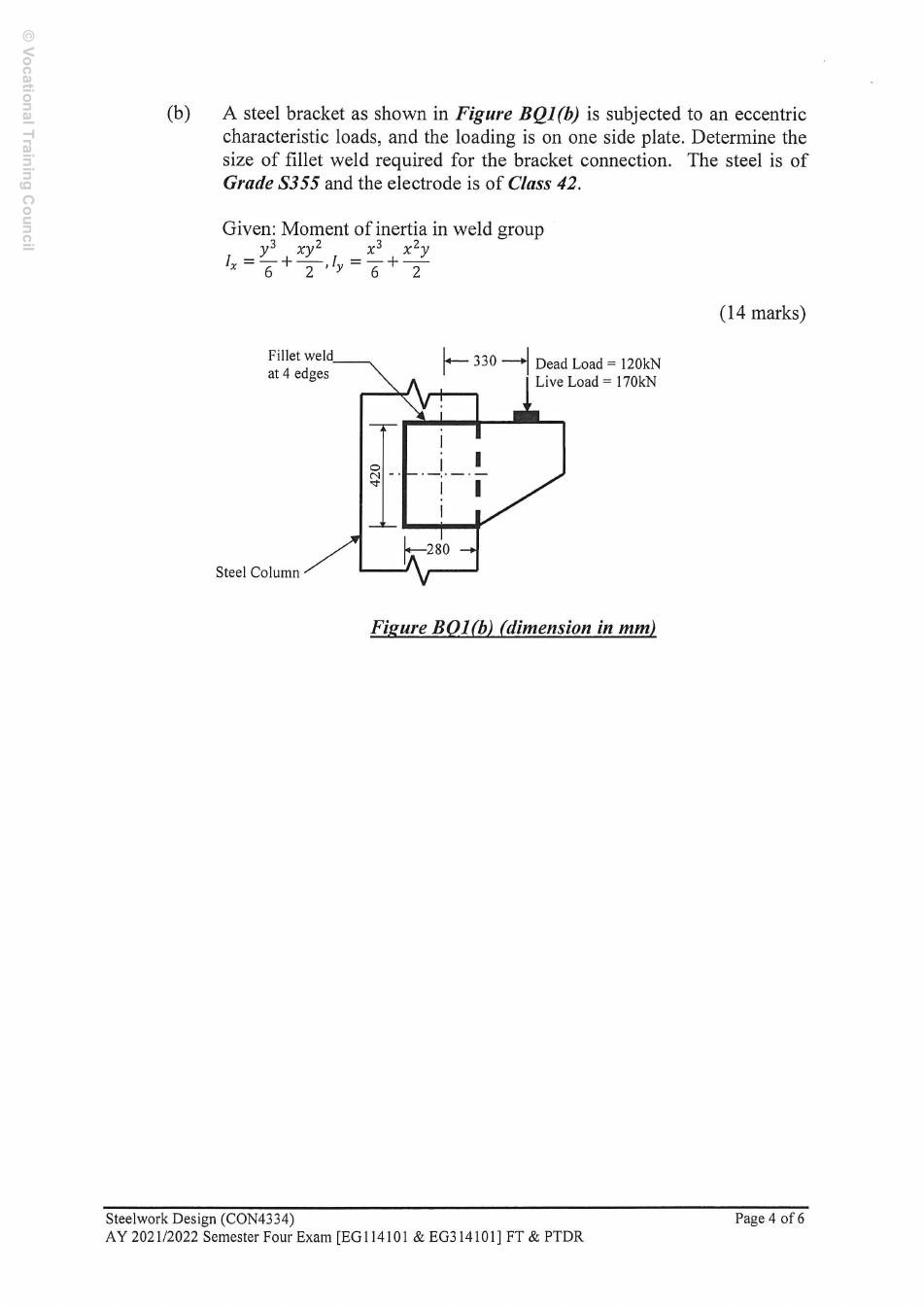
Choose a suitable fillet-weld size for the bracket, allowing for direct shear and for the twisting caused by the off-centre load.

Original source: 21ENGTY031.pdf · physical page 4

Note: marks are as printed in the paper; the working is a teaching guide, not an official marking scheme.

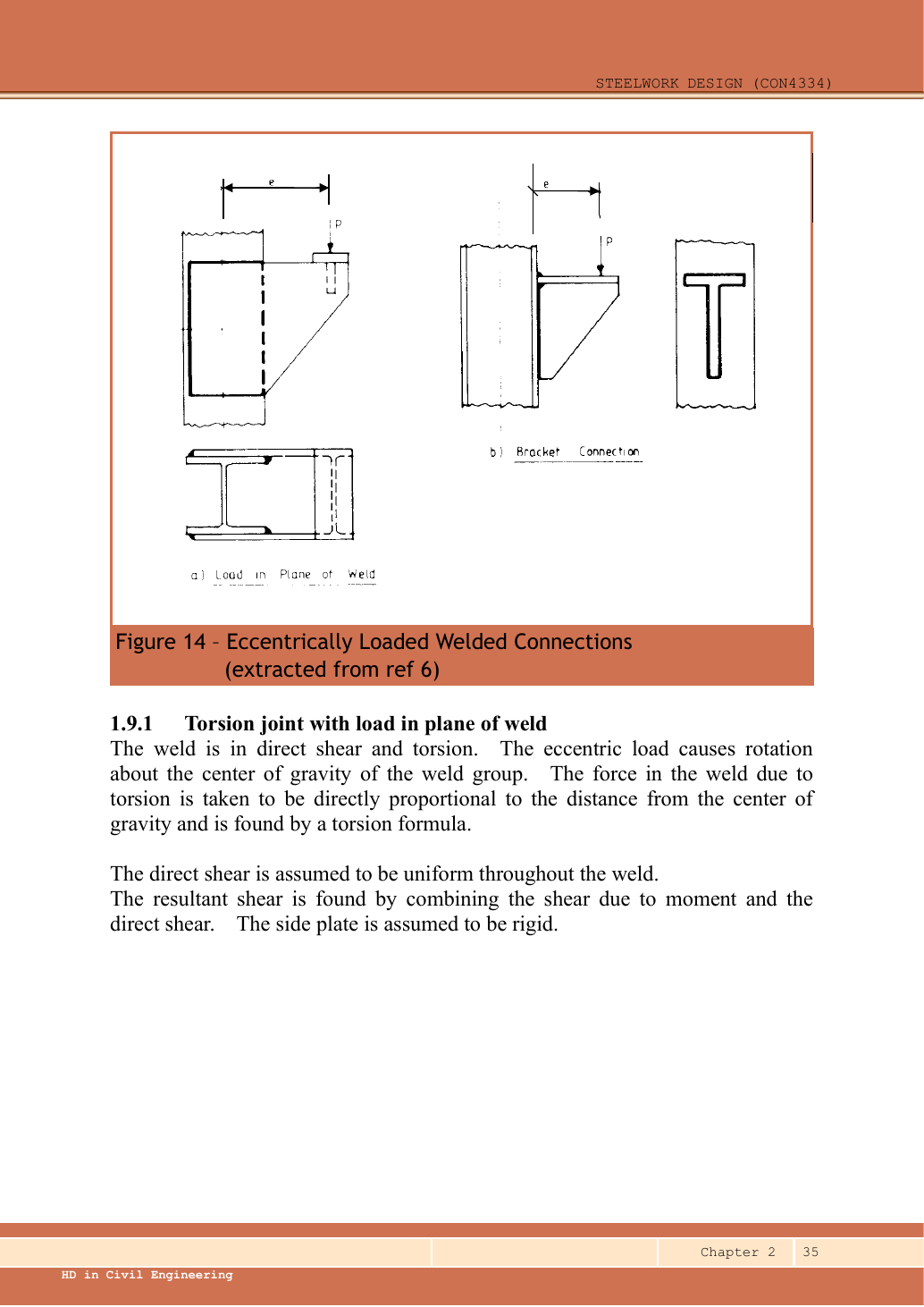
In-plane eccentricity: direct shear plus torsion

Given dead load 120 kN, imposed load 170 kN, S355 and Class 42 electrodes. The four-sided weld rectangle is 280 mm wide and 420 mm high. The 330 mm dimension runs from its dashed centreline to the load line; do not add another half-width. Treat the four sides as a continuous closed weld centreline, with one bracket plate.

Simple explanation — open only if needed

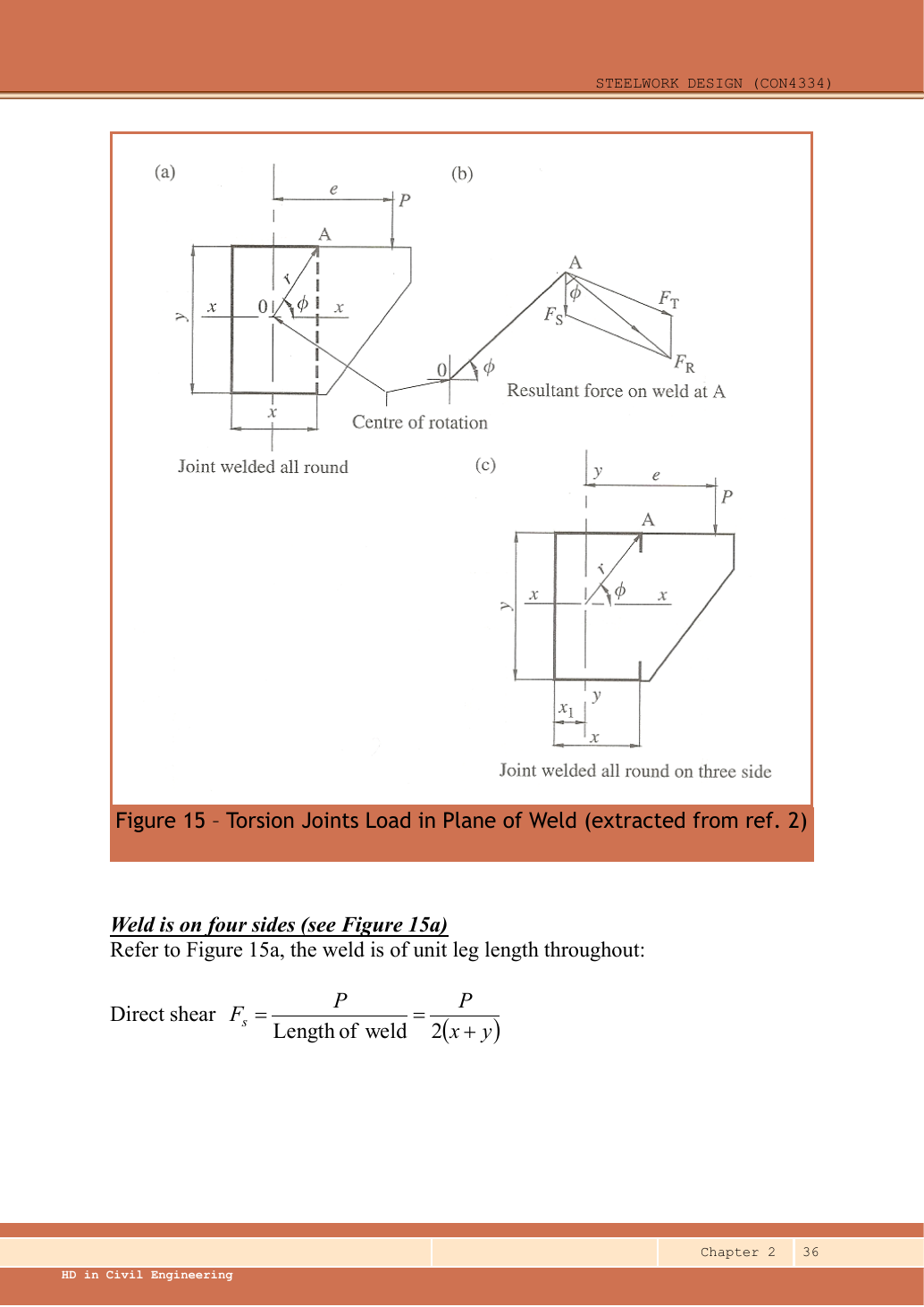
The load makes the weld group slide down and rotate. At the critical corner, the rotation’s vertical part helps the downward sliding. Add those vertical parts, then combine with the horizontal part using a right-angled triangle.

BQ1(b) — design the fillet weld [14 marks]

Source: LectureNotes/Ch2_Connection.pdf · p.31, p.35, p.36, p.37

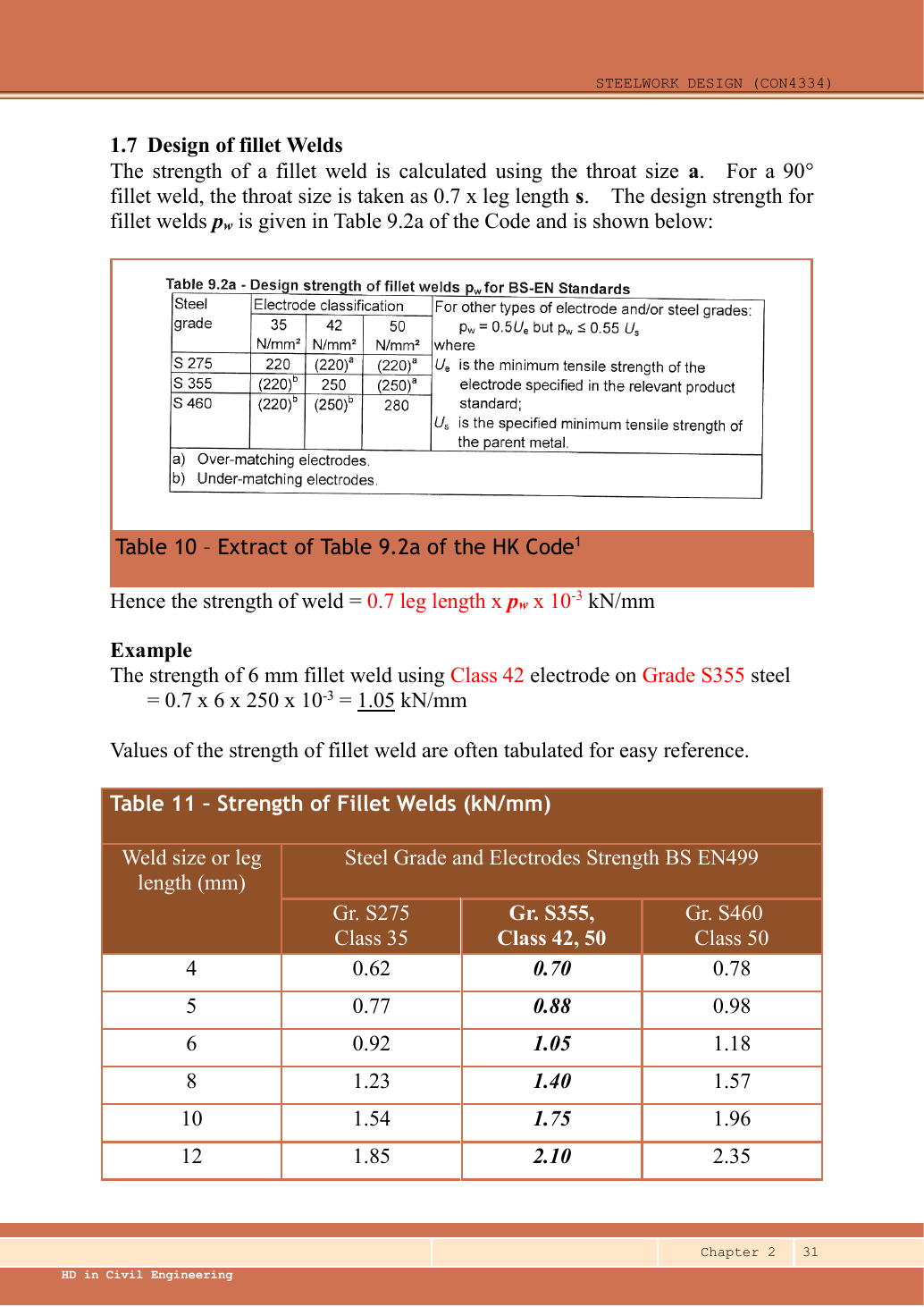
The Class 42/S355 row gives weld design strength 250 N/mm². A fillet of leg size s has effective throat 0.7s. Work with force per unit weld length, q, in kN/mm; line second moments have units mm³, not mm⁴.

P=1.4(120)+1.6(170)=440 kN,M=Pe=440(330)=145200 kN mmP=1.4(120)+1.6(170)=440\,\mathrm{kN},\quad M=Pe=440(330)=145200\,\mathrm{kN\,mm}
Lw=2(B+H)=2(280+420)=1400 mmL_w=2(B+H)=2(280+420)=1400\,\mathrm{mm}
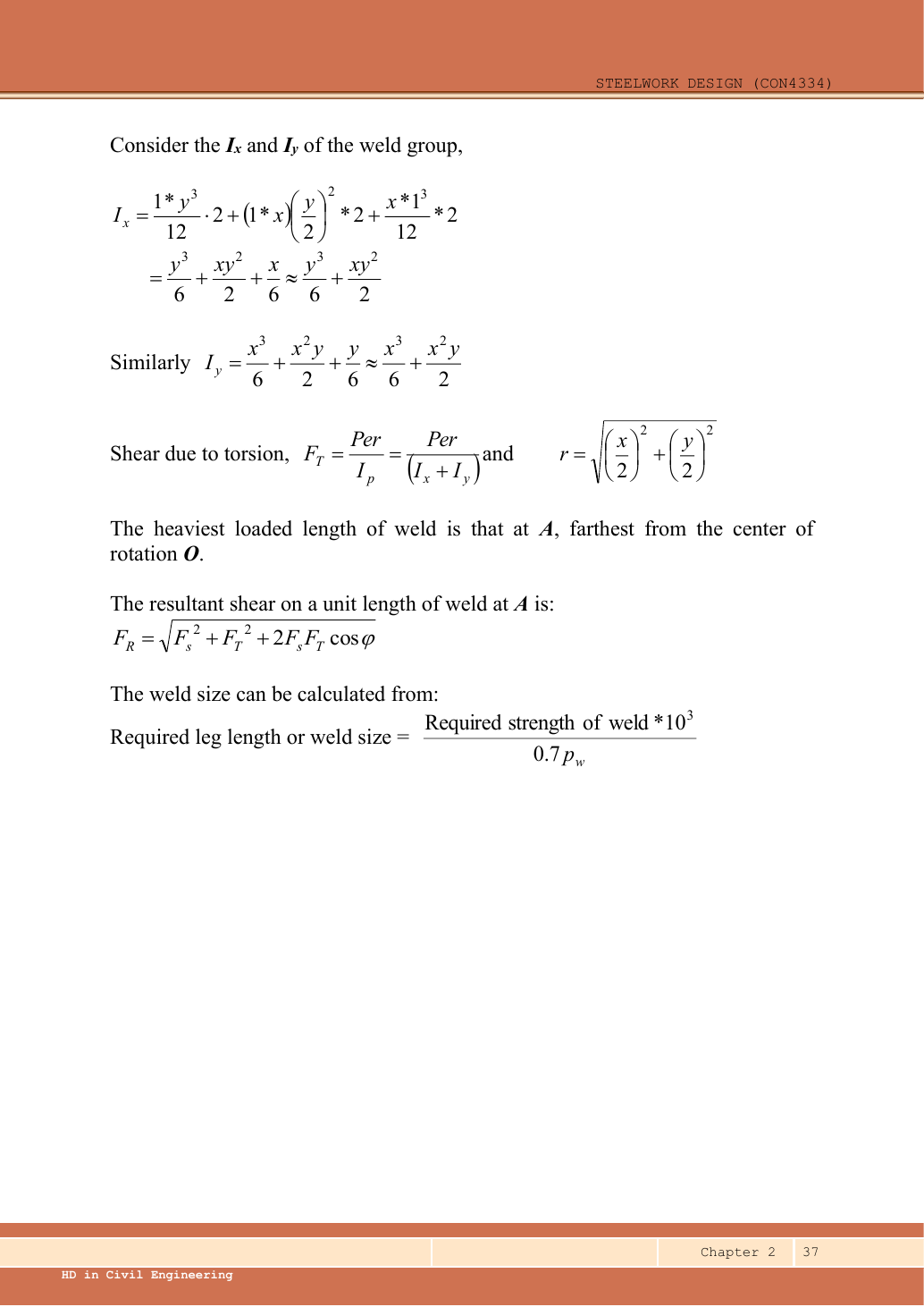
Ix=H3/6+BH2/2=4203/6+280(4202)/2=37044000 mm3I_x=H^3/6+BH^2/2=420^3/6+280(420^2)/2=37044000\,\mathrm{mm^3}
Iy=B3/6+B2H/2=2803/6+2802(420)/2=20122666.667 mm3I_y=B^3/6+B^2H/2=280^3/6+280^2(420)/2=20122666.667\,\mathrm{mm^3}
J=Ix+Iy=57166666.667 mm3,xc=B/2=140 mm,yc=H/2=210 mmJ=I_x+I_y=57166666.667\,\mathrm{mm^3},\quad x_c=B/2=140\,\mathrm{mm},\quad y_c=H/2=210\,\mathrm{mm}

Take a corner on the side where torsional vertical shear adds to direct vertical shear. The opposite side has subtraction and is less severe. Signs choose the corner; the resistance check uses the resultant magnitude.

qd=P/Lw=440/1400=0.314286 kN/mmq_d=P/L_w=440/1400=0.314286\,\mathrm{kN/mm}
qtv=Mxc/J=145200(140)/57166666.667=0.355592 kN/mmq_{tv}=Mx_c/J=145200(140)/57166666.667=0.355592\,\mathrm{kN/mm}
qth=Myc/J=145200(210)/57166666.667=0.533388 kN/mmq_{th}=My_c/J=145200(210)/57166666.667=0.533388\,\mathrm{kN/mm}
qmax=(qd+qtv)2+qth2=(0.314286+0.355592)2+0.5333882=0.856293 kN/mmq_{max}=\sqrt{(q_d+q_{tv})^2+q_{th}^2}=\sqrt{(0.314286+0.355592)^2+0.533388^2}=0.856293\,\mathrm{kN/mm}

Rearrange the throat-resistance condition to find a minimum leg size; round the provided size upward. Here a 6 mm fillet is selected.

0.7spw/1000≥qmax⟹s≥1000qmax0.7pw0.7s p_w/1000\ge q_{max}\quad\Longrightarrow\quad s\ge\frac{1000q_{max}}{0.7p_w}
sreq=1000(0.856293)0.7(250)=4.893105 mm⟹s=6 mms_{req}=\frac{1000(0.856293)}{0.7(250)}=4.893105\,\mathrm{mm}\quad\Longrightarrow\quad s=6\,\mathrm{mm}
qRd=0.7(6)(250)/1000=1.05 kN/mm>0.856294 kN/mmq_{Rd}=0.7(6)(250)/1000=1.05\,\mathrm{kN/mm}>0.856294\,\mathrm{kN/mm}

Compact exam script

Reveal the exam script
P=440 kN,J=57.166667×106 mm3,qmax=0.856294 kN/mm,sreq=4.893105 mmP=440\,\mathrm{kN},\quad J=57.166667\times10^6\,\mathrm{mm^3},\quad q_{max}=0.856294\,\mathrm{kN/mm},\quad s_{req}=4.893105\,\mathrm{mm}

Provide a 6 mm continuous fillet on the four sides under the stated centreline model. Strength passes; parent/support thickness and detailing remain conditional.

Common mistakes

  • Do not add the magnitudes of perpendicular force components directly.
  • Do not add half the width to the given centroid eccentricity.

Procedure for a new variant

  1. Locate centroid, load line and critical corner.
  2. Calculate line length, polar line moment, direct shear and torsional components.
  3. Resolve vectors, size the throat, round up and check detailing.

Independent self-check — invented variant

Invented variant: eccentricity becomes zero. Find the strength-only minimum leg size.

Hint

Set the torsional moment to zero.

Answer and reasoning
sreq=1000(440/1400)0.7(250)=1.795918 mms_{req}=\frac{1000(440/1400)}{0.7(250)}=1.795918\,\mathrm{mm}

Only direct shear remains. Do not specify a 1.80 mm weld without checking the independent minimum size/detailing requirements.