Connection example 7: calculate a rectangular weld group from first principles
Open “Animation lab” beside a teaching step for a visual explanation or a walkthrough of its original expressions. Models are illustrative; source answers remain unchanged.
← Read this lecture example beside its chapter concepts
Need a simpler picture? Open “Simple explanation” beside a difficult step. These optional notes do not replace the full solution.
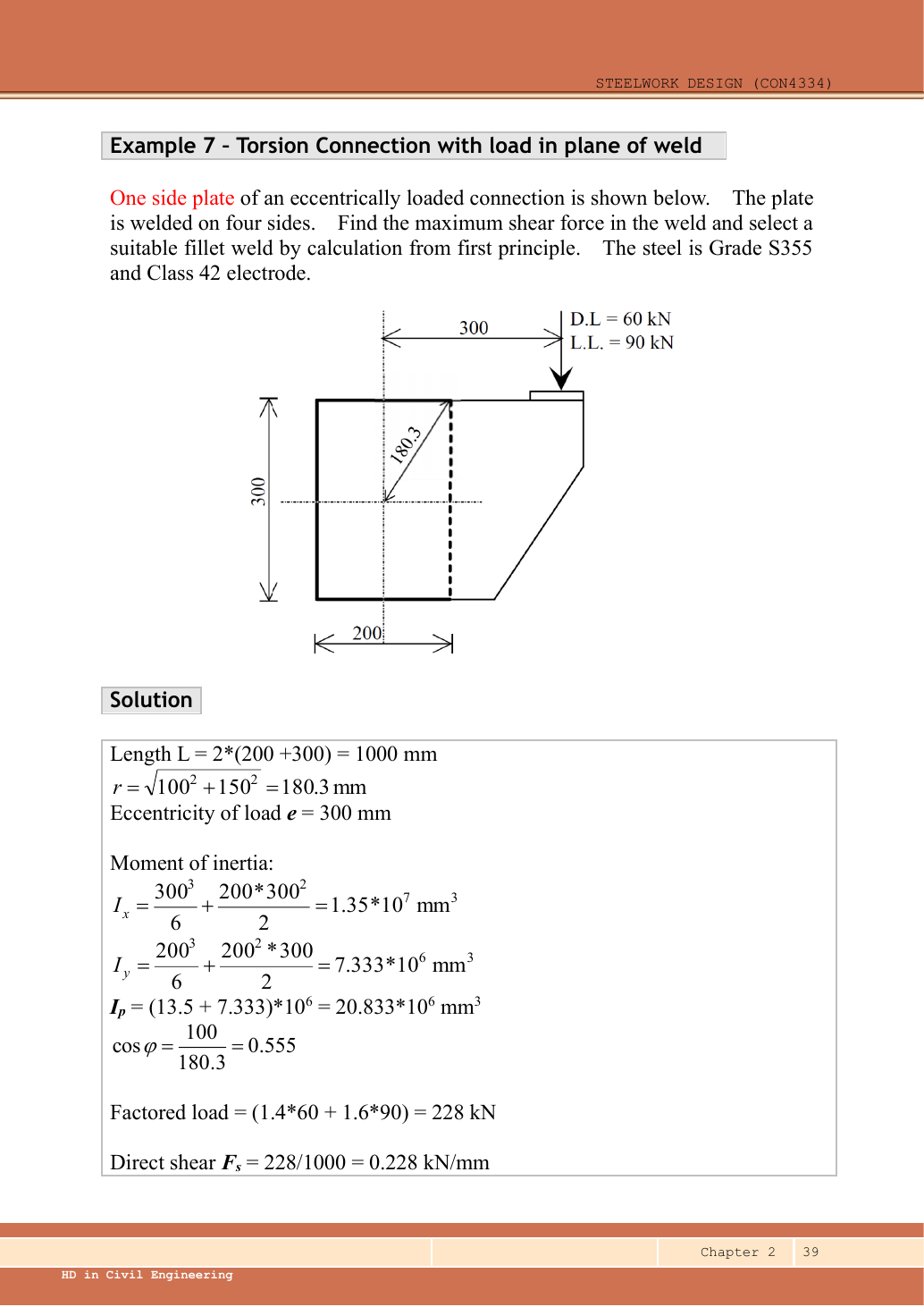
Find the maximum force per unit weld length and select a fillet weld for one side plate carrying dead plus imposed load. The weld is on all four sides of a rectangle; the force eccentricity from its centre is . Steel is S355 with Class 42 electrode.
Original source: LectureNotes/Ch 2_Connection.pdf — p. 39, p. 40. Values tagged given are in the question or diagram; lookup values come from a named table; calculated values follow from the working; assumptions are stated explicitly.
Read the diagram and collect the data
| Input | Origin |
|---|---|
| Given geometry | ,; four weld sides. Centre is at half width/height: , at a corner. |
| Given load arm | from group centroid, not from the right edge. |
| Given materials | S355/Class 42 → lookup , Table 9.2a. |
| Assumption | Uniform fillet size, rigid plate and line-weld elastic distribution, as in Ch 2 pp.35–37. |
Before calculating: recognition and strategy
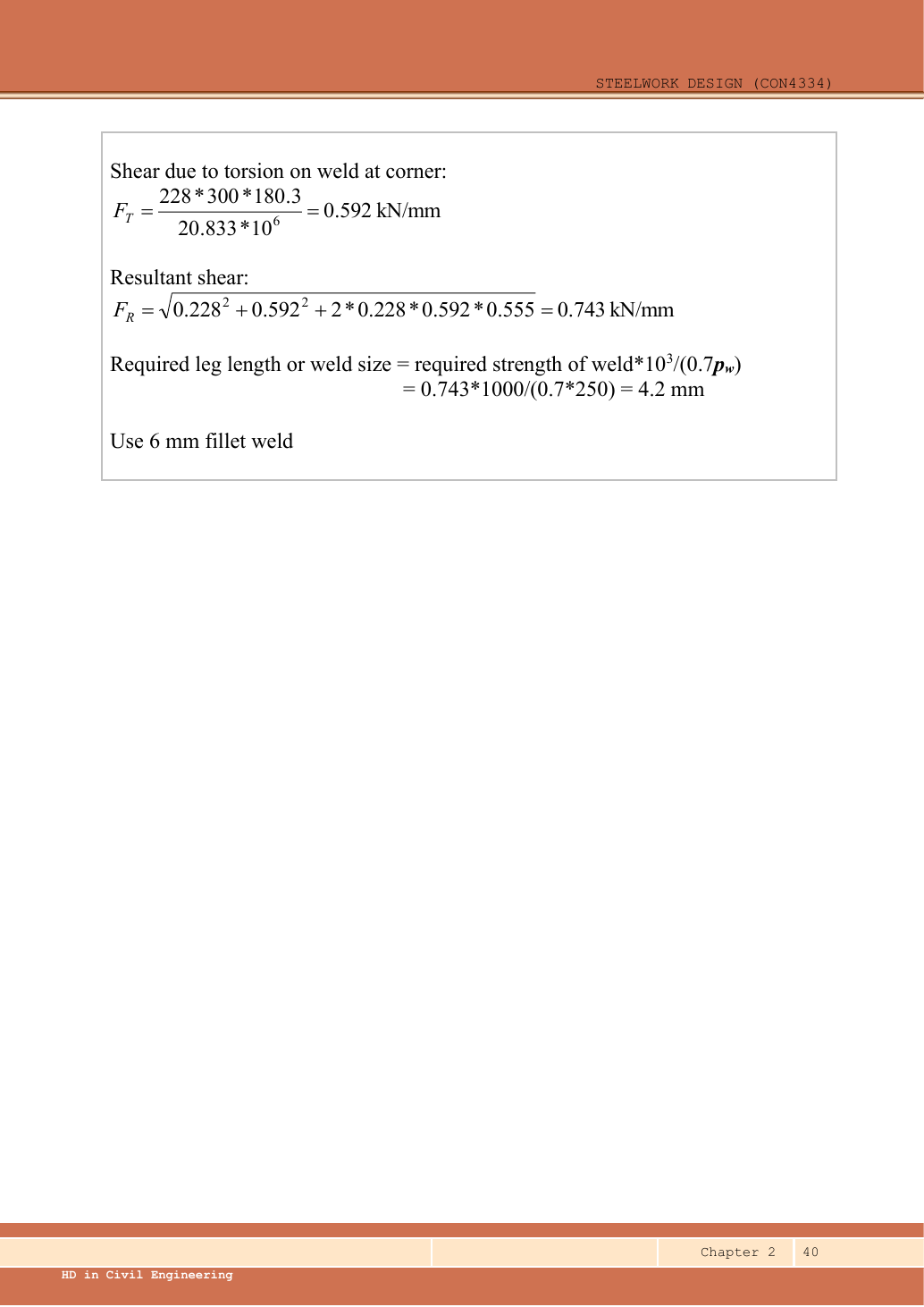
Separate direct shear from torsional force caused by . Use the weld lines for centroid and inertia; the plate interior does not carry weld force. Derive line inertias with the parallel-axis rule. Then combine the horizontal and vertical force-per-length components at the right-hand corner, where vertical components add.
1. Geometry and factored force
Animation labA weld group is a set of lines
Supplement to the original lesson. Enable JavaScript to play, step through calculations and rotate 3D models. The following explanation remains readable offline.
- The centre is empty: resistance comes from the weld lines, not a solid plate filling the group.
- Use line lengths for centroid weighting. Line second moments have units ; add the parallel-axis terms.
- Direct force per length is . The eccentric moment adds tangential flow proportional to distance from the centroid.
- Combine signed components at every candidate corner, then compare the maximum with throat resistance per length.
2. Derive both line second moments
Simple explanation: Only the weld lines resist as weld
Imagine a wire rectangle: its empty middle is not more wire.
- Count only the weld runs actually shown.
- Use their total length and line second moments.
- Combine direct and torsional forces at the critical location.
Remember: Line second moments have units ; plate-area moments use .
About the horizontal centroidal axis: two vertical welds each contribute ; two horizontal welds each contribute . About the vertical axis reverse the roles.
Why is the unit ? Weld-line length () multiplied by distance squared () gives that unit. Do not substitute the second moment of area of a solid rectangular plate, , whose unit is .
Animation labA weld group is a set of lines
Supplement to the original lesson. Enable JavaScript to play, step through calculations and rotate 3D models. The following explanation remains readable offline.
- The centre is empty: resistance comes from the weld lines, not a solid plate filling the group.
- Use line lengths for centroid weighting. Line second moments have units ; add the parallel-axis terms.
- Direct force per length is . The eccentric moment adds tangential flow proportional to distance from the centroid.
- Combine signed components at every candidate corner, then compare the maximum with throat resistance per length.
3. Uniform direct shear per length
Animation labA weld group is a set of lines
Supplement to the original lesson. Enable JavaScript to play, step through calculations and rotate 3D models. The following explanation remains readable offline.
- The centre is empty: resistance comes from the weld lines, not a solid plate filling the group.
- Use line lengths for centroid weighting. Line second moments have units ; add the parallel-axis terms.
- Direct force per length is . The eccentric moment adds tangential flow proportional to distance from the centroid.
- Combine signed components at every candidate corner, then compare the maximum with throat resistance per length.
4. Torsional components at the critical corner
The source uses for the angle between the vertical direct shear and the tangential torsion force. The corner radius itself is not the force direction.
Animation labA weld group is a set of lines
Supplement to the original lesson. Enable JavaScript to play, step through calculations and rotate 3D models. The following explanation remains readable offline.
- The centre is empty: resistance comes from the weld lines, not a solid plate filling the group.
- Use line lengths for centroid weighting. Line second moments have units ; add the parallel-axis terms.
- Direct force per length is . The eccentric moment adds tangential flow proportional to distance from the centroid.
- Combine signed components at every candidate corner, then compare the maximum with throat resistance per length.
5. Add components and calculate the maximum
Simple explanation: Add arrows before taking the magnitude
Walking east and walking north do not point in the same direction.
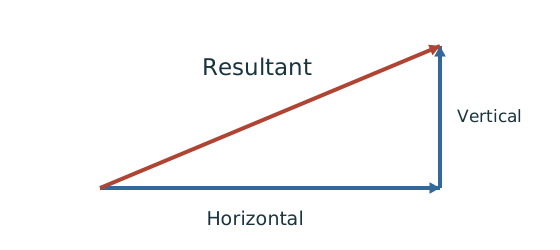
- Choose signed horizontal and vertical directions.
- Add contributions along each direction separately.
- For perpendicular components, use the right-triangle resultant.
Remember: Check the corner where direct and torsional components reinforce each other.
The opposite column of weld has vertical components subtracting, hence a smaller resultant. The upper and lower right corners have the same maximum magnitude.
Animation labA weld group is a set of lines
Supplement to the original lesson. Enable JavaScript to play, step through calculations and rotate 3D models. The following explanation remains readable offline.
- The centre is empty: resistance comes from the weld lines, not a solid plate filling the group.
- Use line lengths for centroid weighting. Line second moments have units ; add the parallel-axis terms.
- Direct force per length is . The eccentric moment adds tangential flow proportional to distance from the centroid.
- Combine signed components at every candidate corner, then compare the maximum with throat resistance per length.
6. Size the fillet and check its resistance
Simple explanation: Why the weld throat is smaller than its leg
The shortest cut through the weld is thinner than the outside leg.
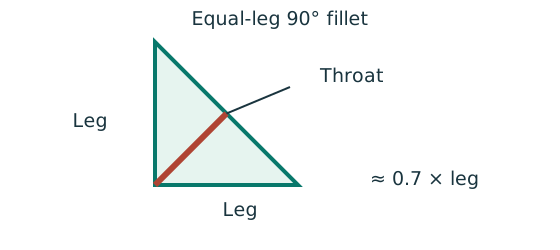
- For the stated equal-leg 90° fillet, throat is approximately 0.7 × leg.
- Multiply throat area by the matching weld design strength.
- For force per length, use a one-millimetre weld strip.
Remember: Choose strength from both the steel grade and electrode class.
The closed four-side weld is treated as the full line rectangle by the source method. This differs from separately terminated side welds with start/end deductions. The plate thickness is absent, so the numerical strength result is complete but minimum/maximum permitted leg size cannot be confirmed from Table 9.1/edge-thickness rules. The choice is the lecturer’s selection, conditional on those missing detailing inputs.
Animation labFrom fillet leg to effective throat
Supplement to the original lesson. Enable JavaScript to play, step through calculations and rotate 3D models. The following explanation remains readable offline.
- An equal-leg fillet between perpendicular plates has an approximately right-triangular section.
- For this geometry, throat . It is shorter than the leg.
- Effective resisting area = . With here, capacity per length is .
- Use the course end allowances, minimum size and length rules; increasing the geometric length alone does not resolve every detailing check.
Compact exam answer
,,,. ; torsion components vertical and 0.49248 horizontal kN/mm. . ; fillet supplies and passes weld strength. Plate-thickness detailing remains unverified because it is not given.
Mistakes to avoid
- The two dimensions mean different things: height and eccentricity.
- Use line inertia in , not solid-plate inertia in .
- The dashed right edge still belongs to the stated four-side weld.
- Do not certify minimum/maximum weld size without the plate thickness.
Procedure for an unfamiliar variant
- Identify every actual weld line and its load path.
- Find centroid, length and line inertias.
- Measure load eccentricity from the centroid.
- Calculate direct and torsional components and the critical resultant.
- Solve for leg size and check detailing separately.
Independent self-check
Try it yourself. Keep the same load and rectangle but move the load line through the weld centroid. Find required strength and leg by strength alone.
Reveal answer and reasoning
so torsion vanishes. . by strength alone. The actual selected leg is still controlled by minimum/detailing rules; a design cannot be adopted just from this strength result.
Animation labA weld group is a set of lines
Supplement to the original lesson. Enable JavaScript to play, step through calculations and rotate 3D models. The following explanation remains readable offline.
- The centre is empty: resistance comes from the weld lines, not a solid plate filling the group.
- Use line lengths for centroid weighting. Line second moments have units ; add the parallel-axis terms.
- Direct force per length is . The eccentric moment adds tangential flow proportional to distance from the centroid.
- Combine signed components at every candidate corner, then compare the maximum with throat resistance per length.