2023 past paper: complete solution navigator
← Worked Examples: answers by chapter or year
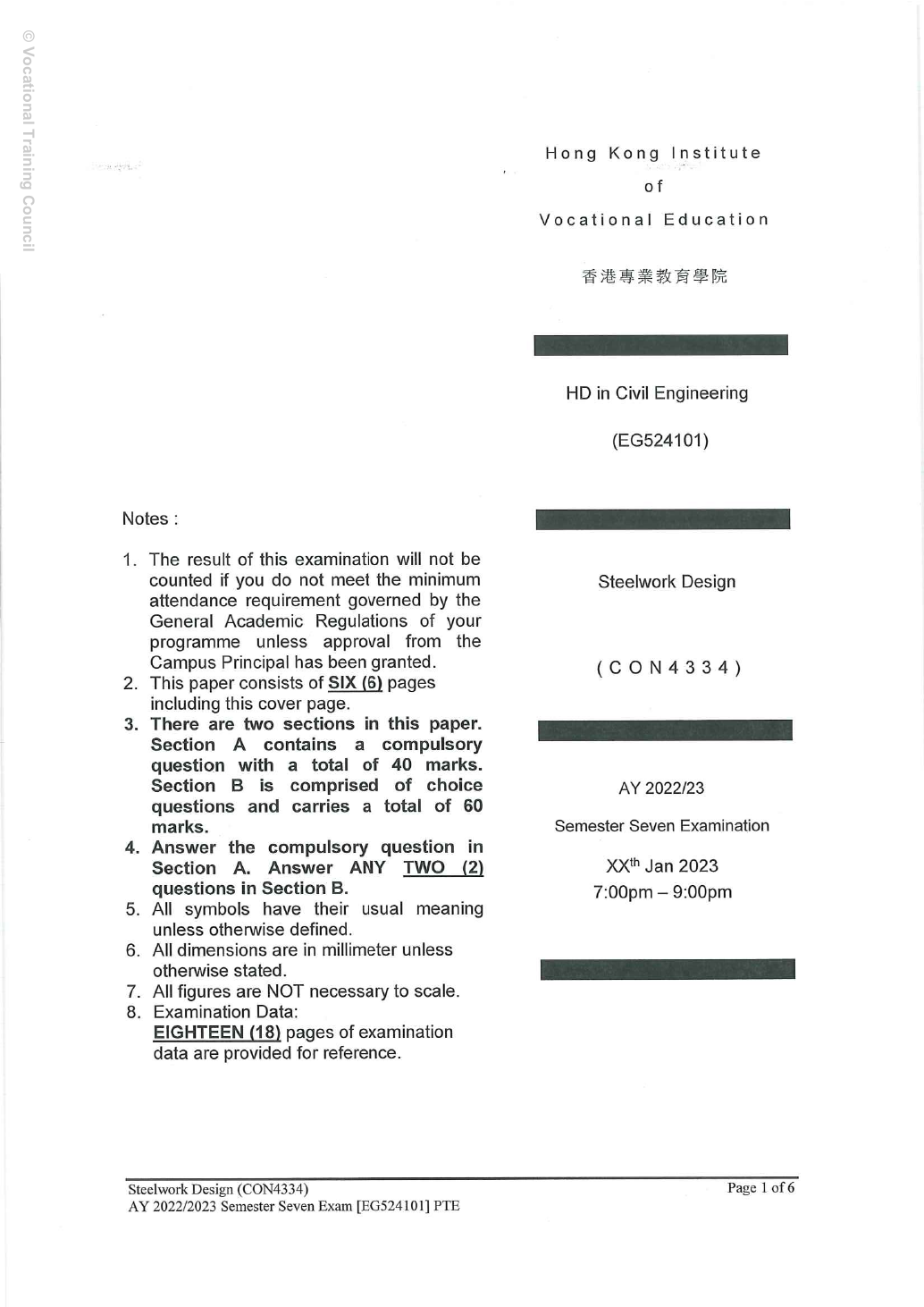
Original paper: Pastpaper/22ENGTY033.pdf. All printed subquestions have a teaching solution linked below. Keep the original diagram beside the calculation and attempt the question before opening the compact answer.
Printed examination format
Time allowed: hours. Answer compulsory Section A ( marks) and any TWO Section B questions ( marks each). Required total: marks; marks are offered. The printed marks below are official question allocations. No official worked solutions or marking schemes were supplied. Every model solution, method-mark suggestion and exam strategy on this website is independently written teaching guidance.
Planning suggestion, not an official rule: allow minutes to read/select, minutes for Section A, minutes for each selected Section B question, and minutes to check units, omissions and conclusions.
Section A Q1: floor beams and short theory
| Part | Task / full teaching solution | Printed marks |
|---|---|---|
| a 1-ai | Floor factored intensity | |
| a 1-aii | Beam B1 and B2 actions | |
| a 1-aiii | Beam section classes | |
| a 1-aiv | B1 shear, bending and deflection | |
| a 1-av | B2 shear, bending and deflection | |
| a 1-b | Two corrosion protection methods |
Section B Q2: connections
| Part | Task / full teaching solution | Printed marks |
|---|---|---|
| b 2-ai | Double welded angle tension capacity | |
| b 2-aii | Final weld lengths | |
| b 2-bi | Bolt shear and tension capacities | |
| b 2-bii | Bracket bolt adequacy |
Section B Q3: columns
| Part | Task / full teaching solution | Printed marks |
|---|---|---|
| b 3-a | Column class | |
| b 3-b | Column cross-section capacity | |
| b 3-c | Column member buckling |
Section B Q4: unrestrained beams
| Part | Task / full teaching solution | Printed marks |
|---|---|---|
| b 4-a | Beam shear and moment | |
| b 4-b | Beam LTB with support restraints | |
| b 4-c | Beam LTB with added midspan restraint |
Review an attempt
- Mark incorrect decisions separately from arithmetic slips: wrong load factor, wrong support span, wrong restraint, wrong table, wrong units.
- Use the detailed solution to find the first wrong line; redo everything downstream without copying.
- Close the original solution and change one input. Predict whether the result should rise or fall before calculating.
- Record conditional assumptions and missing data. A plausible answer must not become a fabricated official answer.
Graduated practice and unseen variants · A new timed mock in the supplied format