Steelwork · Exam learning

2014–2019 · Reference answers

2017-01-07 — column answer

Check 305 × 305 × 118 UC under combined compression and biaxial bending.

Independent teaching answer, not an official solution or marking scheme. Printed marks are retained. Read the source conditions beside each result.

Strategy and prerequisites

Units: 1 kN = 1,000 N; 1 m = 1,000 mm; 1 cm³ = 1,000 mm³; 1 cm⁴ = 10,000 mm⁴. A demand is the load effect; a resistance is what the member can carry. Compare matching units.

Simple explanation — open only if needed

A section is one slice of the column; buckling concerns the whole long member. Three passing checks are needed, just as a strong ruler can still bend sideways when pushed at its ends.

Biaxial column checks [30 marks]

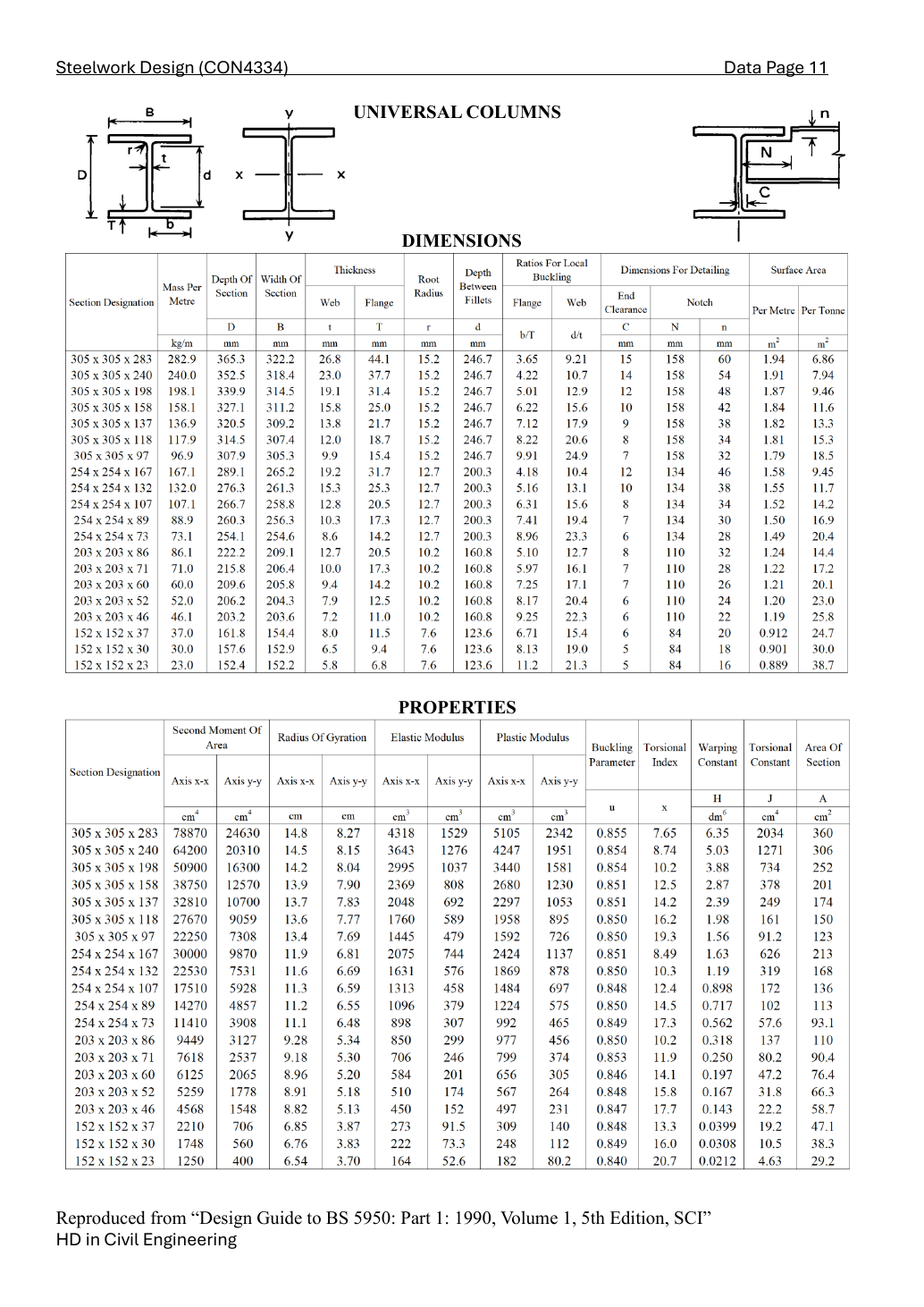
Source: LectureNotes/CON4334-Data File-20260730.pdf · p.1, p.11

Exact UC row: 305 × 305 × 118. A is gross area, r radius of gyration, Z elastic modulus, S plastic modulus. Convert the tabulated radii from cm to mm; do not use nominal section size as a radius.

T=18.7, t=12, d=246.7, rx=136, ry=77.7(mm)T=18.7,\ t=12,\ d=246.7,\ r_x=136,\ r_y=77.7\quad(\mathrm{mm})
Ag=150×100=15000 mm2A_g=150\times100=15000\,\mathrm{mm^2}
Zx=1760, Zy=589, Sx=1958, Sy=895(cm3)Z_x=1760,\ Z_y=589,\ S_x=1958,\ S_y=895\quad(\mathrm{cm^3})
u=0.85, x=16.2, py=345 N/mm2u=0.85,\ x=16.2,\ p_y=345\,\mathrm{N/mm^2}

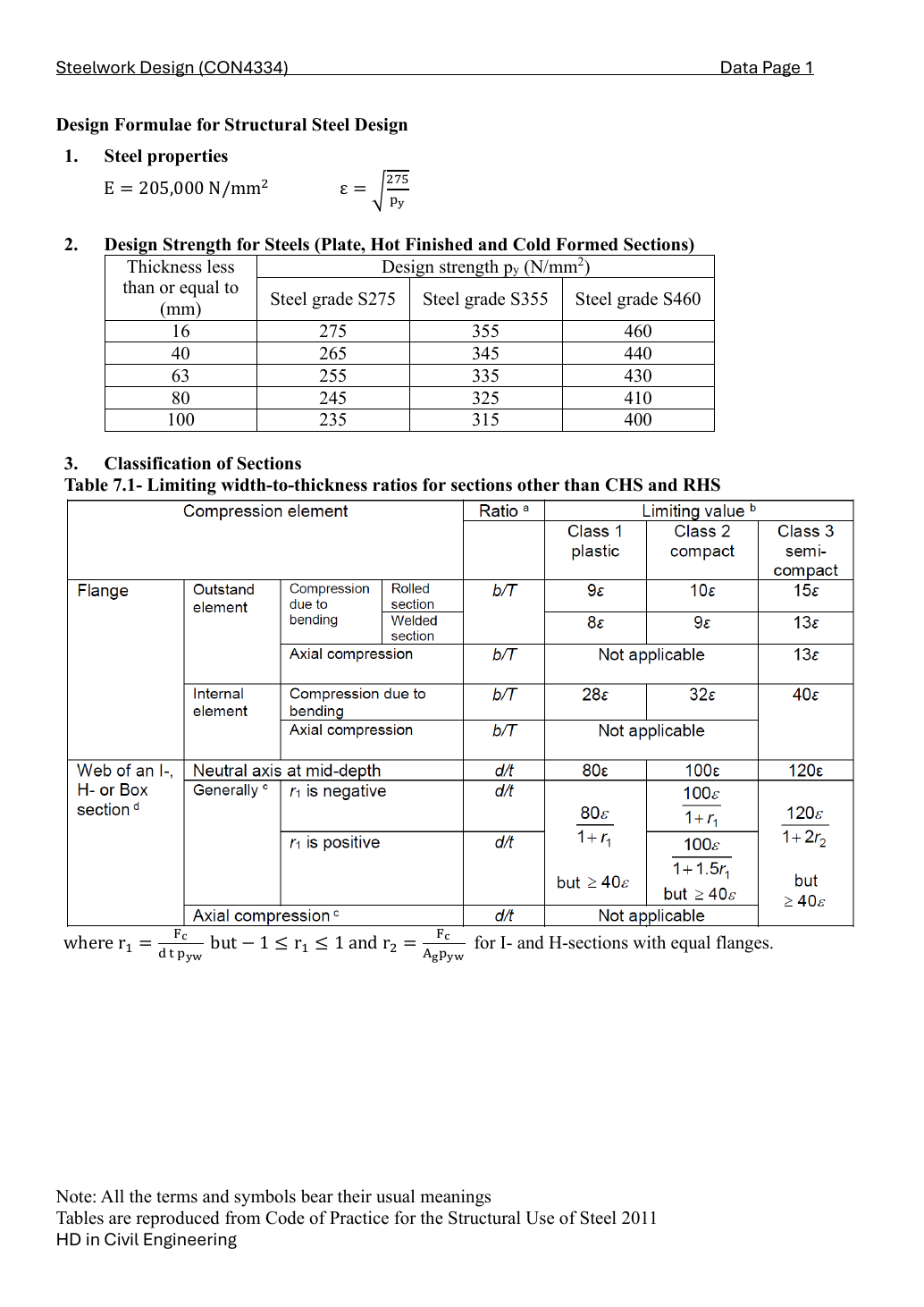
The conservative Class 1 web bound 40ε is valid for the course combined-stress formula because its axial stress parameter is bounded by one. Check the flange separately; use the worse class.

ϵf=275/345=0.892805,b/T=8.22,9ϵf=8.035,10ϵf=8.928\epsilon_f=\sqrt{275/345}=0.892805,\quad b/T=8.22,\quad9\epsilon_f=8.035,\quad10\epsilon_f=8.928
d/t=20.6<40275/355=35.205633d/t=20.6<40\sqrt{275/355}=35.205633

Overall Class 2.

The horizontal x–x axis passes through the web; y–y is vertical on the plan. A vertical drawing offset creates Mx; a horizontal offset creates My. All point forces are axial compression. Opposite offsets give opposite moments. Sum all axial forces, but share the joint moments equally between the equally stiff upper and lower columns.

Force (kN)Horizontal x (mm)Vertical y (mm)
3502500
230-1500
4200-300
N=1500+350+230+420=2500 kNN=1500+350+230+420=2500\,\mathrm{kN}
Mx,j=420(−300)/1000=−126 kN mM_{x,j}=420(-300)/1000=-126\,\mathrm{kN\,m}
My,j=350(250)/1000+230(−150)/1000=53 kN mM_{y,j}=350(250)/1000+230(-150)/1000=53\,\mathrm{kN\,m}
Mx=∣Mx,j∣/2=63,My=∣My,j∣/2=26.5(kN m)M_x=|M_{x,j}|/2=63,\quad M_y=|M_{y,j}|/2=26.5\quad(\mathrm{kN\,m})
M^x=1.15(63)=72.45,M^y=1.15(26.5)=30.475(kN m)\widehat M_x=1.15(63)=72.45,\quad\widehat M_y=1.15(26.5)=30.475\quad(\mathrm{kN\,m})

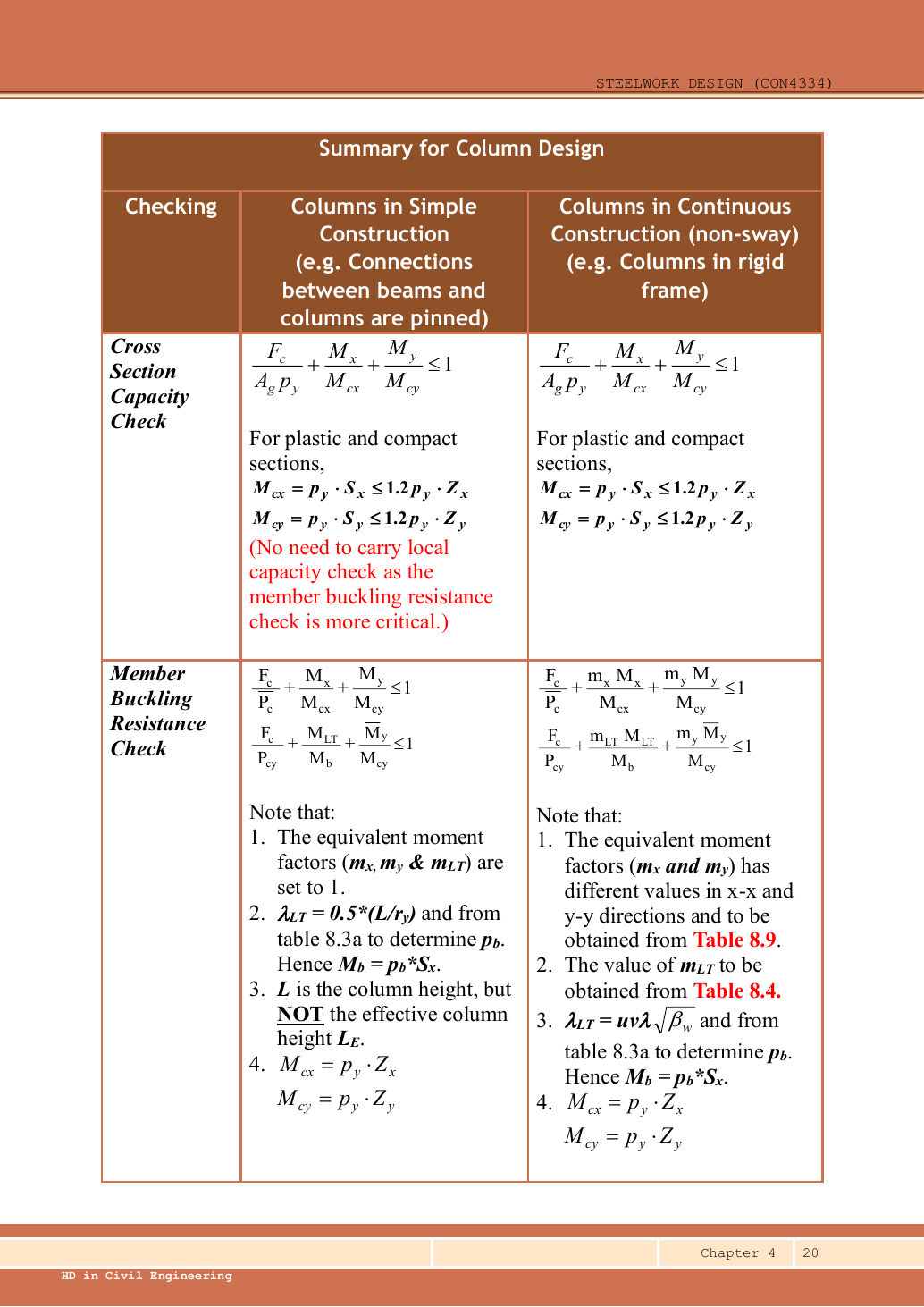
At a section, combine compression and amplified bending using capped plastic resistances for Class 1/2. All three fractions are dimensionless.

NRd=150(100)(345)/1000=5175 kNN_{Rd}=150(100)(345)/1000=5175\,\mathrm{kN}
Mcx=min⁡(345(1958),1.2(345)(1760))/1000=675.51 kN mM_{cx}=\min(345(1958),1.2(345)(1760))/1000=675.51\,\mathrm{kN\,m}
Mcy=min⁡(345(895),1.2(345)(589))/1000=243.846 kN mM_{cy}=\min(345(895),1.2(345)(589))/1000=243.846\,\mathrm{kN\,m}
ηs=25005175+72.45675.51+30.475243.846=0.715321\eta_s=\frac{2500}{5175}+\frac{72.45}{675.51}+\frac{30.475}{243.846}=0.715321

PASS

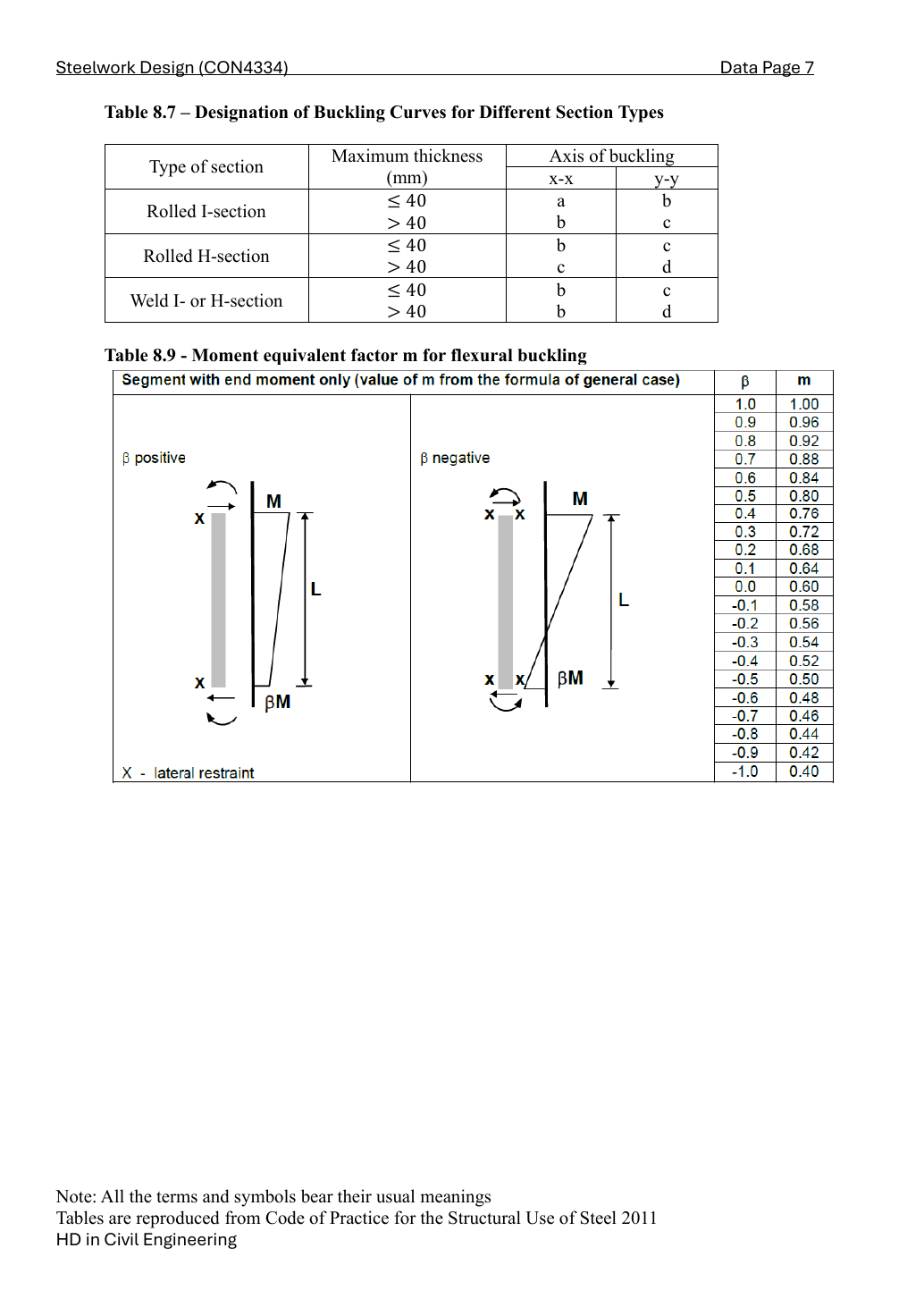
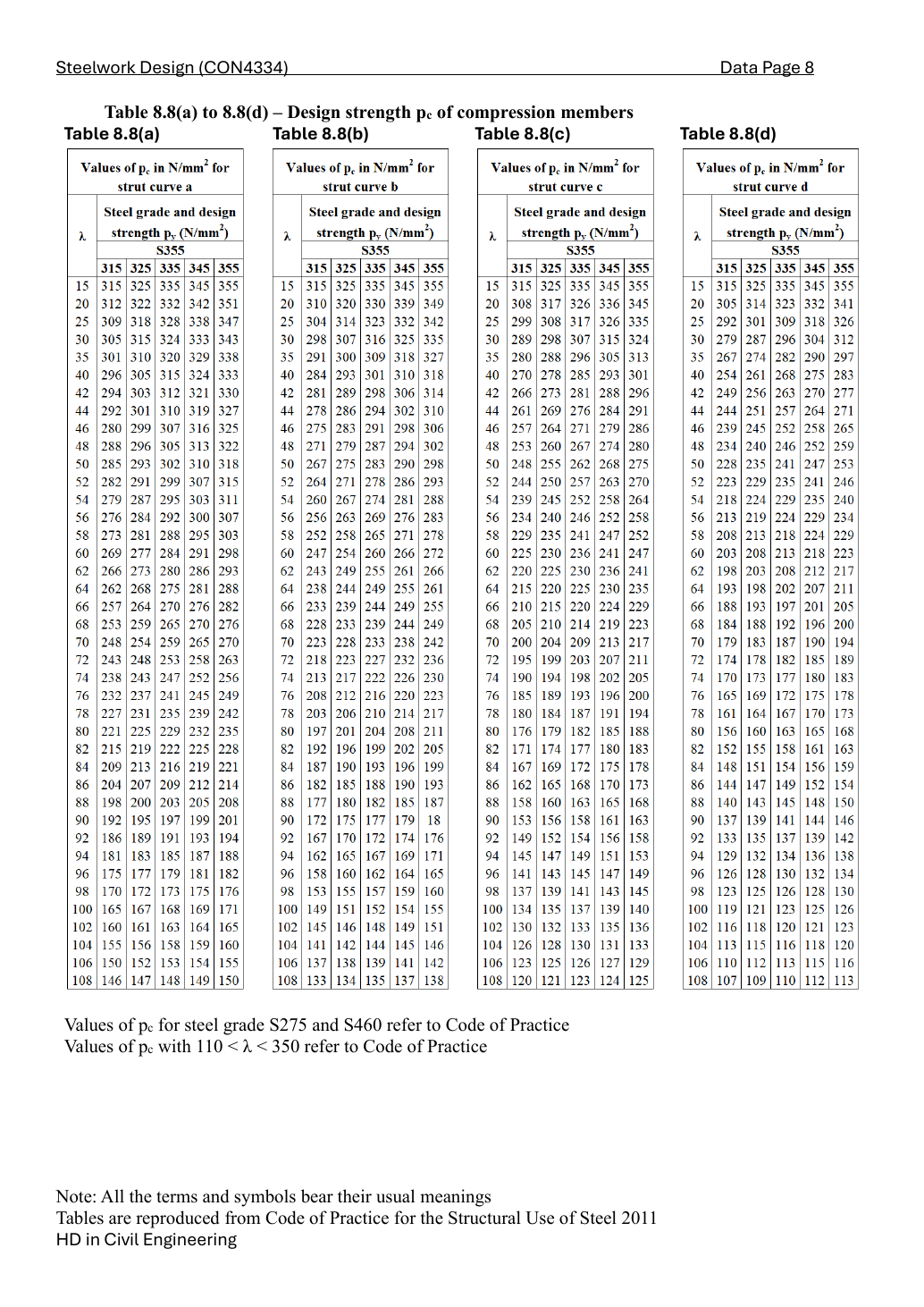
Source: LectureNotes/CON4334-Data File-20260730.pdf · p.7, p.8

Rolled UC with flange thickness 18.7 mm ≤ 40 mm: curve b about x and curve c about y. Use py = 345 N/mm² in both tables. Linear interpolation uses adjacent slenderness rows, not the nearest section size.

λx=4250/136=31.25,λy=4250/77.7=54.697555\lambda_x=4250/136=31.25,\quad\lambda_y=4250/77.7=54.697555
pcx=325+31.25−3035−30(318−325)=323.25 N/mm2p_{cx}=325+\frac{31.25-30}{35-30}(318-325)=323.25\,\mathrm{N/mm^2}
pcy=258+54.697555−5456−54(252−258)=255.907336 N/mm2p_{cy}=258+\frac{54.697555-54}{56-54}(252-258)=255.907336\,\mathrm{N/mm^2}
Pcx=150(323.25)/10=4848.75 kNP_{cx}=150(323.25)/10=4848.75\,\mathrm{kN}
Pcy=150(255.907336)/10=3838.610039 kNP_{cy}=150(255.907336)/10=3838.610039\,\mathrm{kN}

All moment factors are given as one. The simple-construction LTB slenderness uses ACTUAL storey height, not the compression effective length.

mx=my=mLT=1,λLT=0.5L/ry=0.5(5000)/77.7=32.175032m_x=m_y=m_{LT}=1,\quad\lambda_{LT}=0.5L/r_y=0.5(5000)/77.7=32.175032
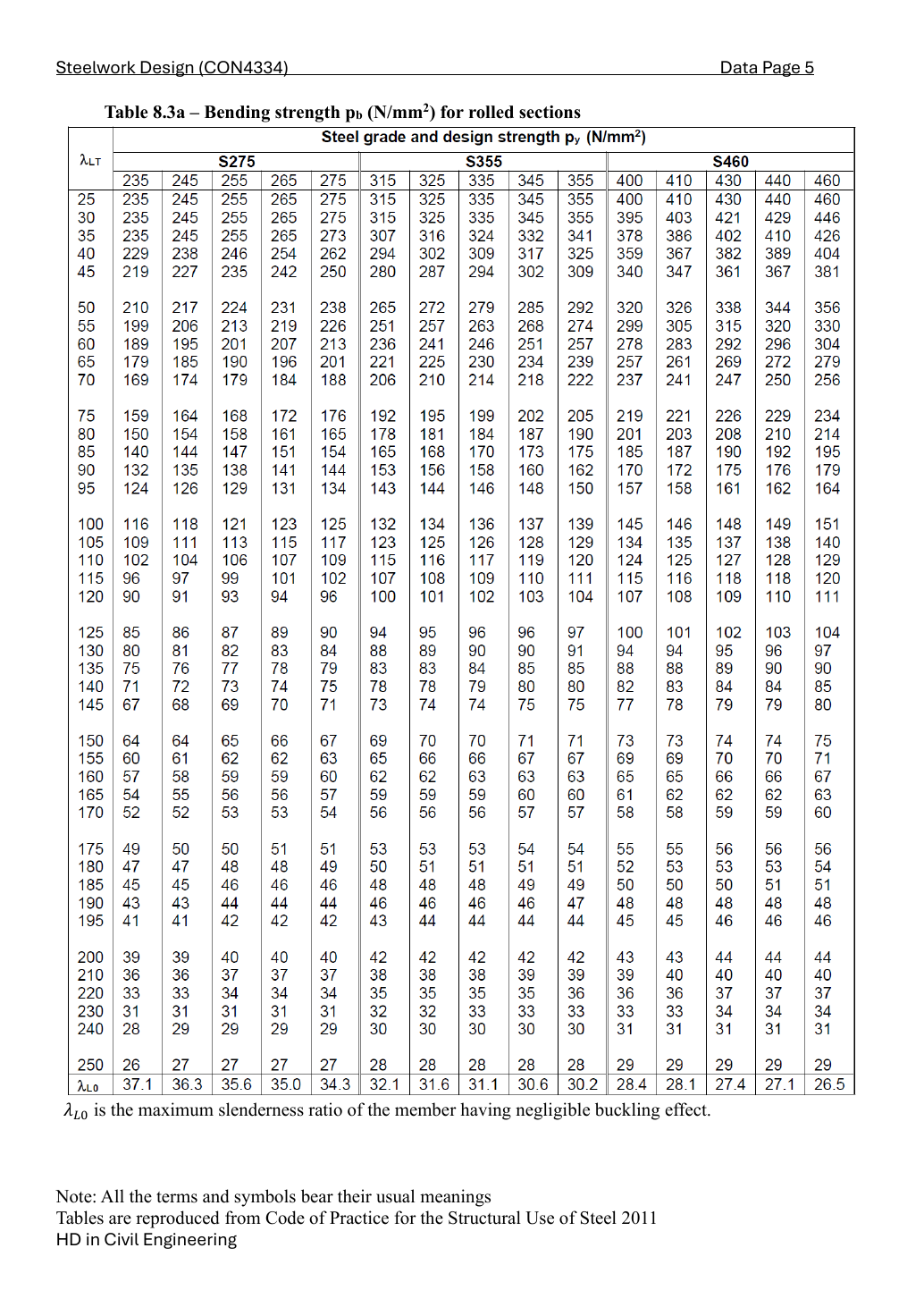
Source: LectureNotes/CON4334-Data File-20260730.pdf · p.5

Table 8.3: py 345 column, λLT rows 30 to 35.

pb=345+32.175032−3035−30(332−345)=339.344916 N/mm2p_b=345+\frac{32.175032-30}{35-30}(332-345)=339.344916\,\mathrm{N/mm^2}
Mb=339.344916(1958)/1000=664.437346 kN mM_b=339.344916(1958)/1000=664.437346\,\mathrm{kN\,m}

Member interaction uses ELASTIC moduli in the ordinary bending denominators. First equation: smaller axial buckling resistance and amplified moments. Second equation: Pcy and MLT, with first-order minor-axis moment.

Source: LectureNotes/Ch4_Column.pdf · p.20
Mex=345(1760)/1000=607.2,Mey=345(589)/1000=203.205(kN m)M_{ex}=345(1760)/1000=607.2,\quad M_{ey}=345(589)/1000=203.205\quad(\mathrm{kN\,m})
ηf=Nmin⁡(Pcx,Pcy)+mxM^xMex+myM^yMey\eta_f=\frac{N}{\min(P_{cx},P_{cy})}+\frac{m_x\widehat M_x}{M_{ex}}+\frac{m_y\widehat M_y}{M_{ey}}
ηf=25003838.610039+1(72.45)607.2+1(30.475)203.205=0.920567\eta_f=\frac{2500}{3838.610039}+\frac{1(72.45)}{607.2}+\frac{1(30.475)}{203.205}=0.920567

PASS

ηLT=NPcy+mLTMLTMb+myMyMey\eta_{LT}=\frac{N}{P_{cy}}+\frac{m_{LT}M_{LT}}{M_b}+\frac{m_yM_y}{M_{ey}}
ηLT=25003838.610039+1(72.45)664.437346+1(26.5)203.205=0.890727\eta_{LT}=\frac{2500}{3838.610039}+\frac{1(72.45)}{664.437346}+\frac{1(26.5)}{203.205}=0.890727

PASS

Compact exam answer — key result lines
ηs=0.715321,ηf=0.920567,ηLT=0.890727\eta_s=0.715321,\quad\eta_f=0.920567,\quad\eta_{LT}=0.890727

All three checks: PASS under the stated model.

Procedure and common mistakes

Identify the model → axes and actions → class → section → both strut curves → LTB → both member equations. Do not halve axial load, swap x/y moduli, replace the given effective length with the actual height, or amplify MLT twice.

Independent practice — invented variant

Invented variant: axial load increases by 100 kN, moments and class unchanged. How does each utilisation change?

Hint

Only the axial-force numerator changes in this stated variant.
Reveal answer
Δηs=100/5175=0.019324,Δηf=100/3838.610039=0.026051,ΔηLT=100/3838.610039=0.026051\Delta\eta_s=100/5175=0.019324,\quad\Delta\eta_f=100/3838.610039=0.026051,\quad\Delta\eta_{LT}=100/3838.610039=0.026051