Steelwork · Exam learning

2014–2019 · Reference answers

2018-01-08 — floor and foundations

Solve the complete compulsory question, using the original diagram beside the calculation.

Independent teaching answer, not an official solution or marking scheme. Printed marks are retained. Read the source conditions beside each result.

Read the load path first

The slab arrows point across adjacent B1 beams. Each interior B1 collects half the 3 m bay on either side: tributary width 3 m. Its labelled span is 7 m. The supporting B2 spans 6 m between the drawn columns and receives 1 B1 end reaction(s), at its middle.

Beams aligned directly with a column deliver their end reaction to that column, not as an extra midspan load on B2. The B2 point load is already factored; do not factor it again. The slab gives full compression-flange restraint, so this is section resistance rather than an LTB design.

Units: 1 kN = 1,000 N; 1 m = 1,000 mm; 1 cm³ = 1,000 mm³; 1 cm⁴ = 10,000 mm⁴. A demand is the load effect; a resistance is what the member can carry. Compare matching units.

Simple explanation — open only if needed

Think of a tray resting on small bars, then on two larger edge bars. Follow where each bar ends: that determines which reaction goes onto the next bar.

Load intensity [4 marks]

Given slab thickness 180 mm, finishes 0.4 kN/m², imposed load 4.5 kN/m². Convert thickness to metres. Permanent area load includes concrete and finishes; beam weight is added later as a line load.

gk=hγc+gfin=0.18(24.5)+0.4=4.81 kN/m2g_k=h\gamma_c+g_{fin}=0.18(24.5)+0.4=4.81\,\mathrm{kN/m^2}
qu=1.4gk+1.6qk=1.4(4.81)+1.6(4.5)=13.934 kN/m2q_u=1.4g_k+1.6q_k=1.4(4.81)+1.6(4.5)=13.934\,\mathrm{kN/m^2}
Compact exam answer — key result lines
gk=hγc+gfin=0.18(24.5)+0.4=4.81 kN/m2g_k=h\gamma_c+g_{fin}=0.18(24.5)+0.4=4.81\,\mathrm{kN/m^2}
qu=1.4gk+1.6qk=1.4(4.81)+1.6(4.5)=13.934 kN/m2q_u=1.4g_k+1.6q_k=1.4(4.81)+1.6(4.5)=13.934\,\mathrm{kN/m^2}

Given slab thickness 180 mm, finishes 0.4 kN/m², imposed load 4.5 kN/m². Convert thickness to metres. Permanent area load includes concrete and finishes; beam weight is added later as a line load.

Beam actions [8 marks]

Source: LectureNotes/CON4334-Data File-20260730.pdf · p.9, p.10

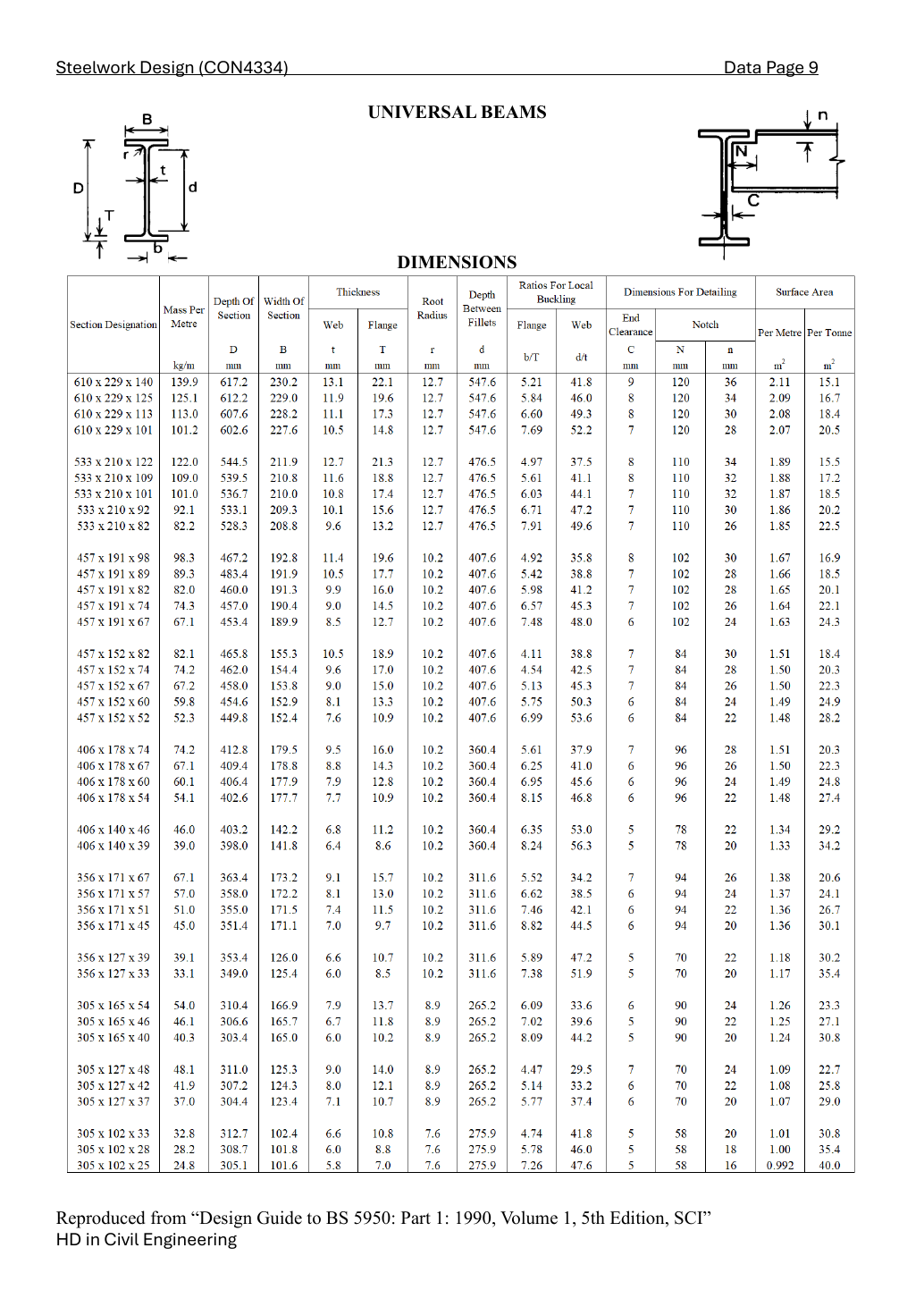
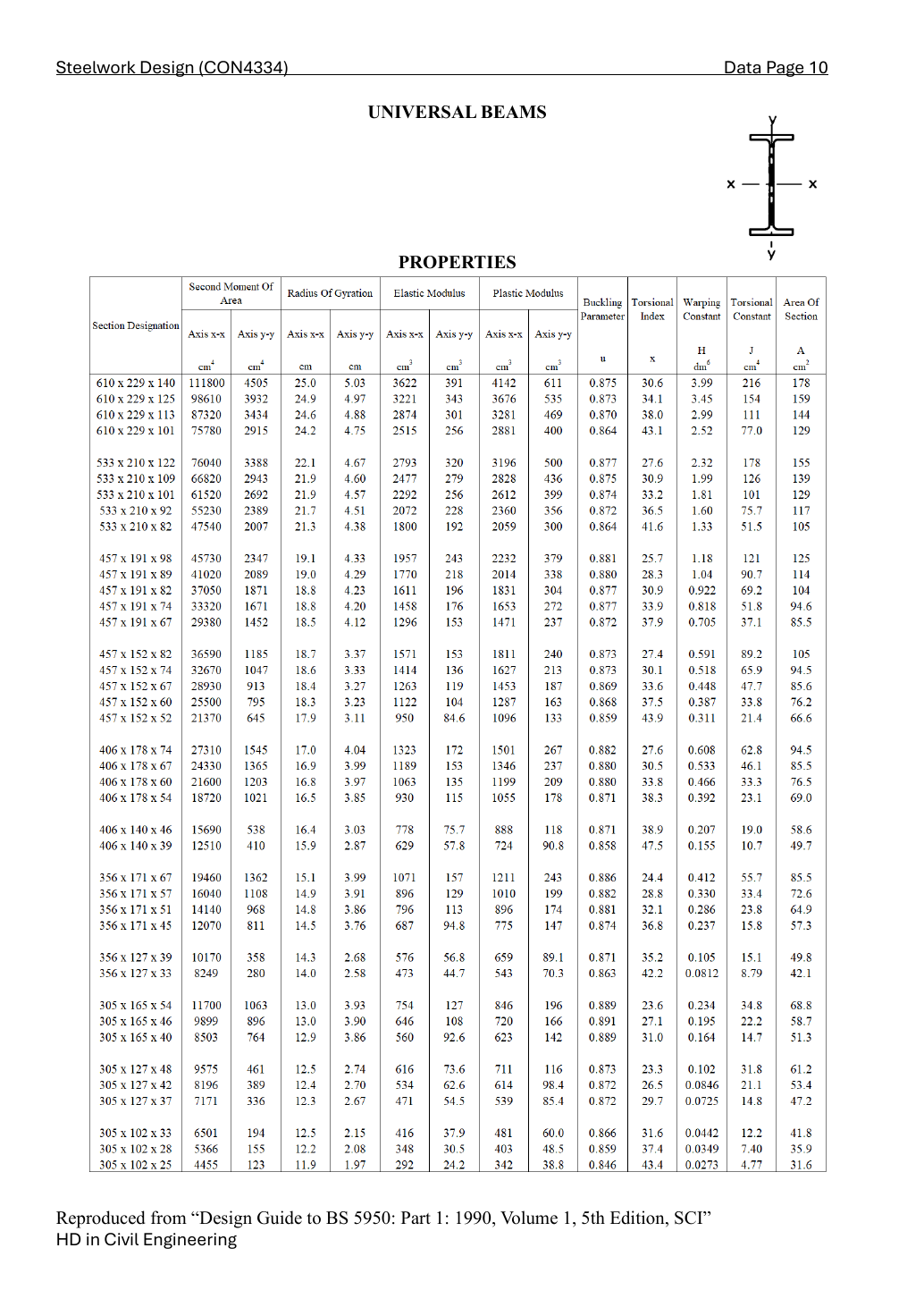
Lookup the exact 356 × 171 × 67 UB row. Read dimensions first, properties second. D = overall depth; t = web thickness; T = flange thickness; d = clear web depth. The designation is not an exact dimension.

D=363.4, t=9.1, T=15.7, d=311.6(mm)D=363.4,\ t=9.1,\ T=15.7,\ d=311.6\quad(\mathrm{mm})
b/T=5.52, d/t=34.2, Ix=19460 cm4, Zx=1071 cm3, Sx=1211 cm3b/T=5.52,\ d/t=34.2,\ I_x=19460\,\mathrm{cm^4},\ Z_x=1071\,\mathrm{cm^3},\ S_x=1211\,\mathrm{cm^3}
ry=39.9 mm,u=0.886,x=24.4r_y=39.9\,\mathrm{mm},\quad u=0.886,\quad x=24.4
Source: LectureNotes/CON4334-Data File-20260730.pdf · p.9, p.10

Lookup the exact 406 × 178 × 74 UB row. Read dimensions first, properties second. D = overall depth; t = web thickness; T = flange thickness; d = clear web depth. The designation is not an exact dimension.

D=412.8, t=9.5, T=16, d=360.4(mm)D=412.8,\ t=9.5,\ T=16,\ d=360.4\quad(\mathrm{mm})
b/T=5.61, d/t=37.9, Ix=27310 cm4, Zx=1323 cm3, Sx=1501 cm3b/T=5.61,\ d/t=37.9,\ I_x=27310\,\mathrm{cm^4},\ Z_x=1323\,\mathrm{cm^3},\ S_x=1501\,\mathrm{cm^3}
ry=40.4 mm,u=0.882,x=27.6r_y=40.4\,\mathrm{mm},\quad u=0.882,\quad x=27.6

Lookup mass in kg/m and multiply by g/1000 to get kN/m. Multiply the slab area load by the tributary width, not by the full slab area.

wg1=67.1(10)/1000=0.671,wg2=74.2(10)/1000=0.742(kN/m)w_{g1}=67.1(10)/1000=0.671,\quad w_{g2}=74.2(10)/1000=0.742\quad(\mathrm{kN/m})
wu1=qub+1.4wg1=13.934(3)+1.4(0.671)=42.7414 kN/mw_{u1}=q_ub+1.4w_{g1}=13.934(3)+1.4(0.671)=42.7414\,\mathrm{kN/m}
V1=R1=wu1L1/2=42.7414(7)/2=149.5949 kNV_1=R_1=w_{u1}L_1/2=42.7414(7)/2=149.5949\,\mathrm{kN}
M1=wu1L12/8=42.7414(72)/8=261.791075 kN mM_1=w_{u1}L_1^2/8=42.7414(7^2)/8=261.791075\,\mathrm{kN\,m}

For B2 use superposition: the B1 point reactions plus B2 self-weight. Equilibrium divides the symmetric total load equally between the supports.

wu2=1.4(0.742)=1.0388 kN/m,P=R1=149.5949 kNw_{u2}=1.4(0.742)=1.0388\,\mathrm{kN/m},\quad P=R_1=149.5949\,\mathrm{kN}
V2=1P+wu2L22=1(149.5949)+1.0388(6)2=77.91385 kNV_2=\frac{1P+w_{u2}L_2}{2}=\frac{1(149.5949)+1.0388(6)}{2}=77.91385\,\mathrm{kN}
M2=PL24+wu2L228=149.5949(6)4+1.0388(62)8=229.06695 kN mM_2=\frac{PL_2}{4}+\frac{w_{u2}L_2^2}{8}=\frac{149.5949(6)}{4}+\frac{1.0388(6^2)}{8}=229.06695\,\mathrm{kN\,m}
Compact exam answer — key result lines
V1=R1=wu1L1/2=42.7414(7)/2=149.5949 kNV_1=R_1=w_{u1}L_1/2=42.7414(7)/2=149.5949\,\mathrm{kN}
M1=wu1L12/8=42.7414(72)/8=261.791075 kN mM_1=w_{u1}L_1^2/8=42.7414(7^2)/8=261.791075\,\mathrm{kN\,m}
wu2=1.4(0.742)=1.0388 kN/m,P=R1=149.5949 kNw_{u2}=1.4(0.742)=1.0388\,\mathrm{kN/m},\quad P=R_1=149.5949\,\mathrm{kN}
V2=1P+wu2L22=1(149.5949)+1.0388(6)2=77.91385 kNV_2=\frac{1P+w_{u2}L_2}{2}=\frac{1(149.5949)+1.0388(6)}{2}=77.91385\,\mathrm{kN}
M2=PL24+wu2L228=149.5949(6)4+1.0388(62)8=229.06695 kN mM_2=\frac{PL_2}{4}+\frac{w_{u2}L_2^2}{8}=\frac{149.5949(6)}{4}+\frac{1.0388(6^2)}{8}=229.06695\,\mathrm{kN\,m}

For B2 use superposition: the B1 point reactions plus B2 self-weight. Equilibrium divides the symmetric total load equally between the supports.

Section classes [4 marks]

Source: LectureNotes/CON4334-Data File-20260730.pdf · p.1

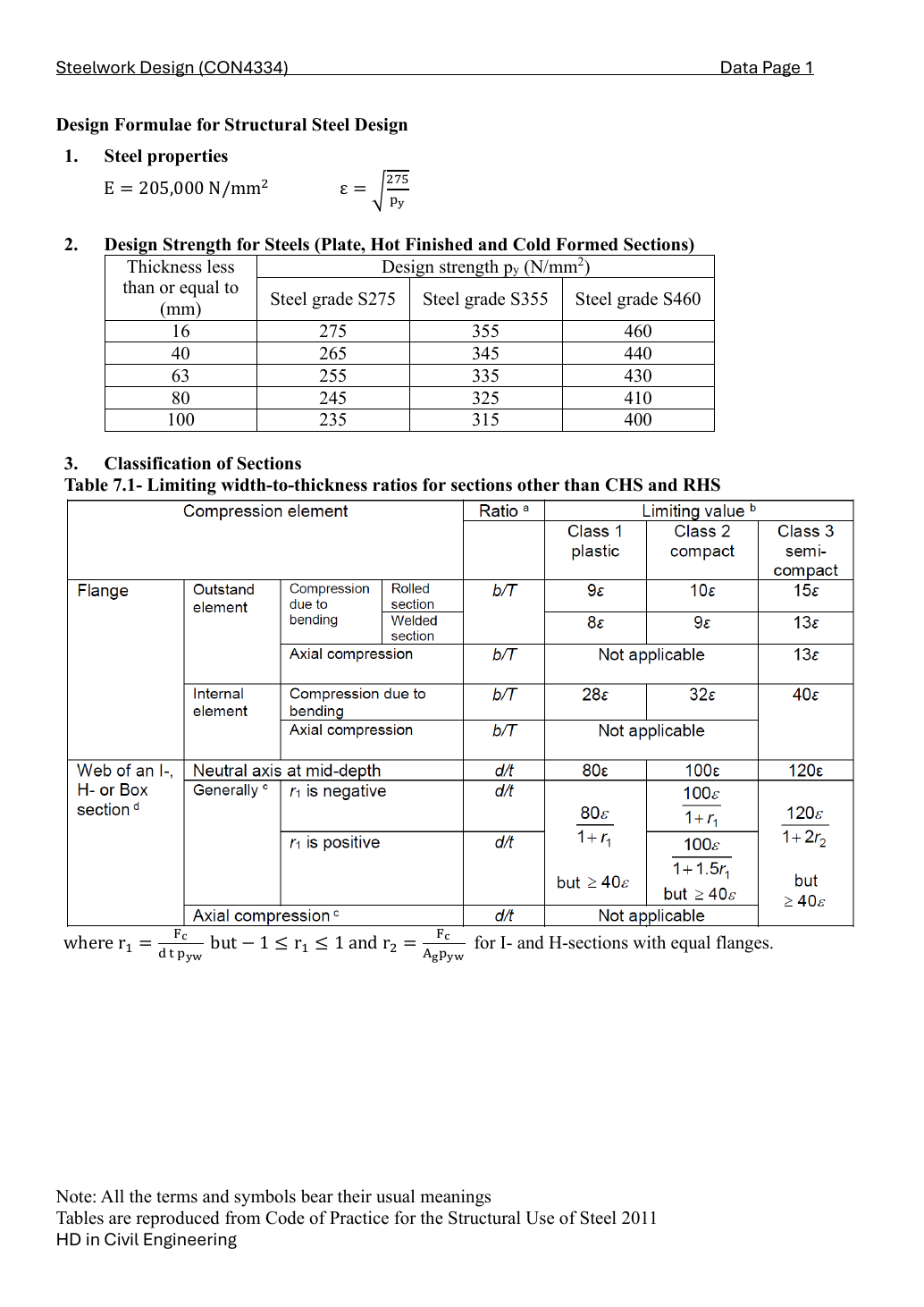
S355 design strength depends on the actual flange thickness. Local classification decides whether plastic bending resistance is allowed. In pure bending the web limit is different from uniform compression.

py=355 N/mm2,ϵ=275/355=0.880141p_y=355\,\mathrm{N/mm^2},\quad\epsilon=\sqrt{275/355}=0.880141
b/T=5.52,9ϵ=7.921,10ϵ=8.801,13ϵ=11.442b/T=5.52,\quad9\epsilon=7.921,\quad10\epsilon=8.801,\quad13\epsilon=11.442
d/t=34.2<80ϵ=70.411⟹Class 1d/t=34.2<80\epsilon=70.411\quad\Longrightarrow\quad\mathrm{Class}\ 1

Take the worse flange/web class. Class 1 or 2 permits the capped plastic modulus; Class 3 uses the elastic modulus.

Source: LectureNotes/CON4334-Data File-20260730.pdf · p.1

S355 design strength depends on the actual flange thickness. Local classification decides whether plastic bending resistance is allowed. In pure bending the web limit is different from uniform compression.

py=355 N/mm2,ϵ=275/355=0.880141p_y=355\,\mathrm{N/mm^2},\quad\epsilon=\sqrt{275/355}=0.880141
b/T=5.61,9ϵ=7.921,10ϵ=8.801,13ϵ=11.442b/T=5.61,\quad9\epsilon=7.921,\quad10\epsilon=8.801,\quad13\epsilon=11.442
d/t=37.9<80ϵ=70.411⟹Class 1d/t=37.9<80\epsilon=70.411\quad\Longrightarrow\quad\mathrm{Class}\ 1

Take the worse flange/web class. Class 1 or 2 permits the capped plastic modulus; Class 3 uses the elastic modulus.

Compact exam answer — key result lines
b/T=5.52,9ϵ=7.921,10ϵ=8.801,13ϵ=11.442b/T=5.52,\quad9\epsilon=7.921,\quad10\epsilon=8.801,\quad13\epsilon=11.442
d/t=34.2<80ϵ=70.411⟹Class 1d/t=34.2<80\epsilon=70.411\quad\Longrightarrow\quad\mathrm{Class}\ 1
py=355 N/mm2,ϵ=275/355=0.880141p_y=355\,\mathrm{N/mm^2},\quad\epsilon=\sqrt{275/355}=0.880141
b/T=5.61,9ϵ=7.921,10ϵ=8.801,13ϵ=11.442b/T=5.61,\quad9\epsilon=7.921,\quad10\epsilon=8.801,\quad13\epsilon=11.442
d/t=37.9<80ϵ=70.411⟹Class 1d/t=37.9<80\epsilon=70.411\quad\Longrightarrow\quad\mathrm{Class}\ 1

Take the worse flange/web class. Class 1 or 2 permits the capped plastic modulus; Class 3 uses the elastic modulus.

B1 checks [10 marks]

Source: LectureNotes/CON4334-Data File-20260730.pdf · p.2

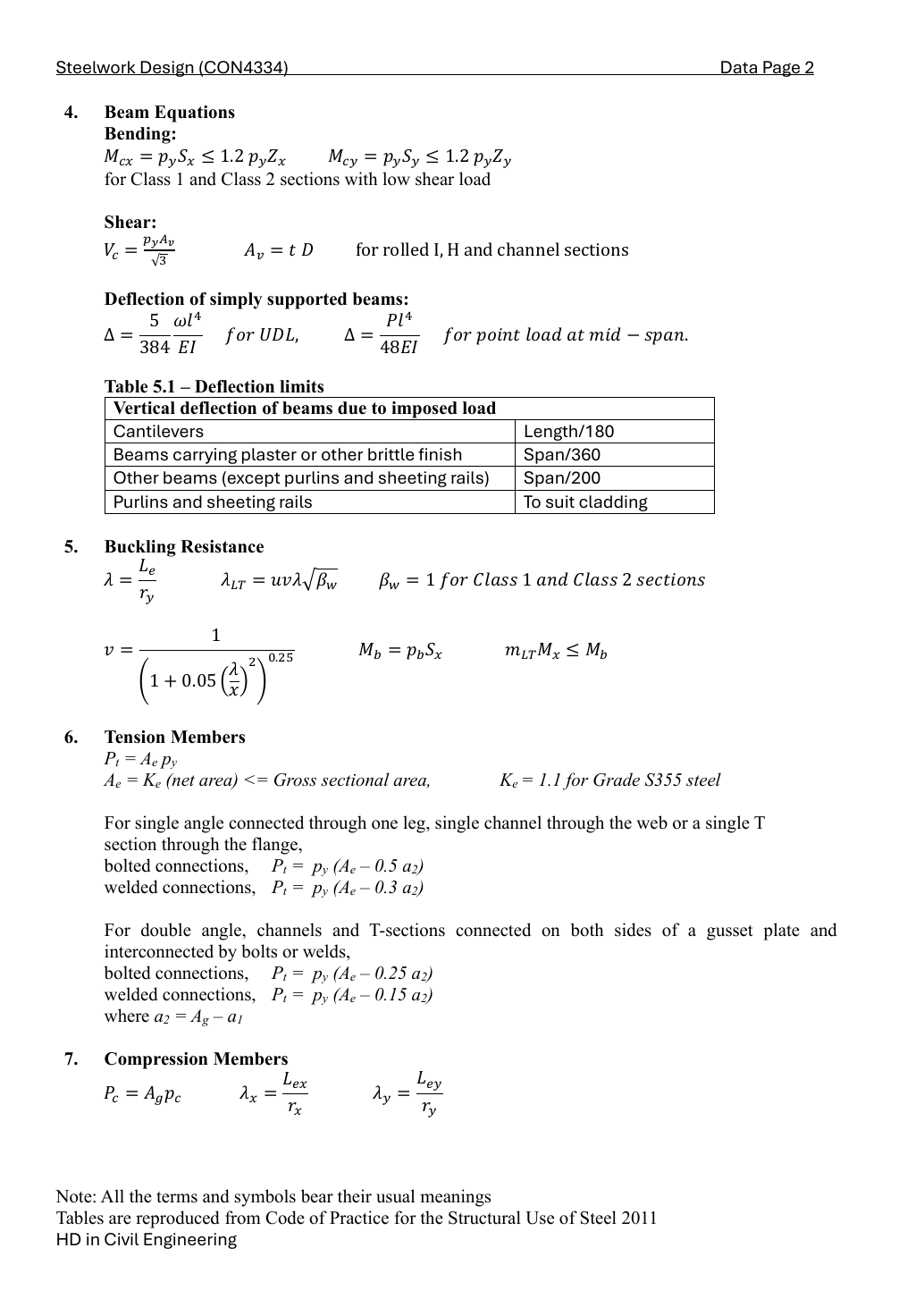
The web carries shear. For a rolled UB use Av = Dt, then the course shear resistance pyAv/√3. The 0.6 factor below is the low-shear threshold; it is not the coefficient in the shear-resistance formula.

Av=363.4(9.1)=3306.94 mm2A_v=363.4(9.1)=3306.94\,\mathrm{mm^2}
Vc=pyAv3=355(3306.94)3(1000)=677.788258 kNV_c=\frac{p_yA_v}{\sqrt3}=\frac{355(3306.94)}{\sqrt3(1000)}=677.788258\,\mathrm{kN}
V=149.5949 kN,V/Vc=0.22071,0.6Vc=406.672955 kNV=149.5949\,\mathrm{kN},\quad V/V_c=0.22071,\quad0.6V_c=406.672955\,\mathrm{kN}

PASS

Mc=min⁡(pySx,1.2pyZx)/1000=min⁡(355(1211),1.2(355)(1071))/1000=429.905 kN mM_c=\min(p_yS_x,1.2p_yZ_x)/1000=\min(355(1211),1.2(355)(1071))/1000=429.905\,\mathrm{kN\,m}
M/Mc=261.791075/429.905=0.608951M/M_c=261.791075/429.905=0.608951

PASS

Even the maximum shear is below 0.6Vc, so the low-shear moment resistance applies throughout.

For serviceability use unfactored imposed load only, E = 205,000 N/mm², I in mm⁴ and span in mm. Do not include the ULS factors or dead load in this course deflection limit.

δ1=5wQL14384EI1=5(4.5(3))(7000)4384(205000)(19460×104)=10.57957 mm\delta_1=\frac{5w_QL_1^4}{384EI_1}=\frac{5(4.5(3))(7000)^4}{384(205000)(19460\times10^4)}=10.57957\,\mathrm{mm}
δlim=L/360=7000/360=19.444444 mm\delta_{lim}=L/360=7000/360=19.444444\,\mathrm{mm}

PASS

Compact exam answer — key result lines
V=149.5949 kN,V/Vc=0.22071,0.6Vc=406.672955 kNV=149.5949\,\mathrm{kN},\quad V/V_c=0.22071,\quad0.6V_c=406.672955\,\mathrm{kN}
Mc=min⁡(pySx,1.2pyZx)/1000=min⁡(355(1211),1.2(355)(1071))/1000=429.905 kN mM_c=\min(p_yS_x,1.2p_yZ_x)/1000=\min(355(1211),1.2(355)(1071))/1000=429.905\,\mathrm{kN\,m}
M/Mc=261.791075/429.905=0.608951M/M_c=261.791075/429.905=0.608951
δ1=5wQL14384EI1=5(4.5(3))(7000)4384(205000)(19460×104)=10.57957 mm\delta_1=\frac{5w_QL_1^4}{384EI_1}=\frac{5(4.5(3))(7000)^4}{384(205000)(19460\times10^4)}=10.57957\,\mathrm{mm}
δlim=L/360=7000/360=19.444444 mm\delta_{lim}=L/360=7000/360=19.444444\,\mathrm{mm}

PASS

B2 checks [10 marks]

Source: LectureNotes/CON4334-Data File-20260730.pdf · p.2

The web carries shear. For a rolled UB use Av = Dt, then the course shear resistance pyAv/√3. The 0.6 factor below is the low-shear threshold; it is not the coefficient in the shear-resistance formula.

Av=412.8(9.5)=3921.6 mm2A_v=412.8(9.5)=3921.6\,\mathrm{mm^2}
Vc=pyAv3=355(3921.6)3(1000)=803.76857 kNV_c=\frac{p_yA_v}{\sqrt3}=\frac{355(3921.6)}{\sqrt3(1000)}=803.76857\,\mathrm{kN}
V=77.91385 kN,V/Vc=0.096936,0.6Vc=482.261142 kNV=77.91385\,\mathrm{kN},\quad V/V_c=0.096936,\quad0.6V_c=482.261142\,\mathrm{kN}

PASS

Mc=min⁡(pySx,1.2pyZx)/1000=min⁡(355(1501),1.2(355)(1323))/1000=532.855 kN mM_c=\min(p_yS_x,1.2p_yZ_x)/1000=\min(355(1501),1.2(355)(1323))/1000=532.855\,\mathrm{kN\,m}
M/Mc=229.06695/532.855=0.429886M/M_c=229.06695/532.855=0.429886

PASS

Even the maximum shear is below 0.6Vc, so the low-shear moment resistance applies throughout.

For serviceability use unfactored imposed load only, E = 205,000 N/mm², I in mm⁴ and span in mm. Do not include the ULS factors or dead load in this course deflection limit.

PQ=qkbL1/2=4.5(3)(7)/2=47.25 kNP_Q=q_kbL_1/2=4.5(3)(7)/2=47.25\,\mathrm{kN}
δ2=PQL2348EI2=47.25(1000)(6000)348(205000)(27310×104)=3.797858 mm\delta_2=\frac{P_QL_2^3}{48EI_2}=\frac{47.25(1000)(6000)^3}{48(205000)(27310\times10^4)}=3.797858\,\mathrm{mm}
δlim=L/360=6000/360=16.666667 mm\delta_{lim}=L/360=6000/360=16.666667\,\mathrm{mm}

PASS

Compact exam answer — key result lines
Mc=min⁡(pySx,1.2pyZx)/1000=min⁡(355(1501),1.2(355)(1323))/1000=532.855 kN mM_c=\min(p_yS_x,1.2p_yZ_x)/1000=\min(355(1501),1.2(355)(1323))/1000=532.855\,\mathrm{kN\,m}
M/Mc=229.06695/532.855=0.429886M/M_c=229.06695/532.855=0.429886
PQ=qkbL1/2=4.5(3)(7)/2=47.25 kNP_Q=q_kbL_1/2=4.5(3)(7)/2=47.25\,\mathrm{kN}
δ2=PQL2348EI2=47.25(1000)(6000)348(205000)(27310×104)=3.797858 mm\delta_2=\frac{P_QL_2^3}{48EI_2}=\frac{47.25(1000)(6000)^3}{48(205000)(27310\times10^4)}=3.797858\,\mathrm{mm}
δlim=L/360=6000/360=16.666667 mm\delta_{lim}=L/360=6000/360=16.666667\,\mathrm{mm}

PASS

Short theory: sections [4 marks]

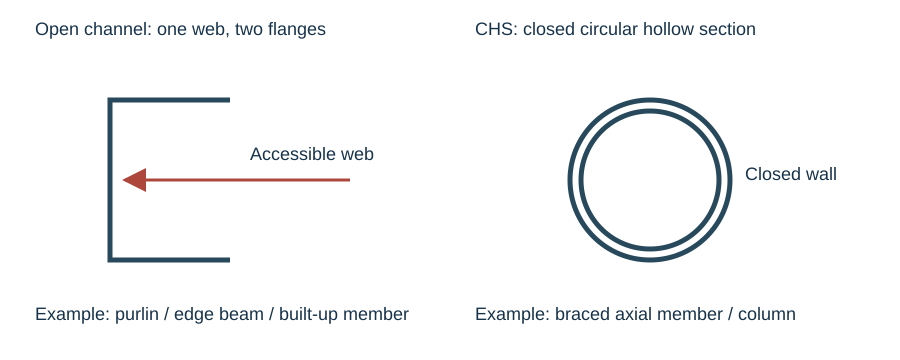
Channel and circular hollow section: shape and typical use labelled.
Channel and circular hollow section: shape and typical use labelled. Full-size image

A channel is an open section with one web and two flanges. Its accessible web helps connections, so it is used for purlins, edge beams and built-up members. An open channel has relatively low torsional stiffness and an eccentric shear centre. A circular hollow section (CHS) is closed and has equal bending properties about all centroidal diameters; it is efficient in torsion and useful for bracing/columns. Its curved closed wall requires suitable connection detailing.

Compact exam answer — key result lines
Channel and circular hollow section: shape and typical use labelled.
Channel and circular hollow section: shape and typical use labelled. Full-size image

A channel is an open section with one web and two flanges. Its accessible web helps connections, so it is used for purlins, edge beams and built-up members. An open channel has relatively low torsional stiffness and an eccentric shear centre. A circular hollow section (CHS) is closed and has equal bending properties about all centroidal diameters; it is efficient in torsion and useful for bracing/columns. Its curved closed wall requires suitable connection detailing.

Reusable exam procedure and mistakes

  1. Trace the slab arrows and count reactions before doing arithmetic.
  2. Use each member’s exact table row. Class 2 is not Class 1, but both allow capped plastic bending.
  3. Never factor an already factored reaction twice; never include beam dead weight in imposed-load deflection.

Independent practice — invented variant

Invented variant: imposed load rises by 20%, with dead load unchanged. What changes?

Hint

Separate permanent and imposed terms before changing a load.

Reveal answer

Multiply imposed-only deflections by 1.2. Rebuild ULS load as 1.4G + 1.6(1.2Q); do not multiply the total ULS action by 1.2. Section capacities and classes stay unchanged.