Steelwork · Exam learning

2014–2019 · Reference answers

2017-05-19 — connection answers

All connection subparts from this paper, including the specified checks and source qualifications.

Independent teaching answer, not an official solution or marking scheme. Printed marks are retained. Read the source conditions beside each result.

Recognise the connection model

Units: 1 kN = 1,000 N; 1 m = 1,000 mm; 1 cm³ = 1,000 mm³; 1 cm⁴ = 10,000 mm⁴. A demand is the load effect; a resistance is what the member can carry. Compare matching units.

A splice transfers axial force through stages. A side-plate bracket creates in-plane torsion. An end-plate bracket creates bolt tension. Identify which picture applies before selecting a formula.

Plate tension [5 marks]

The main plate width is 170 mm; each cover is 120 mm wide, with thicknesses 18 mm and 10 mm respectively. These come from the original width and side-view dimension chains. There are no bolt holes. The two covers act in parallel and each carries half the design tension.

P=800 kN,Pcover=P/2=400 kNP=800\,\mathrm{kN},\quad P_{cover}=P/2=400\,\mathrm{kN}
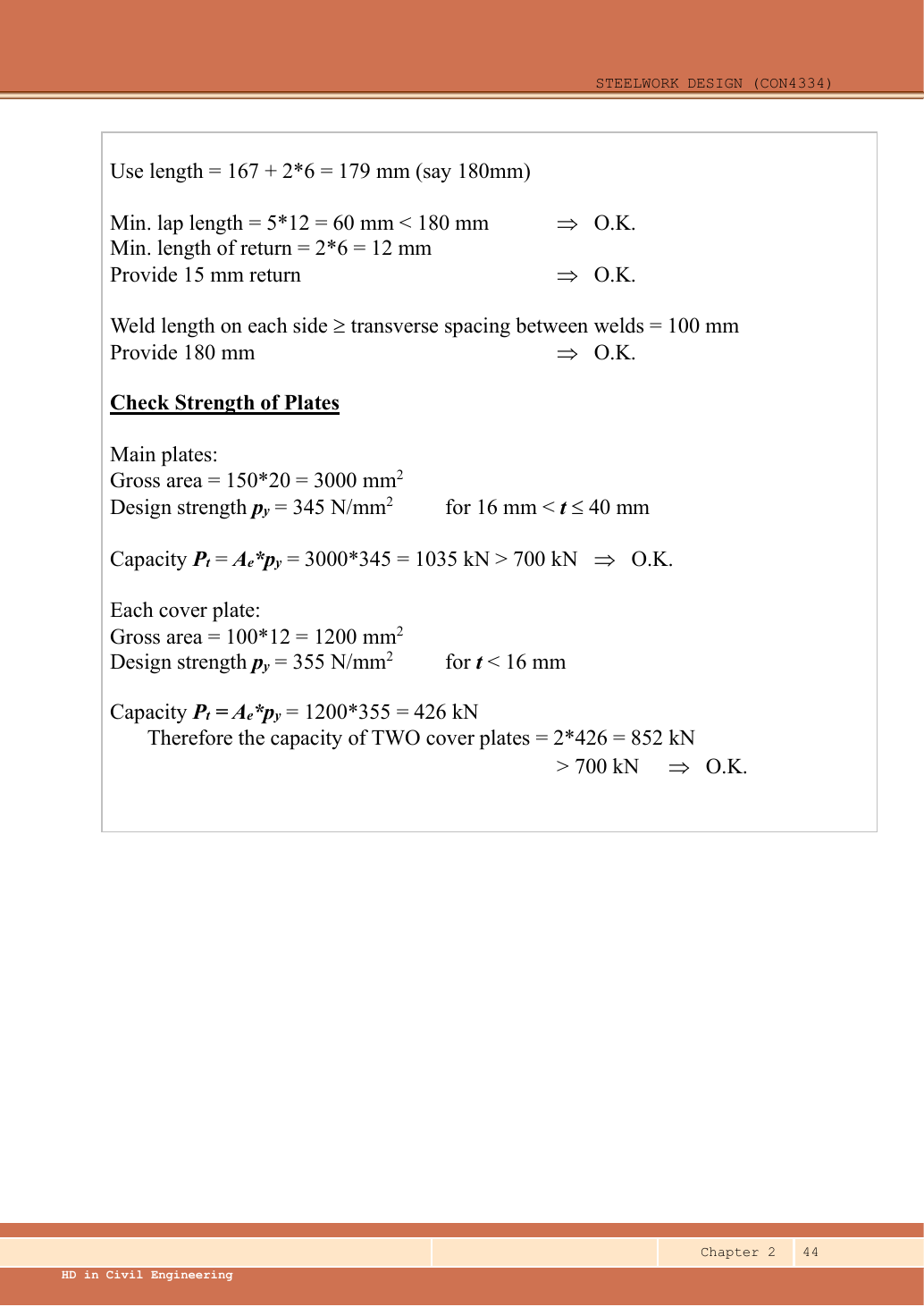
Pt,main=170(18)(345)/1000=1055.7 kNP_{t,main}=170(18)(345)/1000=1055.7\,\mathrm{kN}
Pt,covers=2(120)(10)(355)/1000=852 kNP_{t,covers}=2(120)(10)(355)/1000=852\,\mathrm{kN}

Main: PASS; covers: PASS

Compact exam answer — key result lines
P=800 kN,Pcover=P/2=400 kNP=800\,\mathrm{kN},\quad P_{cover}=P/2=400\,\mathrm{kN}
Pt,main=170(18)(345)/1000=1055.7 kNP_{t,main}=170(18)(345)/1000=1055.7\,\mathrm{kN}
Pt,covers=2(120)(10)(355)/1000=852 kNP_{t,covers}=2(120)(10)(355)/1000=852\,\mathrm{kN}

Main: PASS; covers: PASS

Weld design [4 marks]

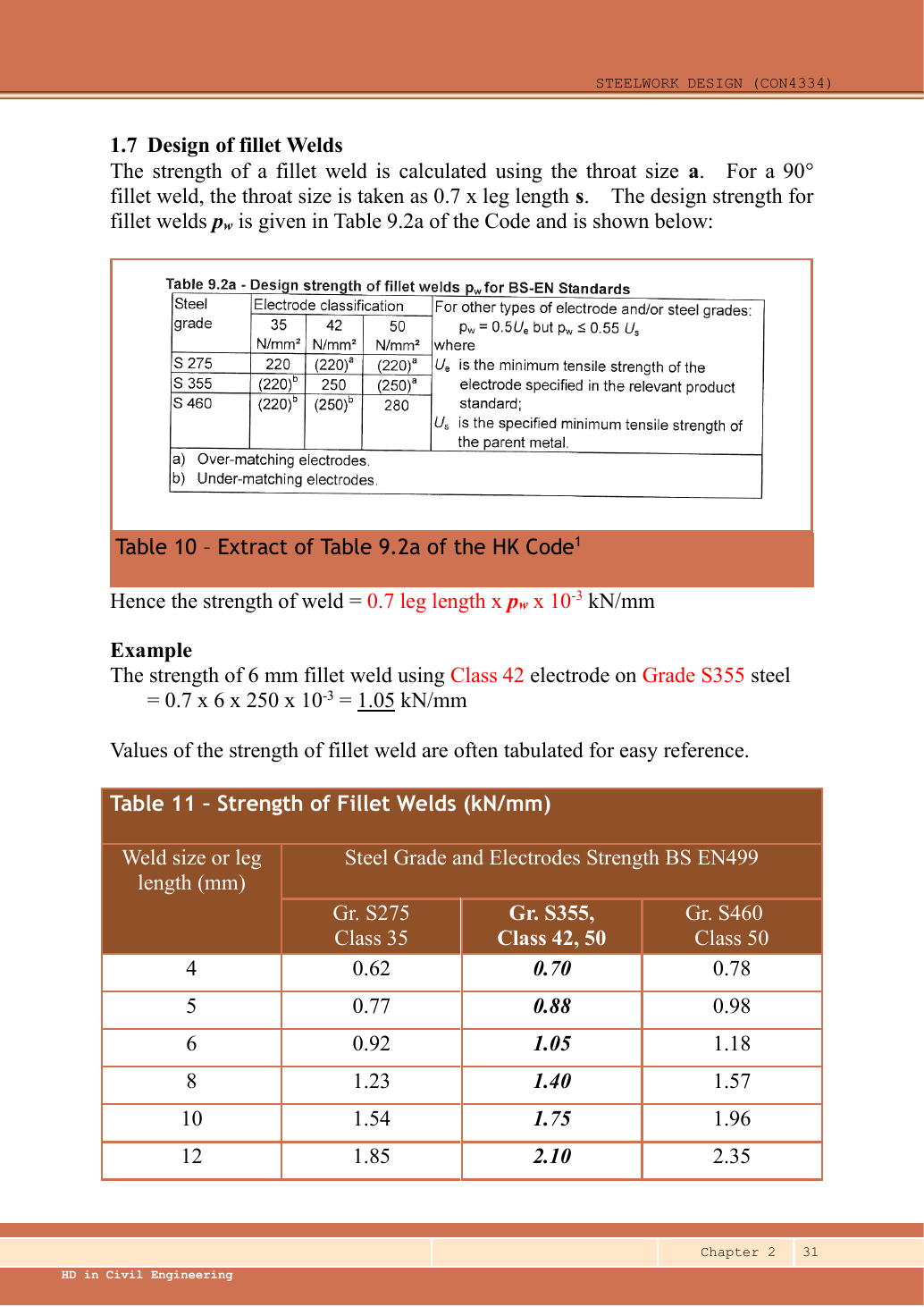
Source: LectureNotes/Ch2_Connection.pdf · p.31, p.33, p.44, p.45

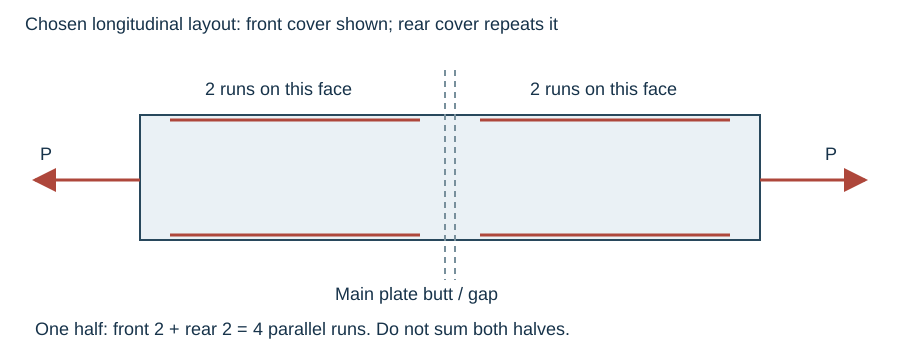
Choose longitudinal welds on both edges of each cover, on each side of the main-plate butt: four parallel weld runs transfer the full force on one half. The other half repeats the load transfer. Count four, not eight, in the capacity of one stage.

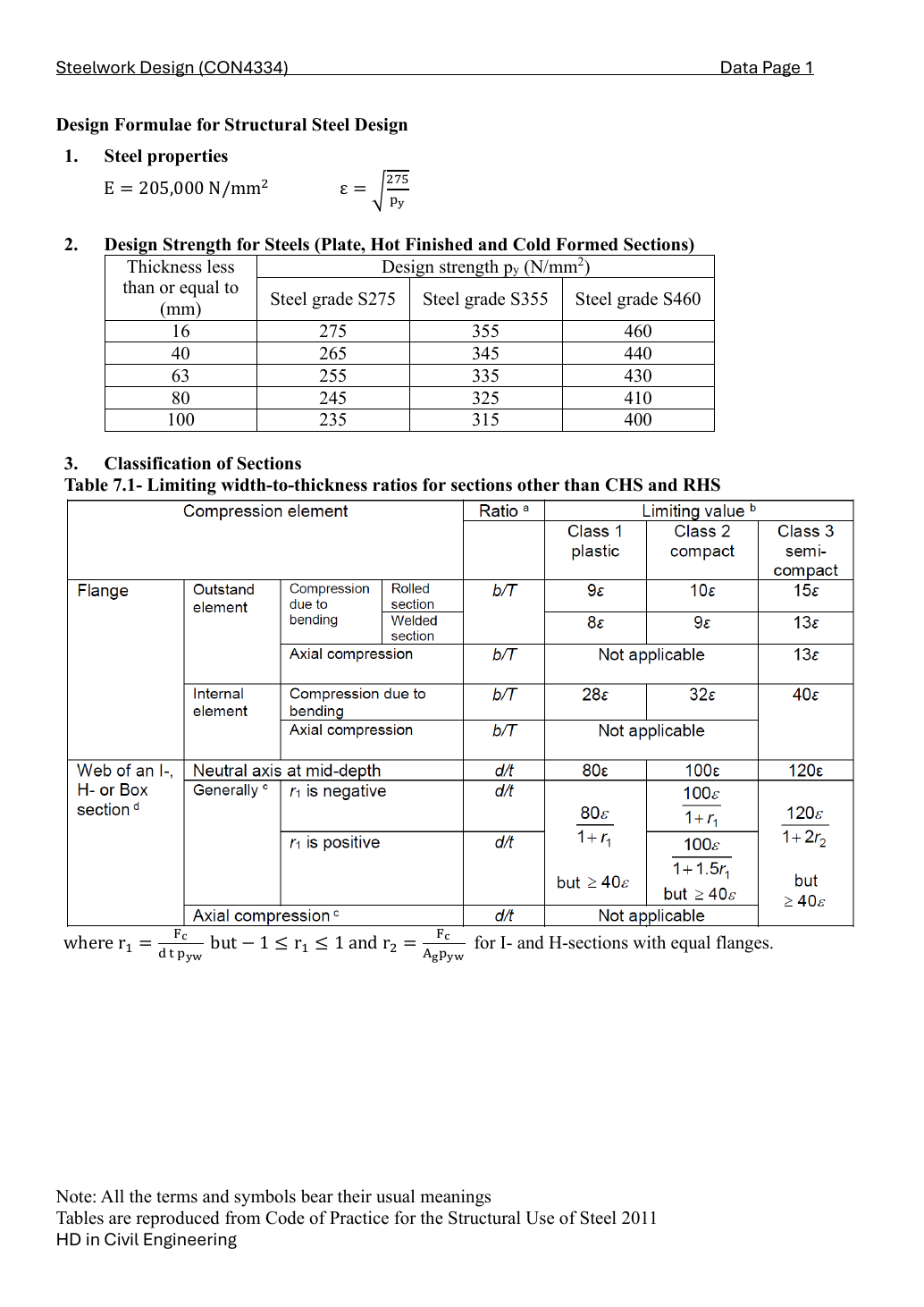
pw=250 N/mm2,a=0.7s=0.7(6)=4.2 mmp_w=250\,\mathrm{N/mm^2},\quad a=0.7s=0.7(6)=4.2\,\mathrm{mm}
qw=apw/1000=4.2(250)/1000=1.05 kN/mmq_w=ap_w/1000=4.2(250)/1000=1.05\,\mathrm{kN/mm}
Leff,required=P/(4qw)=800/(4(1.05))=190.47619 mmL_{eff,required}=P/(4q_w)=800/(4(1.05))=190.47619\,\mathrm{mm}

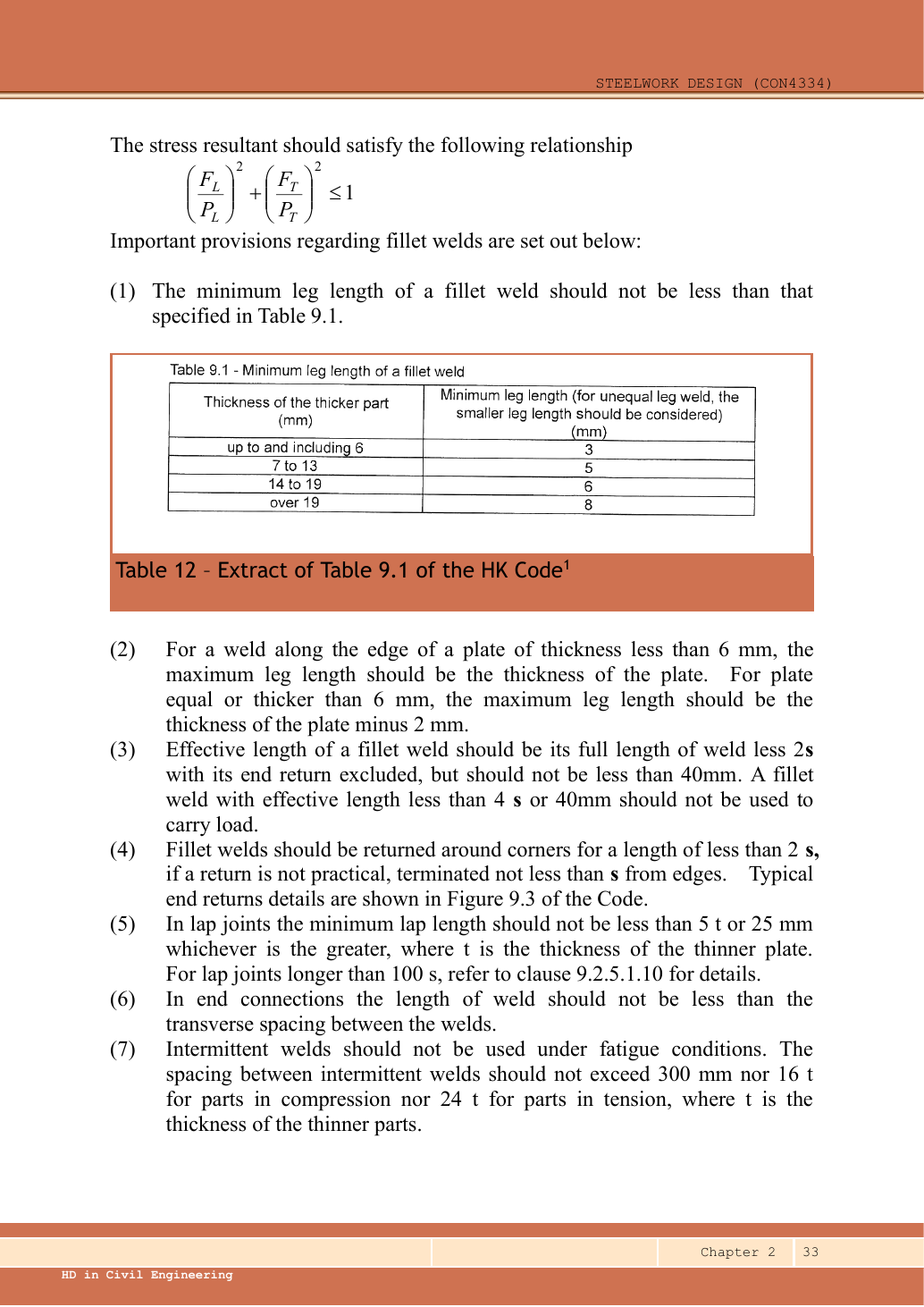
Provide enough effective length for force, minimum effective length and transverse weld spacing; add 2s to each run and round UP to 5 mm. This is a designed arrangement, not an unstated original length.

Lphysical=5⌈max⁡(190.47619,120,40,24)+2(6)5⌉=205 mmL_{physical}=5\left\lceil\frac{\max(190.47619,120,40,24)+2(6)}{5}\right\rceil=205\,\mathrm{mm}
Rw=4(205−2(6))(1.05)=810.6 kNR_w=4(205-2(6))(1.05)=810.6\,\mathrm{kN}
Llap≥max⁡(5tc,25)=max⁡(50,25)=50 mmL_{lap}\ge\max(5t_c,25)=\max(50,25)=50\,\mathrm{mm}
smin=6 mm,smax,edge=10−2=8 mms_{min}=6\,\mathrm{mm},\quad s_{max,edge}=10-2=8\,\mathrm{mm}
Teaching sketch: four longitudinal runs per half, two on each cover. L is each physical run; the butt gap is excluded.
Teaching sketch: four longitudinal runs per half, two on each cover. L is each physical run; the butt gap is excluded. Full-size image
s=6 mm,L=205 mms=6\,\mathrm{mm},\quad L=205\,\mathrm{mm}
Compact exam answer — key result lines
Lphysical=5⌈max⁡(190.47619,120,40,24)+2(6)5⌉=205 mmL_{physical}=5\left\lceil\frac{\max(190.47619,120,40,24)+2(6)}{5}\right\rceil=205\,\mathrm{mm}
Rw=4(205−2(6))(1.05)=810.6 kNR_w=4(205-2(6))(1.05)=810.6\,\mathrm{kN}
Llap≥max⁡(5tc,25)=max⁡(50,25)=50 mmL_{lap}\ge\max(5t_c,25)=\max(50,25)=50\,\mathrm{mm}
smin=6 mm,smax,edge=10−2=8 mms_{min}=6\,\mathrm{mm},\quad s_{max,edge}=10-2=8\,\mathrm{mm}
s=6 mm,L=205 mms=6\,\mathrm{mm},\quad L=205\,\mathrm{mm}

Provide enough effective length for force, minimum effective length and transverse weld spacing; add 2s to each run and round UP to 5 mm. This is a designed arrangement, not an unstated original length.

Welding arrangement [4 marks]

Teaching sketch: four longitudinal runs per half, two on each cover. L is each physical run; the butt gap is excluded.
Teaching sketch: four longitudinal runs per half, two on each cover. L is each physical run; the butt gap is excluded. Full-size image
s=6 mm,L=205 mms=6\,\mathrm{mm},\quad L=205\,\mathrm{mm}

Repeat the two longitudinal runs on the hidden cover. Size the lap for each side separately; do not run a counted load-carrying length across the unsupported butt gap.

Compact exam answer — key result lines
s=6 mm,L=205 mms=6\,\mathrm{mm},\quad L=205\,\mathrm{mm}

Repeat the two longitudinal runs on the hidden cover. Size the lap for each side separately; do not run a counted load-carrying length across the unsupported butt gap.

One-plate actions [2 marks]

Source: LectureNotes/Ch2_Connection.pdf · p.3, p.4, p.5, p.9, p.10
Source: LectureNotes/CON4334-Data File-20260730.pdf · p.1, p.4

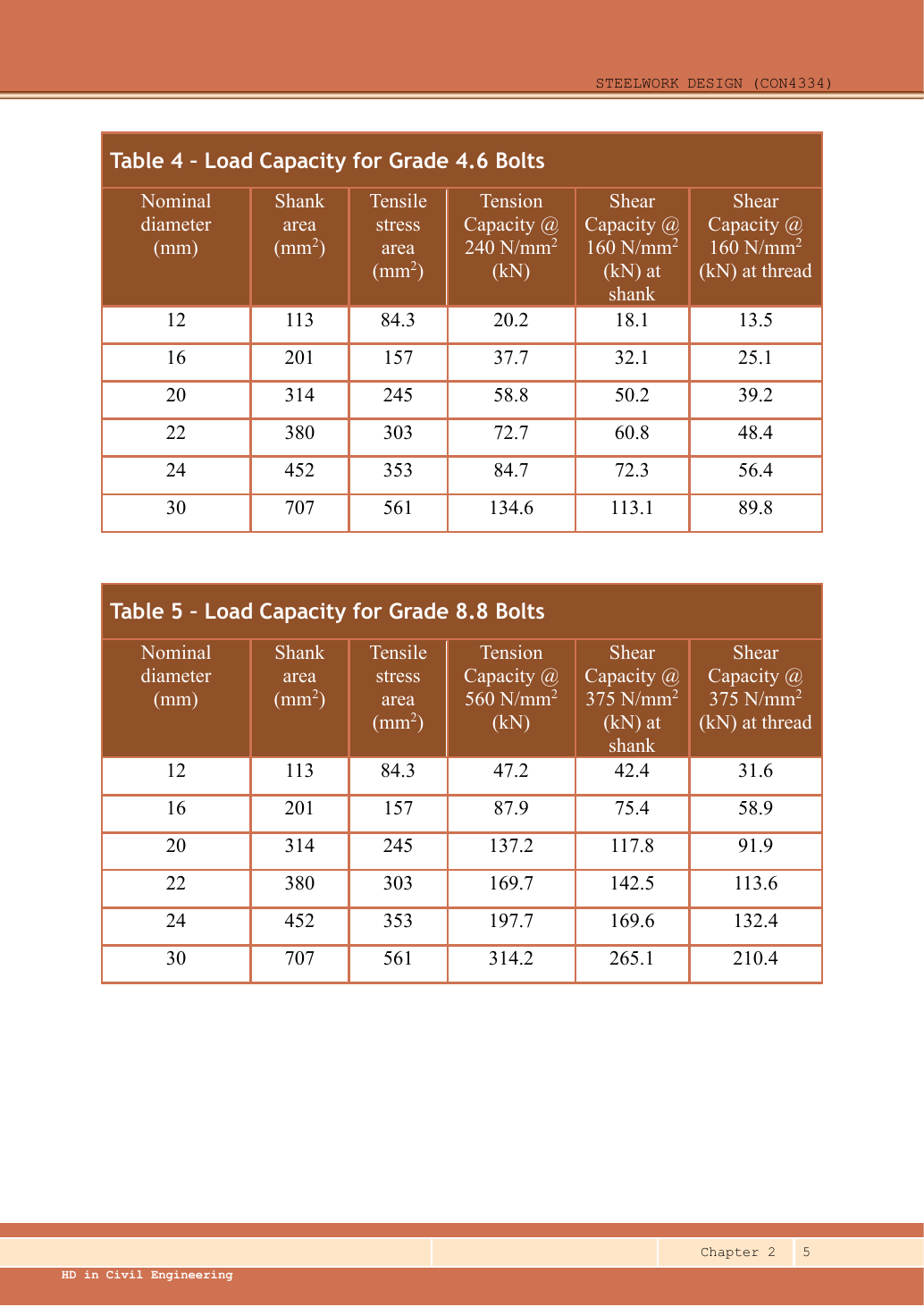
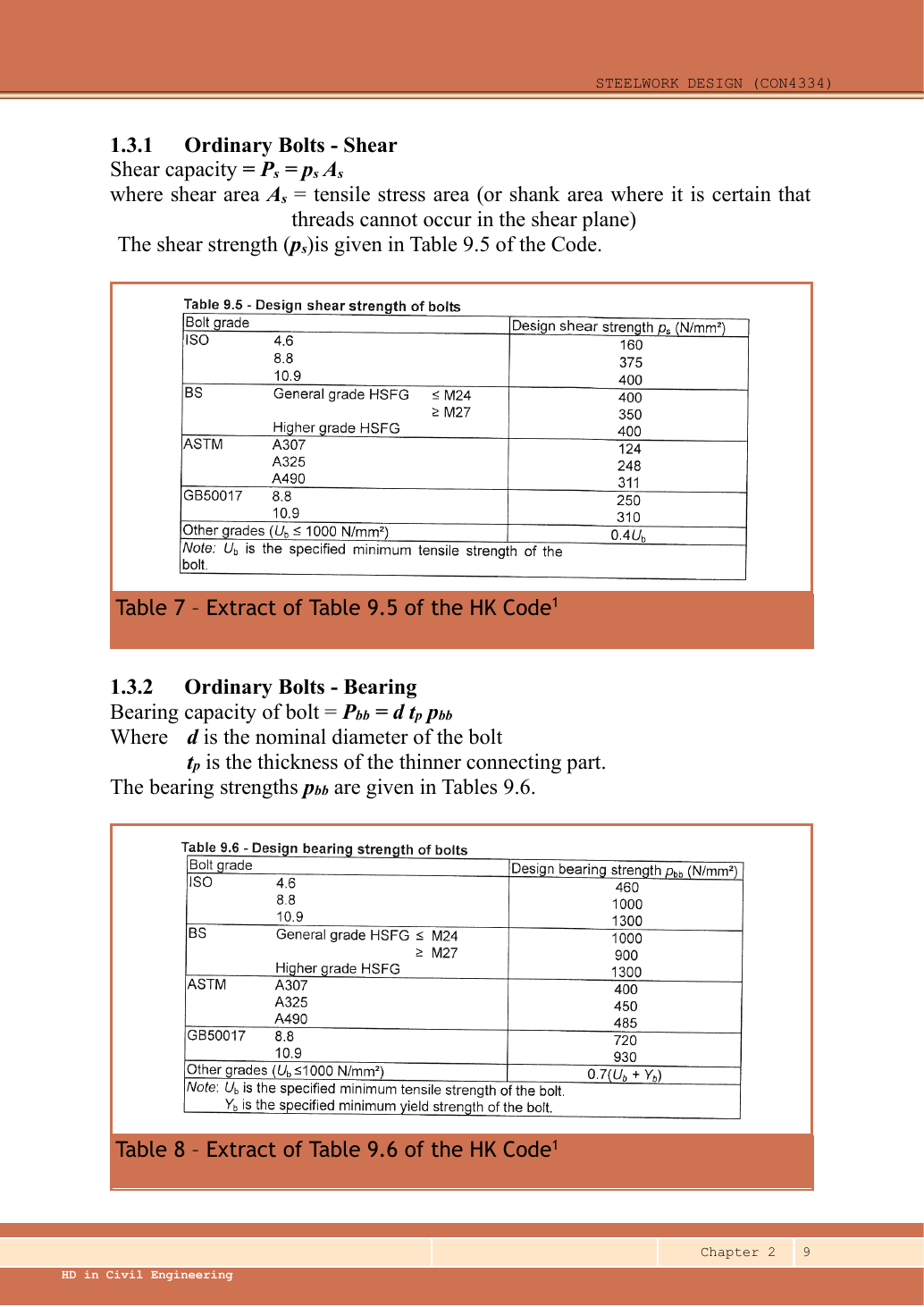
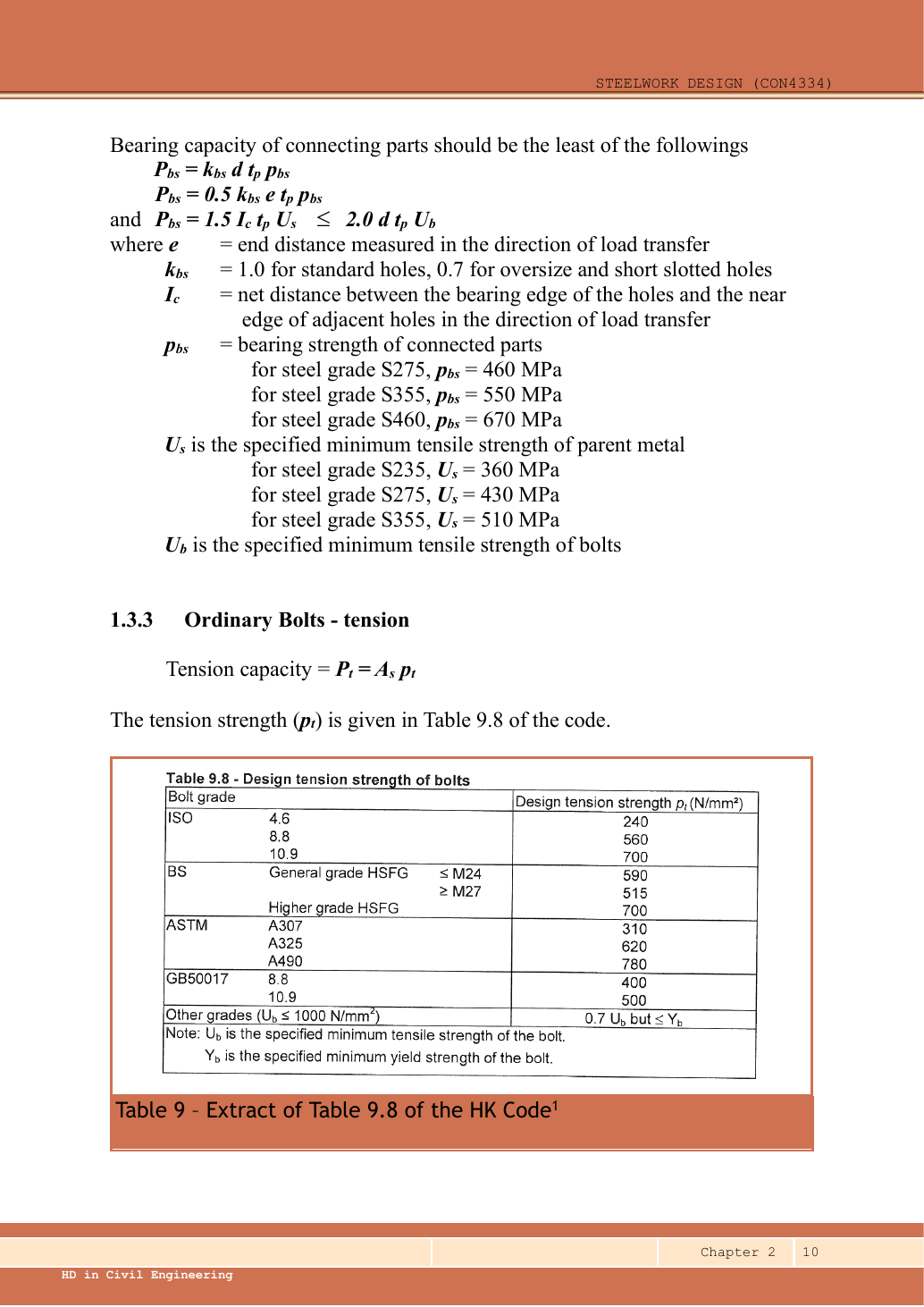
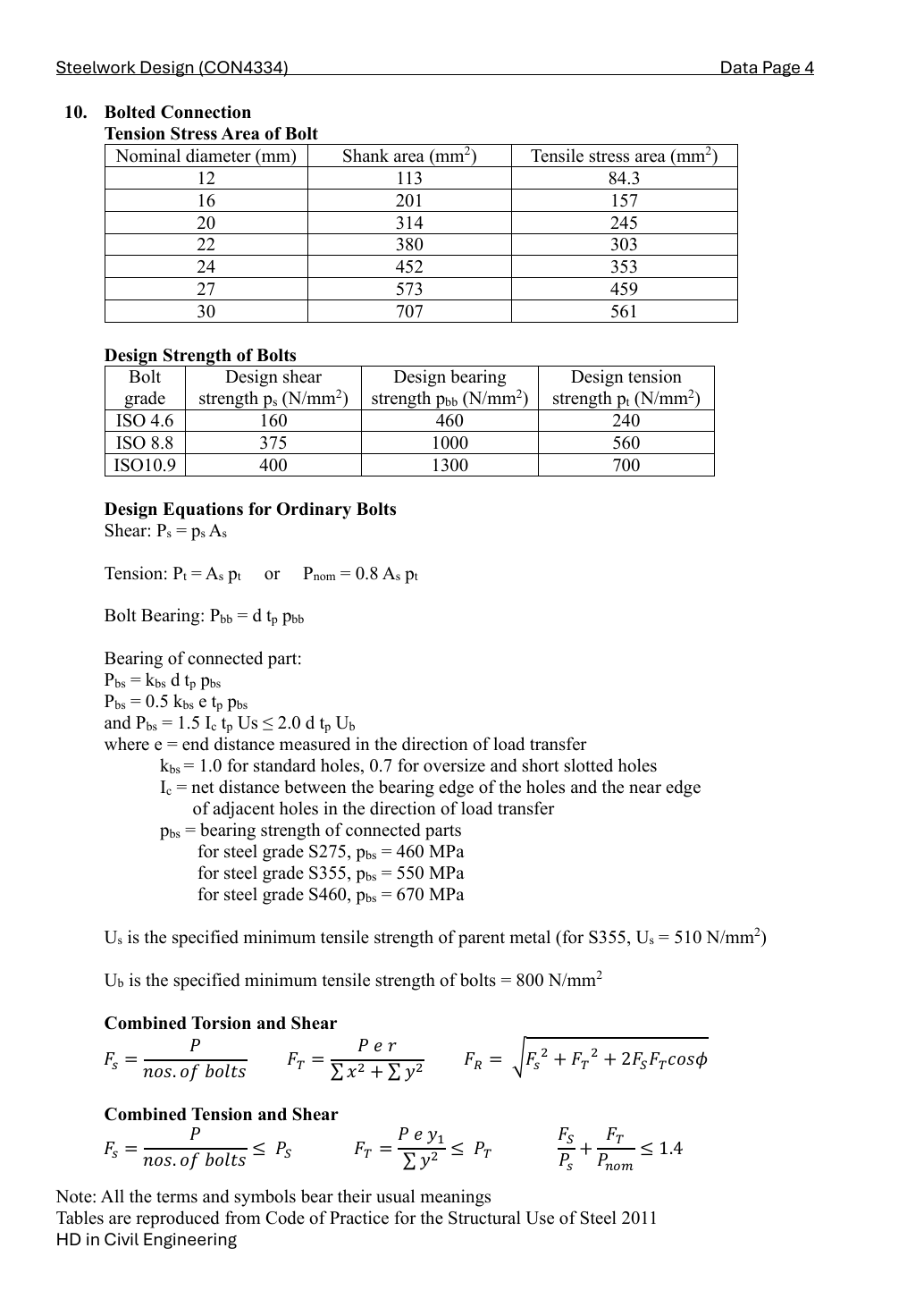
Grade 8.8: shear strength ps = 375, bolt bearing pbb = 1000, ultimate bolt strength Ub = 800 N/mm². S355 plate: pbs = 550, Us = 510 N/mm², Ke = 1.1. Use threaded stress area As for the conservative shear plane, nominal d for bearing, and hole diameter d0 for material removed.

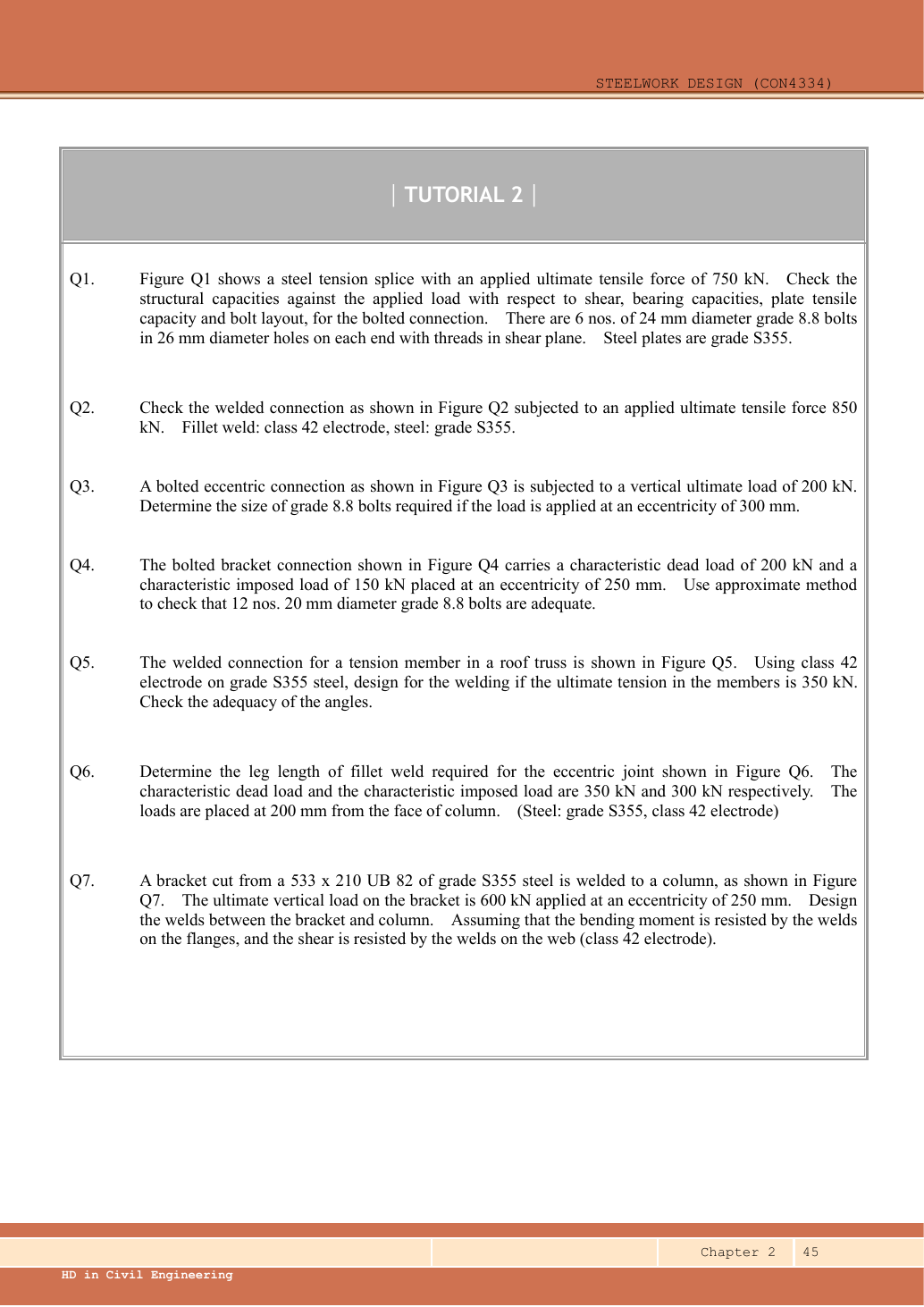
The two symmetric side plates share the total force and moment equally. Work on ONE plate, using bolt coordinates measured from that plate’s bolt-group centroid. A bolt connecting this side plate to its column flange is in single shear.

Pplate=1000/2=500.0 kN,Mplate=220(1000)/2=110000.0 kN mmP_{plate}=1000/2=500.0\,\mathrm{kN},\quad M_{plate}=220(1000)/2=110000.0\,\mathrm{kN\,mm}
xi∈{−70,70},yi∈{−100,0,100}(mm)x_i\in\{-70,70\},\quad y_i\in\{-100,0,100\}\quad(\mathrm{mm})
Compact exam answer — key result lines
Pplate=1000/2=500.0 kN,Mplate=220(1000)/2=110000.0 kN mmP_{plate}=1000/2=500.0\,\mathrm{kN},\quad M_{plate}=220(1000)/2=110000.0\,\mathrm{kN\,mm}
xi∈{−70,70},yi∈{−100,0,100}(mm)x_i\in\{-70,70\},\quad y_i\in\{-100,0,100\}\quad(\mathrm{mm})

The two symmetric side plates share the total force and moment equally. Work on ONE plate, using bolt coordinates measured from that plate’s bolt-group centroid. A bolt connecting this side plate to its column flange is in single shear.

Maximum bolt force [5 marks]

Direct shear P/n acts equally on each bolt. Torsion adds a force perpendicular to the radius. At the most loaded corner, its vertical component adds to direct shear; calculate both components before the resultant.

Jg=∑(xi2+yi2)=69400 mm2J_g=\sum(x_i^2+y_i^2)=69400\,\mathrm{mm^2}
Fx=Mplate∣ymax∣/Jg=110000.0(100)/69400=158.501441 kNF_x=M_{plate}|y_{max}|/J_g=110000.0(100)/69400=158.501441\,\mathrm{kN}
Fy=Pplate/n+Mplatexmax/Jg=500.0/6+110000.0(70)/69400=194.284342 kNF_y=P_{plate}/n+M_{plate}x_{max}/J_g=500.0/6+110000.0(70)/69400=194.284342\,\mathrm{kN}
FR=Fx2+Fy2=158.5014412+194.2843422=250.737138 kN/boltF_R=\sqrt{F_x^2+F_y^2}=\sqrt{158.501441^2+194.284342^2}=250.737138\,\mathrm{kN/bolt}
Compact exam answer — key result lines
Jg=∑(xi2+yi2)=69400 mm2J_g=\sum(x_i^2+y_i^2)=69400\,\mathrm{mm^2}
Fx=Mplate∣ymax∣/Jg=110000.0(100)/69400=158.501441 kNF_x=M_{plate}|y_{max}|/J_g=110000.0(100)/69400=158.501441\,\mathrm{kN}
Fy=Pplate/n+Mplatexmax/Jg=500.0/6+110000.0(70)/69400=194.284342 kNF_y=P_{plate}/n+M_{plate}x_{max}/J_g=500.0/6+110000.0(70)/69400=194.284342\,\mathrm{kN}
FR=Fx2+Fy2=158.5014412+194.2843422=250.737138 kN/boltF_R=\sqrt{F_x^2+F_y^2}=\sqrt{158.501441^2+194.284342^2}=250.737138\,\mathrm{kN/bolt}

Direct shear P/n acts equally on each bolt. Torsion adds a force perpendicular to the radius. At the most loaded corner, its vertical component adds to direct shear; calculate both components before the resultant.

Bolt shear [2 marks]

Ps=245(375)/1000=91.875 kN>0P_s=245(375)/1000=91.875\,\mathrm{kN}>0

FAIL

Compact exam answer — key result lines
Ps=245(375)/1000=91.875 kN>0P_s=245(375)/1000=91.875\,\mathrm{kN}>0

FAIL

Bolt bearing [2 marks]

Pbb,plate=20(12)(1000)/1000=240 kNP_{bb,plate}=20(12)(1000)/1000=240\,\mathrm{kN}

The column flange is another connected part. Its actual thickness must also pass; compare the lower bolt-bearing resistance.

Tcolumn≥FR/(dpbb)=250.737138/20=12.536857 mmT_{column}\ge F_R/(dp_{bb})=250.737138/20=12.536857\,\mathrm{mm}
Compact exam answer — key result lines
Pbb,plate=20(12)(1000)/1000=240 kNP_{bb,plate}=20(12)(1000)/1000=240\,\mathrm{kN}
Tcolumn≥FR/(dpbb)=250.737138/20=12.536857 mmT_{column}\ge F_R/(dp_{bb})=250.737138/20=12.536857\,\mathrm{mm}

The column flange is another connected part. Its actual thickness must also pass; compare the lower bolt-bearing resistance.

Plate bearing [6 marks]

Rbs,basic=20(12)(550)/1000=132 kNR_{bs,basic}=20(12)(550)/1000=132\,\mathrm{kN}

For the vector force, check distance to the edge and neighbouring hole in the bearing direction. A conservative independent-component check uses each component divided by its directional resistance and requires their sum ≤ 1. It bounds a linear interaction rather than pretending the resultant acts vertically.

Horizontal side-plate direction

Rbs=min⁡(dtpbs,0.5etpbs,1.5lctUs,2dtUb)/1000R_{bs}=\min(dt p_{bs},0.5etp_{bs},1.5l_ctU_s,2dtU_b)/1000
lc=p−d0=140−22=118 mml_c=p-d_0=140-22=118\,\mathrm{mm}
Rbs=min⁡(20(12)(550),0.5(59.4)(12)(550),1.5(118)(12)(510),2(20)(12)(800))/1000R_{bs}=\min(20(12)(550),0.5(59.4)(12)(550),1.5(118)(12)(510),2(20)(12)(800))/1000
Rbs=min⁡(132,196.02,1083.24,384)=132 kN/boltR_{bs}=\min(132,196.02,1083.24,384)=132\,\mathrm{kN/bolt}

Vertical side-plate direction

Rbs=min⁡(dtpbs,0.5etpbs,1.5lctUs,2dtUb)/1000R_{bs}=\min(dt p_{bs},0.5etp_{bs},1.5l_ctU_s,2dtU_b)/1000
lc=p−d0=100−22=78 mml_c=p-d_0=100-22=78\,\mathrm{mm}
Rbs=min⁡(20(12)(550),0.5(50)(12)(550),1.5(78)(12)(510),2(20)(12)(800))/1000R_{bs}=\min(20(12)(550),0.5(50)(12)(550),1.5(78)(12)(510),2(20)(12)(800))/1000
Rbs=min⁡(132,165,716.04,384)=132 kN/boltR_{bs}=\min(132,165,716.04,384)=132\,\mathrm{kN/bolt}
ηbearing=Fx/Rx+Fy/Ry=158.501441/132+194.284342/132=2.67262\eta_{bearing}=F_x/R_x+F_y/R_y=158.501441/132+194.284342/132=2.67262

FAIL

Compact exam answer — key result lines
Rbs=min⁡(dtpbs,0.5etpbs,1.5lctUs,2dtUb)/1000R_{bs}=\min(dt p_{bs},0.5etp_{bs},1.5l_ctU_s,2dtU_b)/1000
lc=p−d0=100−22=78 mml_c=p-d_0=100-22=78\,\mathrm{mm}
Rbs=min⁡(20(12)(550),0.5(50)(12)(550),1.5(78)(12)(510),2(20)(12)(800))/1000R_{bs}=\min(20(12)(550),0.5(50)(12)(550),1.5(78)(12)(510),2(20)(12)(800))/1000
Rbs=min⁡(132,165,716.04,384)=132 kN/boltR_{bs}=\min(132,165,716.04,384)=132\,\mathrm{kN/bolt}
ηbearing=Fx/Rx+Fy/Ry=158.501441/132+194.284342/132=2.67262\eta_{bearing}=F_x/R_x+F_y/R_y=158.501441/132+194.284342/132=2.67262

FAIL

Reusable procedure and common errors

  1. Draw the load-transfer stages. Count bolts and shear planes for one stage, then compare all failure modes.
  2. Resolve eccentric forces as vectors. Never add perpendicular components arithmetically.
  3. Use effective weld length and check size limits after strength; “strong enough” does not fix an impossible detail.

Independent practice — invented variant

Invented variant: all applied loads are 10% larger but geometry is unchanged. What scales, and what does not?

Hint

Isolate one load-transfer stage, then distinguish demand from fixed resistance.

Reveal answer

For these linear elastic models, bolt forces and weld force per unit length rise 10%; required strength-only weld throat also rises 10%. Bolt areas, section capacities, effective lengths of already specified welds and detailing limits stay unchanged. Recheck every utilisation.