Steelwork · Exam learning

2014–2019 · Reference answers

2017-05-19 — beam answers

All independent beam subquestions, including the required sketches and restraint variants.

Independent teaching answer, not an official solution or marking scheme. Printed marks are retained. Read the source conditions beside each result.

Identify vertical supports and lateral restraints

Units: 1 kN = 1,000 N; 1 m = 1,000 mm; 1 cm³ = 1,000 mm³; 1 cm⁴ = 10,000 mm⁴. A demand is the load effect; a resistance is what the member can carry. Compare matching units.

The triangular/roller end supports supply the vertical reactions. Intermediate lateral restraints stop sideways motion of the compression flange; they do not supply extra vertical reactions. Point-load distances below are read from the original dimension chain, measured from the left support. All plotted loads are already factored.

Given: 356 × 171 × 51 UB, S355; total span 6 m; full-span UDL 1 kN/m; point loads 40 kN at x=1.5 m, 60 kN at x=3 m, 30 kN at x=4.5 m.
Source: LectureNotes/CON4334-Data File-20260730.pdf · p.9, p.10

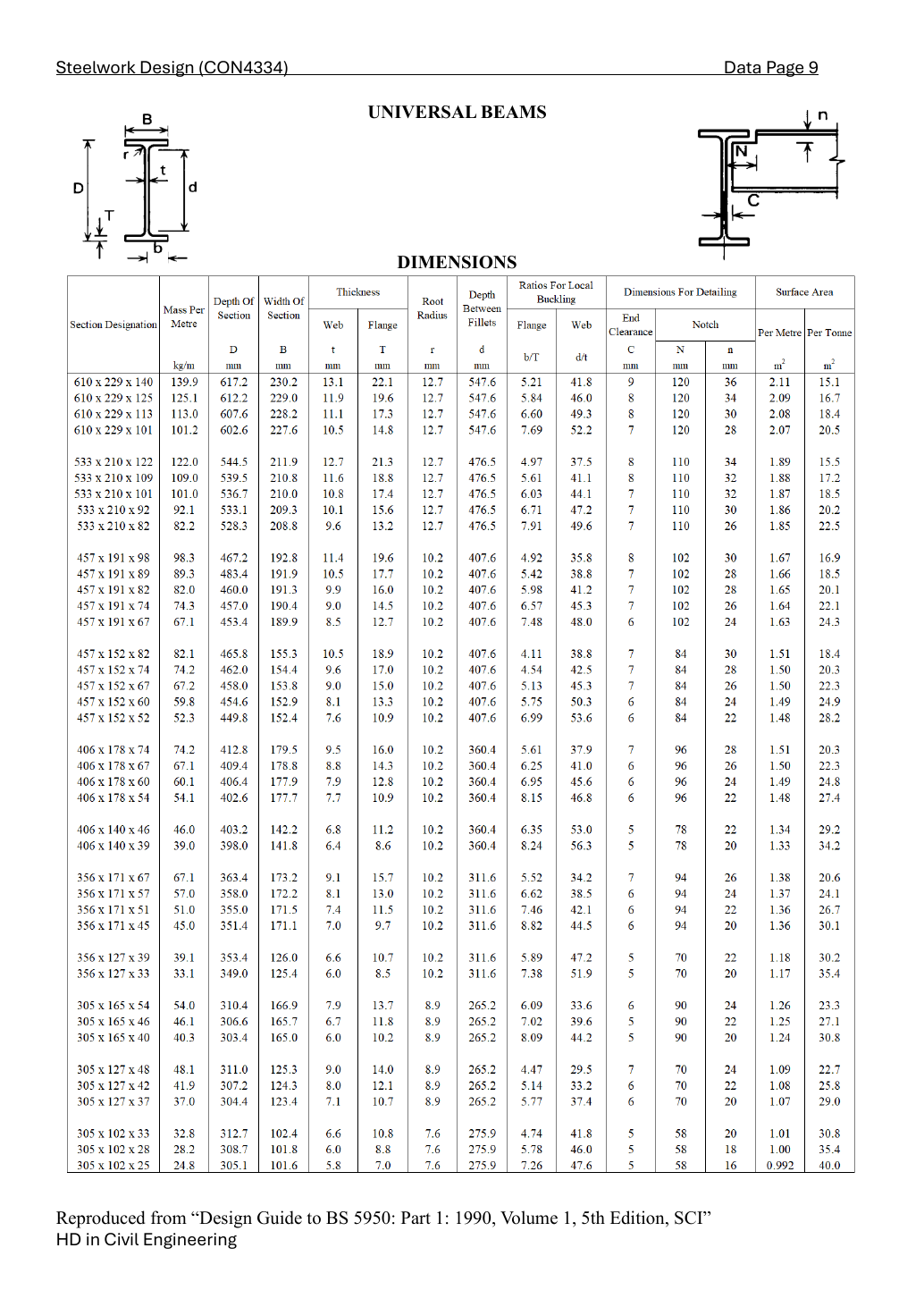
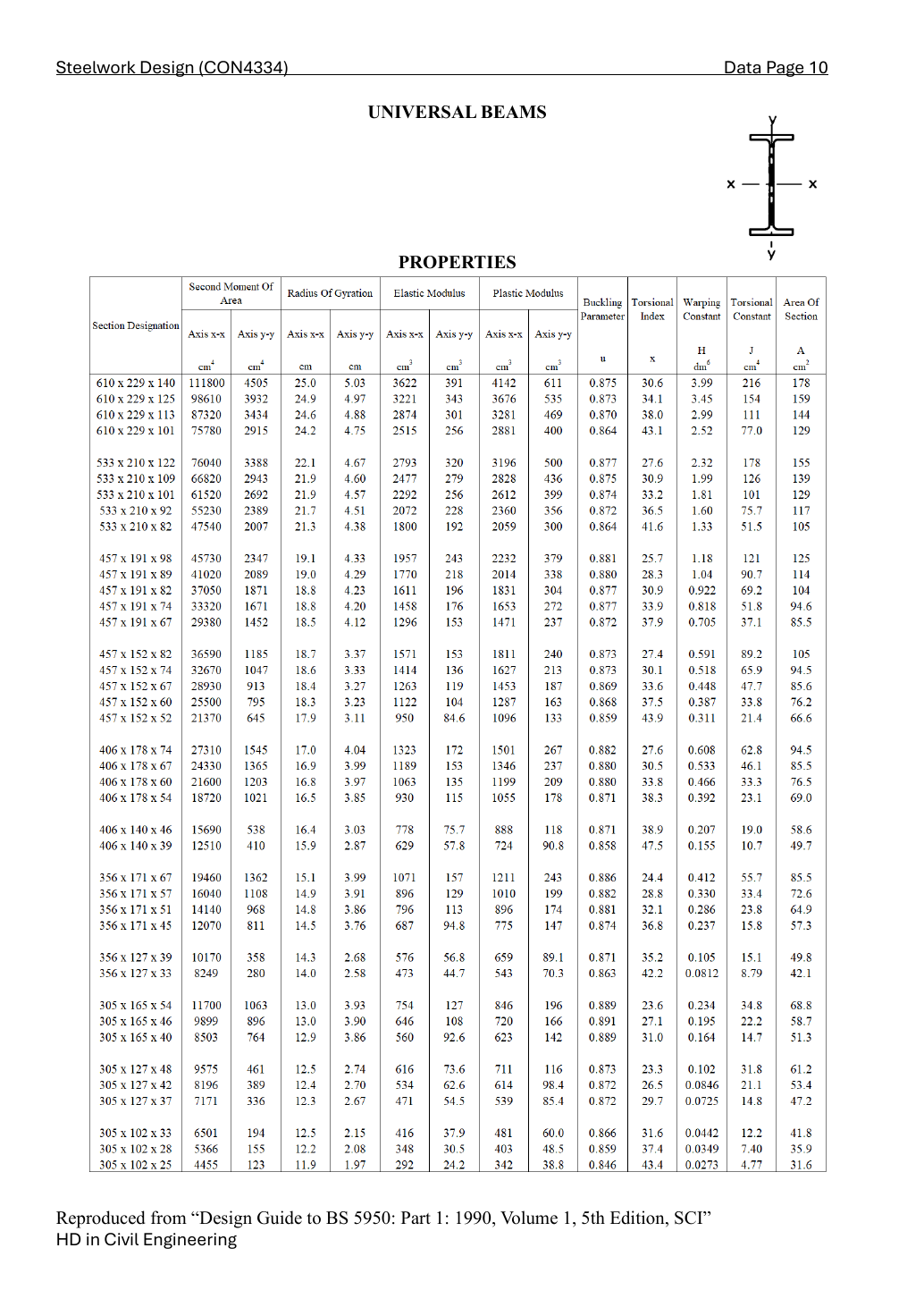
Lookup the exact 356 × 171 × 51 UB row. Read dimensions first, properties second. D = overall depth; t = web thickness; T = flange thickness; d = clear web depth. The designation is not an exact dimension.
D=355, t=7.4, T=11.5, d=311.6(mm)D=355,\ t=7.4,\ T=11.5,\ d=311.6\quad(\mathrm{mm})
b/T=7.46, d/t=42.1, Ix=14140 cm4, Zx=796 cm3, Sx=896 cm3b/T=7.46,\ d/t=42.1,\ I_x=14140\,\mathrm{cm^4},\ Z_x=796\,\mathrm{cm^3},\ S_x=896\,\mathrm{cm^3}
ry=38.6 mm,u=0.881,x=32.1r_y=38.6\,\mathrm{mm},\quad u=0.881,\quad x=32.1
Source: LectureNotes/CON4334-Data File-20260730.pdf · p.1

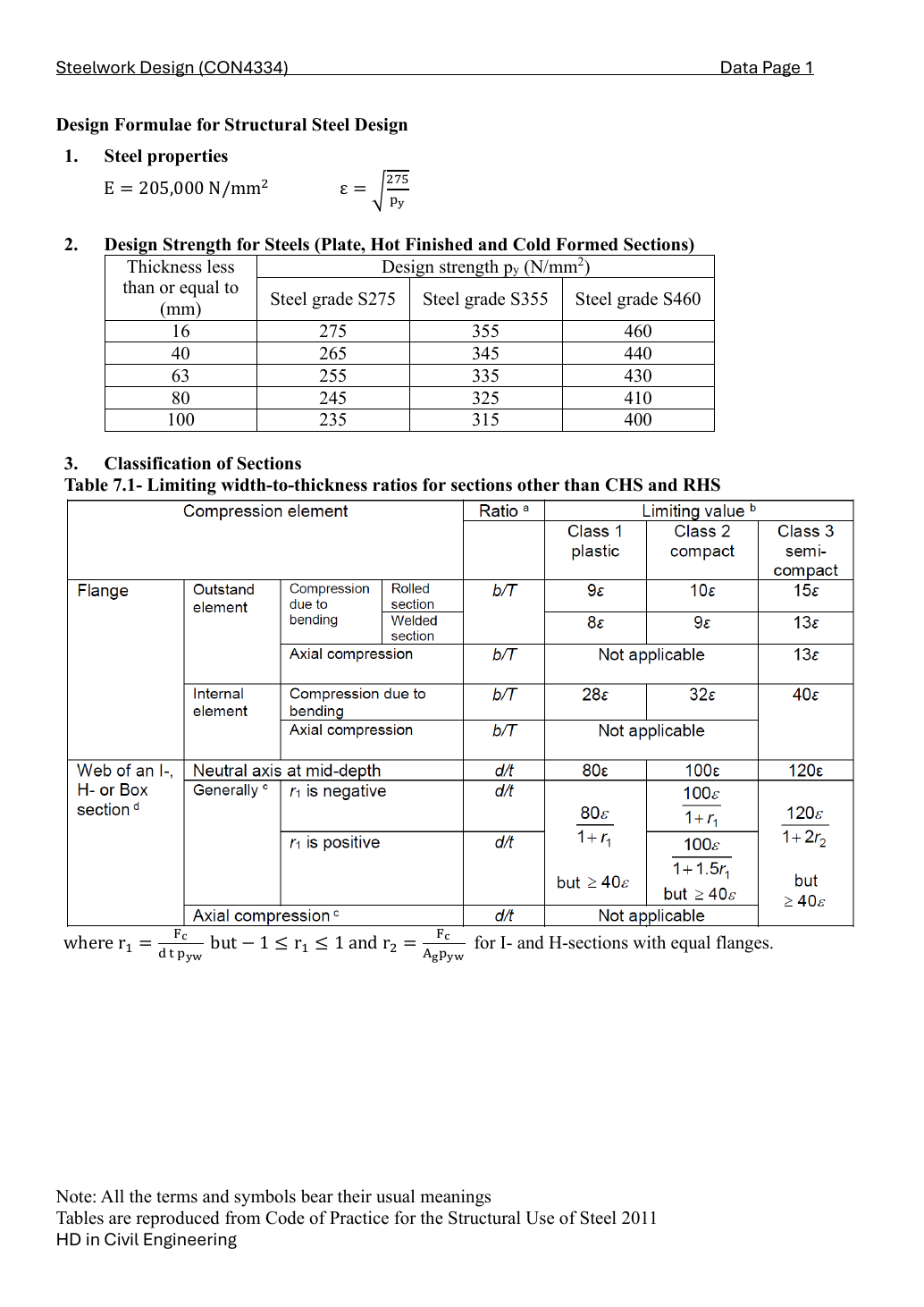
S355 design strength depends on the actual flange thickness. Local classification decides whether plastic bending resistance is allowed. In pure bending the web limit is different from uniform compression.

py=355 N/mm2,ϵ=275/355=0.880141p_y=355\,\mathrm{N/mm^2},\quad\epsilon=\sqrt{275/355}=0.880141
b/T=7.46,9ϵ=7.921,10ϵ=8.801,13ϵ=11.442b/T=7.46,\quad9\epsilon=7.921,\quad10\epsilon=8.801,\quad13\epsilon=11.442
d/t=42.1<80ϵ=70.411⟹Class 1d/t=42.1<80\epsilon=70.411\quad\Longrightarrow\quad\mathrm{Class}\ 1

Take the worse flange/web class. Class 1 or 2 permits the capped plastic modulus; Class 3 uses the elastic modulus.

Support reactions [3 marks]

Take moments about the left support to eliminate RA, then sum vertical forces. An applied counter-clockwise end couple contributes positively to the external moment balance and is subtracted when solving for RB.

RBL+0−wL2/2−∑Piai=0R_BL+0-wL^2/2-\sum P_ia_i=0
RB=1(6)2/2+40(1.5)+60(3)+30(4.5)−06=65.5 kNR_B=\frac{1(6)^2/2+40(1.5)+60(3)+30(4.5)-0}{6}=65.5\,\mathrm{kN}
RA=1(6)+40+60+30−65.5=70.5 kNR_A=1(6)+40+60+30-65.5=70.5\,\mathrm{kN}
RA+RB=136 kN=wL+∑PiR_A+R_B=136\,\mathrm{kN}=wL+\sum P_i
Compact exam answer — key result lines
RBL+0−wL2/2−∑Piai=0R_BL+0-wL^2/2-\sum P_ia_i=0
RB=1(6)2/2+40(1.5)+60(3)+30(4.5)−06=65.5 kNR_B=\frac{1(6)^2/2+40(1.5)+60(3)+30(4.5)-0}{6}=65.5\,\mathrm{kN}
RA=1(6)+40+60+30−65.5=70.5 kNR_A=1(6)+40+60+30-65.5=70.5\,\mathrm{kN}
RA+RB=136 kN=wL+∑PiR_A+R_B=136\,\mathrm{kN}=wL+\sum P_i

Take moments about the left support to eliminate RA, then sum vertical forces. An applied counter-clockwise end couple contributes positively to the external moment balance and is subtracted when solving for RB.

Shear-force and bending-moment diagrams [4 marks]

Cut the beam at distance x. Keep only loads to the left of the cut. A point load drops the SFD by its magnitude; the UDL gives slope −w. The BMD is the integral of shear, so it is continuous through a point force and curved under a UDL. Maximum moment can occur at a shear sign change or at a loaded/coupled boundary.

V(x)=RA−wx−∑ai<xPi(kN)V(x)=R_A-wx-\sum_{a_i<x}P_i\quad(\mathrm{kN})
M(x)=RAx−wx2/2−∑iPimax⁡(0,x−ai)(kN m)M(x)=R_Ax-wx^2/2-\sum_iP_i\max(0,x-a_i)\quad(\mathrm{kN\,m})
M(x)=70.5x−1x2/2−40max⁡(0,x−1.5)−60max⁡(0,x−3)−30max⁡(0,x−4.5)M(x)=70.5x-1x^2/2-40\max(0,x-1.5)-60\max(0,x-3)-30\max(0,x-4.5)
x (m)V just left (kN)V just right (kN)M (kN m)
070.570.50
1.56929104.625
327.5-32.5147
4.5-34-6497.125
6-65.5-65.50

At the end supports the table gives the internal beam-side value; the external SFD closes to zero after including the reaction. At an internal zero-shear point, substitute x = (RA − preceding point loads)/w when that x lies within the interval.
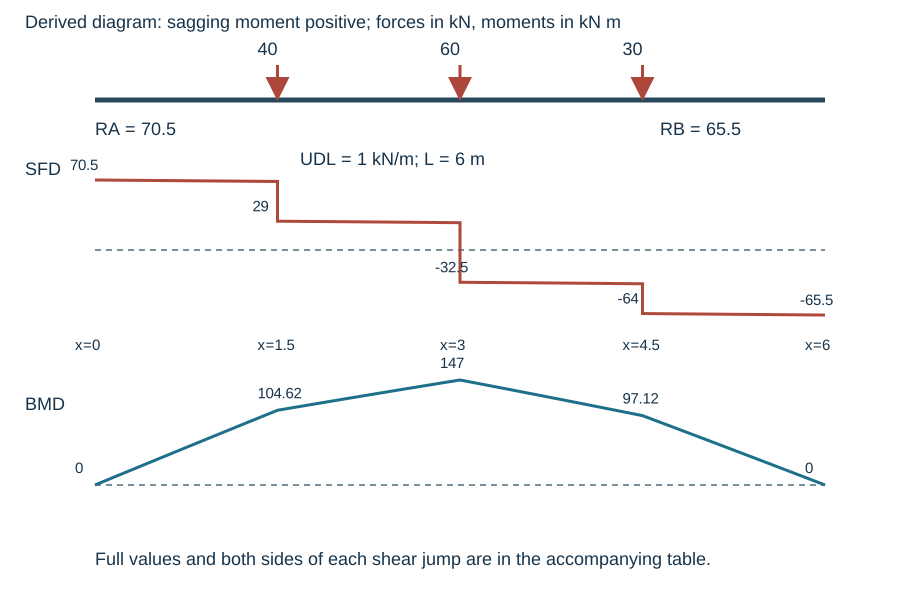
Calculated SFD and BMD; point-load jumps, UDL curvature and labelled ordinates.
Calculated SFD and BMD; point-load jumps, UDL curvature and labelled ordinates. Full-size image
Compact exam answer — key result lines
V(x)=RA−wx−∑ai<xPi(kN)V(x)=R_A-wx-\sum_{a_i<x}P_i\quad(\mathrm{kN})
M(x)=RAx−wx2/2−∑iPimax⁡(0,x−ai)(kN m)M(x)=R_Ax-wx^2/2-\sum_iP_i\max(0,x-a_i)\quad(\mathrm{kN\,m})
M(x)=70.5x−1x2/2−40max⁡(0,x−1.5)−60max⁡(0,x−3)−30max⁡(0,x−4.5)M(x)=70.5x-1x^2/2-40\max(0,x-1.5)-60\max(0,x-3)-30\max(0,x-4.5)

At the end supports the table gives the internal beam-side value; the external SFD closes to zero after including the reaction. At an internal zero-shear point, substitute x = (RA − preceding point loads)/w when that x lies within the interval.

LTB: restraint positions 0, 6 m [13 marks]

Check the segment x = 0 to 6 m. Its length is 6 m; the largest |M| occurs at x = 3 m.

Quarter stations: 1.5 m, 3 m, 4.5 m.
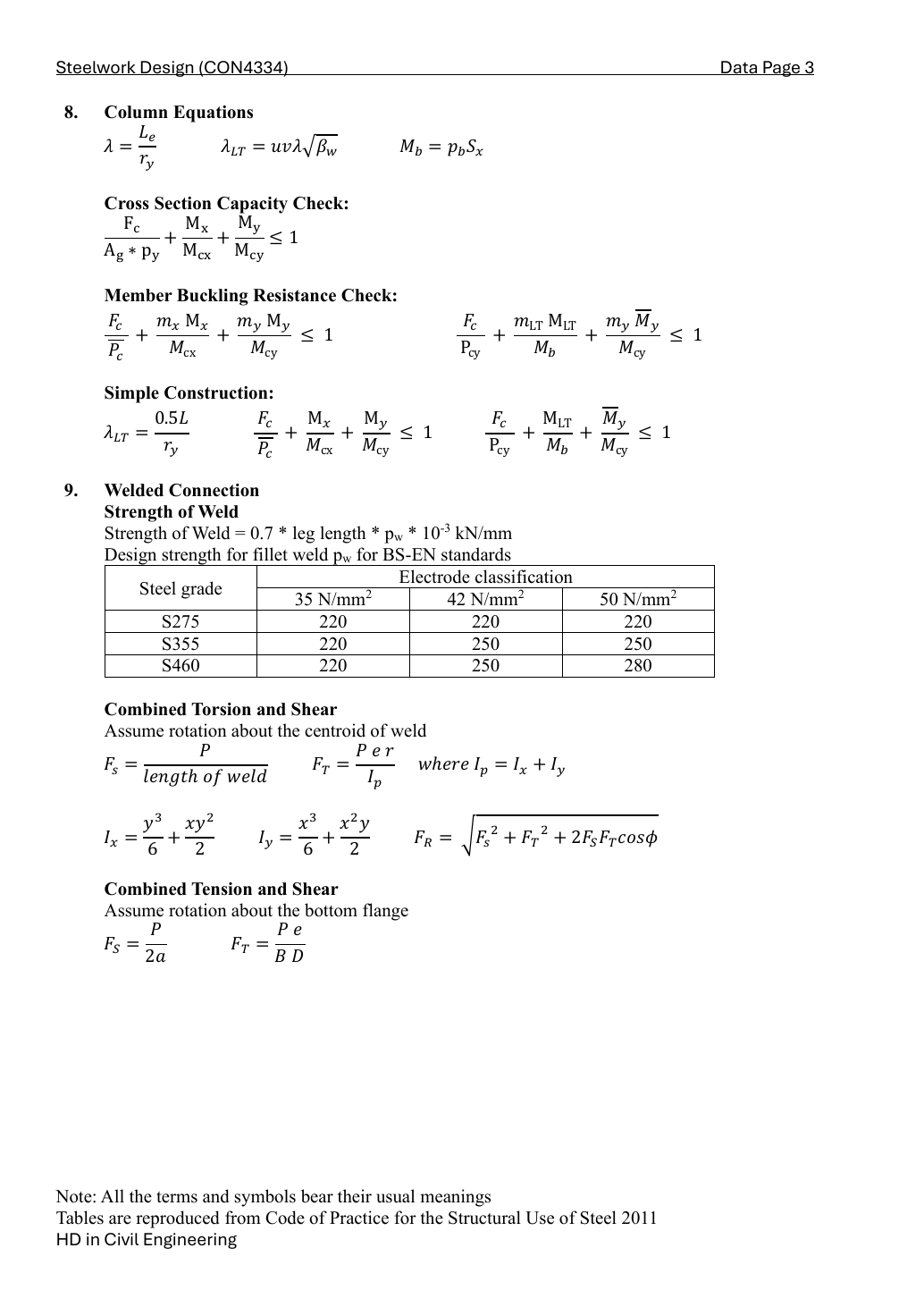
Source: LectureNotes/CON4334-Data File-20260730.pdf · p.3

For this restraint segment, take the absolute moments at its quarter, half and three-quarter points; divide by the largest absolute moment anywhere in the same segment. The stations belong to the segment, not necessarily to the whole beam. Apply the lower bound 0.44.

M2=104.625,M3=147,M4=97.125,Mmax=147(kN m)M_2=104.625,\quad M_3=147,\quad M_4=97.125,\quad M_{max}=147\quad(\mathrm{kN\,m})
mLT=max⁡[0.44,0.2+0.15∣104.625∣+0.5∣147∣+0.15∣97.125∣147]=0.905867m_{LT}=\max\left[0.44,0.2+\frac{0.15|104.625|+0.5|147|+0.15|97.125|}{147}\right]=0.905867

Use the stated normal-loading effective-length branch: LE equals the distance between effective lateral/torsional restraints. A restraint does not create a new vertical support. Class 1/2 gives βW = 1.
λ=LEry=600038.6=155.440415\lambda=\frac{L_E}{r_y}=\frac{6000}{38.6}=155.440415
v=[1+0.05(155.44041532.1)2]−1/4=0.823689v=\left[1+0.05\left(\frac{155.440415}{32.1}\right)^2\right]^{-1/4}=0.823689
λLT=uvλ=0.881(0.823689)(155.440415)=112.798489\lambda_{LT}=uv\lambda=0.881(0.823689)(155.440415)=112.798489
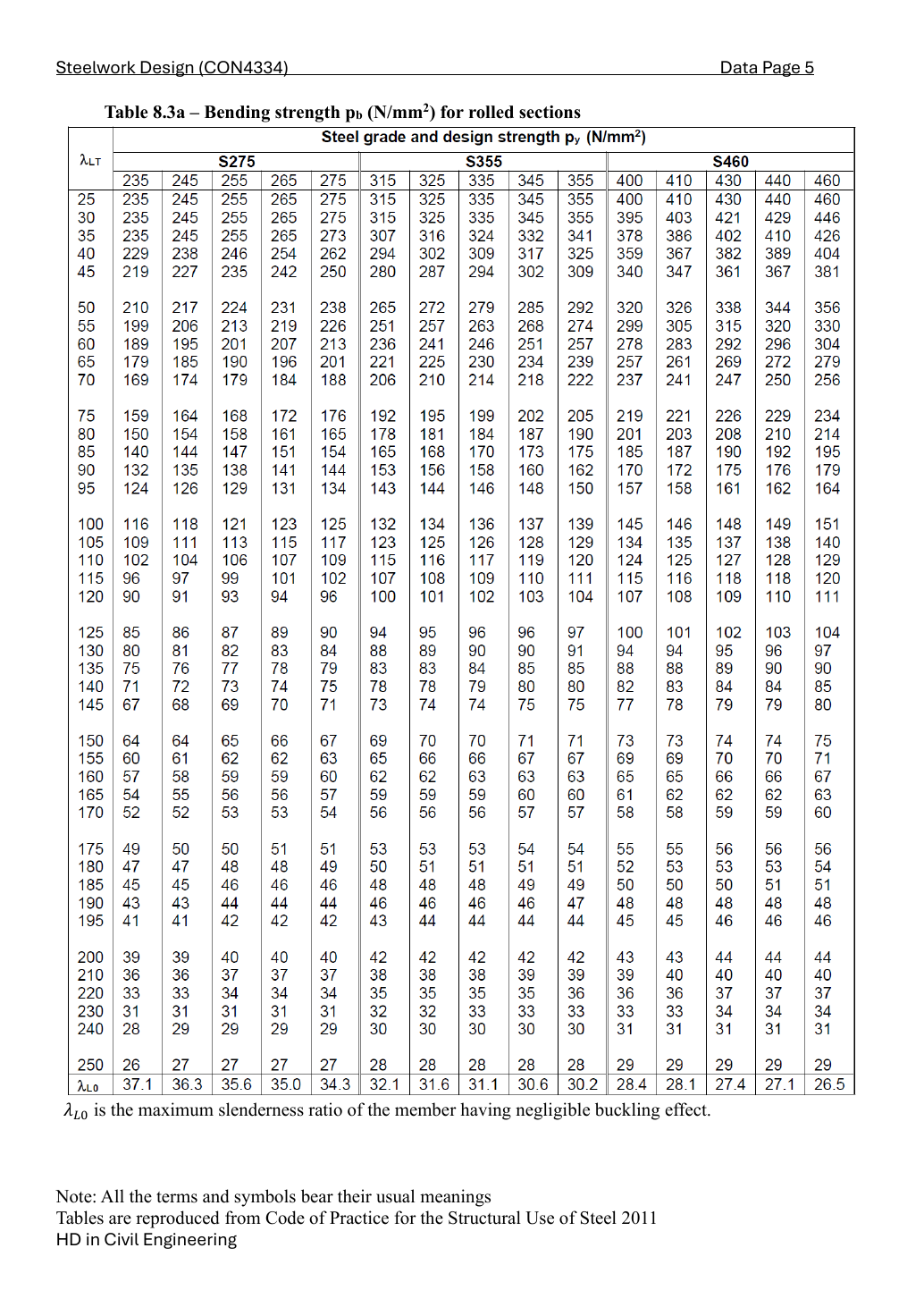
Source: LectureNotes/CON4334-Data File-20260730.pdf · p.5

Table 8.3, py = 355 N/mm² column; bracketing λLT rows 110 and 115. Interpolate in this column only.

pb=120+112.798489−110115−110(111−120)=114.962719 N/mm2p_b=120+\frac{112.798489-110}{115-110}(111-120)=114.962719\,\mathrm{N/mm^2}
Mb=pbSx/1000=114.962719(896)/1000=103.006596 kN mM_b=p_bS_x/1000=114.962719(896)/1000=103.006596\,\mathrm{kN\,m}
mLTMmax=0.905867(147)=133.1625 kN mm_{LT}M_{max}=0.905867(147)=133.1625\,\mathrm{kN\,m}
ηLT=133.1625/103.006596=1.292757\eta_{LT}=133.1625/103.006596=1.292757

FAIL

Every listed segment must pass. Do not compare the whole-beam maximum with a short segment’s capacity unless that maximum occurs in that segment.

Compact exam answer — key result lines
λLT=uvλ=0.881(0.823689)(155.440415)=112.798489\lambda_{LT}=uv\lambda=0.881(0.823689)(155.440415)=112.798489
pb=120+112.798489−110115−110(111−120)=114.962719 N/mm2p_b=120+\frac{112.798489-110}{115-110}(111-120)=114.962719\,\mathrm{N/mm^2}
Mb=pbSx/1000=114.962719(896)/1000=103.006596 kN mM_b=p_bS_x/1000=114.962719(896)/1000=103.006596\,\mathrm{kN\,m}
mLTMmax=0.905867(147)=133.1625 kN mm_{LT}M_{max}=0.905867(147)=133.1625\,\mathrm{kN\,m}
ηLT=133.1625/103.006596=1.292757\eta_{LT}=133.1625/103.006596=1.292757

Every listed segment must pass. Do not compare the whole-beam maximum with a short segment’s capacity unless that maximum occurs in that segment.

LTB: restraint positions 0, 1.5, 3, 4.5, 6 m [10 marks]

Check the segment x = 0 to 1.5 m. Its length is 1.5 m; the largest |M| occurs at x = 1.5 m.

Quarter stations: 0.375 m, 0.75 m, 1.125 m.

Source: LectureNotes/CON4334-Data File-20260730.pdf · p.3

For this restraint segment, take the absolute moments at its quarter, half and three-quarter points; divide by the largest absolute moment anywhere in the same segment. The stations belong to the segment, not necessarily to the whole beam. Apply the lower bound 0.44.

M2=26.367188,M3=52.59375,M4=78.679688,Mmax=104.625(kN m)M_2=26.367188,\quad M_3=52.59375,\quad M_4=78.679688,\quad M_{max}=104.625\quad(\mathrm{kN\,m})
mLT=max⁡[0.44,0.2+0.15∣26.367188∣+0.5∣52.59375∣+0.15∣78.679688∣104.625]=0.601949m_{LT}=\max\left[0.44,0.2+\frac{0.15|26.367188|+0.5|52.59375|+0.15|78.679688|}{104.625}\right]=0.601949

Use the stated normal-loading effective-length branch: LE equals the distance between effective lateral/torsional restraints. A restraint does not create a new vertical support. Class 1/2 gives βW = 1.

λ=LEry=150038.6=38.860104\lambda=\frac{L_E}{r_y}=\frac{1500}{38.6}=38.860104
v=[1+0.05(38.86010432.1)2]−1/4=0.982476v=\left[1+0.05\left(\frac{38.860104}{32.1}\right)^2\right]^{-1/4}=0.982476
λLT=uvλ=0.881(0.982476)(38.860104)=33.635811\lambda_{LT}=uv\lambda=0.881(0.982476)(38.860104)=33.635811
Source: LectureNotes/CON4334-Data File-20260730.pdf · p.5

Table 8.3, py = 355 N/mm² column; bracketing λLT rows 30 and 35. Interpolate in this column only.

pb=355+33.635811−3035−30(341−355)=344.819729 N/mm2p_b=355+\frac{33.635811-30}{35-30}(341-355)=344.819729\,\mathrm{N/mm^2}
Mb=pbSx/1000=344.819729(896)/1000=308.958477 kN mM_b=p_bS_x/1000=344.819729(896)/1000=308.958477\,\mathrm{kN\,m}
mLTMmax=0.601949(104.625)=62.978906 kN mm_{LT}M_{max}=0.601949(104.625)=62.978906\,\mathrm{kN\,m}
ηLT=62.978906/308.958477=0.203843\eta_{LT}=62.978906/308.958477=0.203843

PASS

Check the segment x = 1.5 to 3 m. Its length is 1.5 m; the largest |M| occurs at x = 3 m.

Quarter stations: 1.875 m, 2.25 m, 2.625 m.

Source: LectureNotes/CON4334-Data File-20260730.pdf · p.3

For this restraint segment, take the absolute moments at its quarter, half and three-quarter points; divide by the largest absolute moment anywhere in the same segment. The stations belong to the segment, not necessarily to the whole beam. Apply the lower bound 0.44.

M2=115.429688,M3=126.09375,M4=136.617188,Mmax=147(kN m)M_2=115.429688,\quad M_3=126.09375,\quad M_4=136.617188,\quad M_{max}=147\quad(\mathrm{kN\,m})
mLT=max⁡[0.44,0.2+0.15∣115.429688∣+0.5∣126.09375∣+0.15∣136.617188∣147]=0.886081m_{LT}=\max\left[0.44,0.2+\frac{0.15|115.429688|+0.5|126.09375|+0.15|136.617188|}{147}\right]=0.886081

Use the stated normal-loading effective-length branch: LE equals the distance between effective lateral/torsional restraints. A restraint does not create a new vertical support. Class 1/2 gives βW = 1.

λ=LEry=150038.6=38.860104\lambda=\frac{L_E}{r_y}=\frac{1500}{38.6}=38.860104
v=[1+0.05(38.86010432.1)2]−1/4=0.982476v=\left[1+0.05\left(\frac{38.860104}{32.1}\right)^2\right]^{-1/4}=0.982476
λLT=uvλ=0.881(0.982476)(38.860104)=33.635811\lambda_{LT}=uv\lambda=0.881(0.982476)(38.860104)=33.635811
Source: LectureNotes/CON4334-Data File-20260730.pdf · p.5

Table 8.3, py = 355 N/mm² column; bracketing λLT rows 30 and 35. Interpolate in this column only.

pb=355+33.635811−3035−30(341−355)=344.819729 N/mm2p_b=355+\frac{33.635811-30}{35-30}(341-355)=344.819729\,\mathrm{N/mm^2}
Mb=pbSx/1000=344.819729(896)/1000=308.958477 kN mM_b=p_bS_x/1000=344.819729(896)/1000=308.958477\,\mathrm{kN\,m}
mLTMmax=0.886081(147)=130.253906 kN mm_{LT}M_{max}=0.886081(147)=130.253906\,\mathrm{kN\,m}
ηLT=130.253906/308.958477=0.42159\eta_{LT}=130.253906/308.958477=0.42159

PASS

Check the segment x = 3 to 4.5 m. Its length is 1.5 m; the largest |M| occurs at x = 3 m.

Quarter stations: 3.375 m, 3.75 m, 4.125 m.

Source: LectureNotes/CON4334-Data File-20260730.pdf · p.3

For this restraint segment, take the absolute moments at its quarter, half and three-quarter points; divide by the largest absolute moment anywhere in the same segment. The stations belong to the segment, not necessarily to the whole beam. Apply the lower bound 0.44.

M2=134.742188,M3=122.34375,M4=109.804688,Mmax=147(kN m)M_2=134.742188,\quad M_3=122.34375,\quad M_4=109.804688,\quad M_{max}=147\quad(\mathrm{kN\,m})
mLT=max⁡[0.44,0.2+0.15∣134.742188∣+0.5∣122.34375∣+0.15∣109.804688∣147]=0.865673m_{LT}=\max\left[0.44,0.2+\frac{0.15|134.742188|+0.5|122.34375|+0.15|109.804688|}{147}\right]=0.865673

Use the stated normal-loading effective-length branch: LE equals the distance between effective lateral/torsional restraints. A restraint does not create a new vertical support. Class 1/2 gives βW = 1.

λ=LEry=150038.6=38.860104\lambda=\frac{L_E}{r_y}=\frac{1500}{38.6}=38.860104
v=[1+0.05(38.86010432.1)2]−1/4=0.982476v=\left[1+0.05\left(\frac{38.860104}{32.1}\right)^2\right]^{-1/4}=0.982476
λLT=uvλ=0.881(0.982476)(38.860104)=33.635811\lambda_{LT}=uv\lambda=0.881(0.982476)(38.860104)=33.635811
Source: LectureNotes/CON4334-Data File-20260730.pdf · p.5

Table 8.3, py = 355 N/mm² column; bracketing λLT rows 30 and 35. Interpolate in this column only.

pb=355+33.635811−3035−30(341−355)=344.819729 N/mm2p_b=355+\frac{33.635811-30}{35-30}(341-355)=344.819729\,\mathrm{N/mm^2}
Mb=pbSx/1000=344.819729(896)/1000=308.958477 kN mM_b=p_bS_x/1000=344.819729(896)/1000=308.958477\,\mathrm{kN\,m}
mLTMmax=0.865673(147)=127.253906 kN mm_{LT}M_{max}=0.865673(147)=127.253906\,\mathrm{kN\,m}
ηLT=127.253906/308.958477=0.41188\eta_{LT}=127.253906/308.958477=0.41188

PASS

Check the segment x = 4.5 to 6 m. Its length is 1.5 m; the largest |M| occurs at x = 4.5 m.

Quarter stations: 4.875 m, 5.25 m, 5.625 m.

Source: LectureNotes/CON4334-Data File-20260730.pdf · p.3

For this restraint segment, take the absolute moments at its quarter, half and three-quarter points; divide by the largest absolute moment anywhere in the same segment. The stations belong to the segment, not necessarily to the whole beam. Apply the lower bound 0.44.

M2=73.054688,M3=48.84375,M4=24.492188,Mmax=97.125(kN m)M_2=73.054688,\quad M_3=48.84375,\quad M_4=24.492188,\quad M_{max}=97.125\quad(\mathrm{kN\,m})
mLT=max⁡[0.44,0.2+0.15∣73.054688∣+0.5∣48.84375∣+0.15∣24.492188∣97.125]=0.602099m_{LT}=\max\left[0.44,0.2+\frac{0.15|73.054688|+0.5|48.84375|+0.15|24.492188|}{97.125}\right]=0.602099

Use the stated normal-loading effective-length branch: LE equals the distance between effective lateral/torsional restraints. A restraint does not create a new vertical support. Class 1/2 gives βW = 1.

λ=LEry=150038.6=38.860104\lambda=\frac{L_E}{r_y}=\frac{1500}{38.6}=38.860104
v=[1+0.05(38.86010432.1)2]−1/4=0.982476v=\left[1+0.05\left(\frac{38.860104}{32.1}\right)^2\right]^{-1/4}=0.982476
λLT=uvλ=0.881(0.982476)(38.860104)=33.635811\lambda_{LT}=uv\lambda=0.881(0.982476)(38.860104)=33.635811
Source: LectureNotes/CON4334-Data File-20260730.pdf · p.5

Table 8.3, py = 355 N/mm² column; bracketing λLT rows 30 and 35. Interpolate in this column only.

pb=355+33.635811−3035−30(341−355)=344.819729 N/mm2p_b=355+\frac{33.635811-30}{35-30}(341-355)=344.819729\,\mathrm{N/mm^2}
Mb=pbSx/1000=344.819729(896)/1000=308.958477 kN mM_b=p_bS_x/1000=344.819729(896)/1000=308.958477\,\mathrm{kN\,m}
mLTMmax=0.602099(97.125)=58.478906 kN mm_{LT}M_{max}=0.602099(97.125)=58.478906\,\mathrm{kN\,m}
ηLT=58.478906/308.958477=0.189278\eta_{LT}=58.478906/308.958477=0.189278

PASS

Every listed segment must pass. Do not compare the whole-beam maximum with a short segment’s capacity unless that maximum occurs in that segment.

Compact exam answer — key result lines
λLT=uvλ=0.881(0.982476)(38.860104)=33.635811\lambda_{LT}=uv\lambda=0.881(0.982476)(38.860104)=33.635811
pb=355+33.635811−3035−30(341−355)=344.819729 N/mm2p_b=355+\frac{33.635811-30}{35-30}(341-355)=344.819729\,\mathrm{N/mm^2}
Mb=pbSx/1000=344.819729(896)/1000=308.958477 kN mM_b=p_bS_x/1000=344.819729(896)/1000=308.958477\,\mathrm{kN\,m}
mLTMmax=0.602099(97.125)=58.478906 kN mm_{LT}M_{max}=0.602099(97.125)=58.478906\,\mathrm{kN\,m}
ηLT=58.478906/308.958477=0.189278\eta_{LT}=58.478906/308.958477=0.189278

Every listed segment must pass. Do not compare the whole-beam maximum with a short segment’s capacity unless that maximum occurs in that segment.

Reusable procedure and traps

  1. Separate ultimate resistance from imposed-load serviceability. Keep kN/m and mm-based formulas consistent.
  2. Establish the whole-beam reactions first. For each restraint segment use its own length, quarter-point moments and maximum moment.
  3. A high Mc does not prove LTB passes. Check mLT M ≤ Mb as well as the applicable section resistance.
  4. A smaller unrestrained length normally increases Mb, but its moment factor changes too; recalculate rather than scaling the old ratio.

Independent practice — invented variant

Invented variant: add a lateral brace at a quarter-span point without changing vertical supports or loads. Which calculations change?

Hint

Separate the vertical-load model from the lateral-restraint model.

Reveal answer

Reactions, SFD, BMD and vertical-load deflection remain unchanged in this ideal restraint model. Create new LTB segments, then recalculate each LE, quarter-station moments, mLT, λLT, pb and utilisation. The brace needs a stable load path and cannot be treated as a new vertical support.